

Media
|
News
July 31, 2026
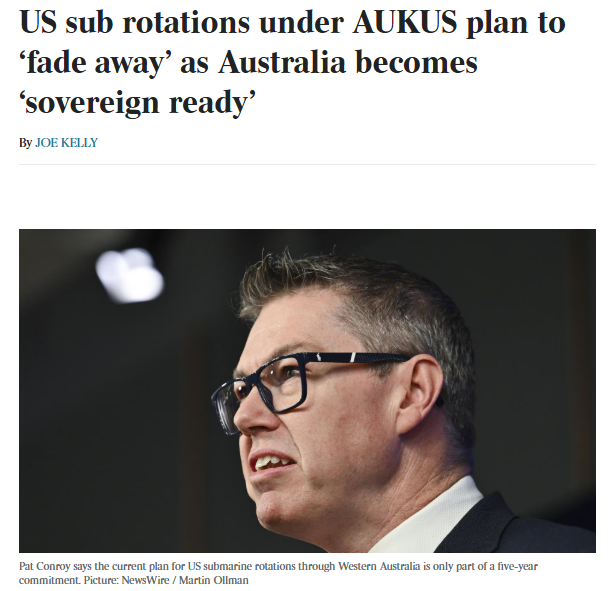
The Albanese government faces calls to urgently clarify the arrangements for US submarine rotations at HMAS Stirling after Defence Industry Minister Pat Conroy said the current plans would expire after five years.
The Coalition’s defence spokesman James Paterson said that Mr Conroy had effectively served an “eviction notice to the US Navy” amid a debate over whether Virginia-class submarines carrying nuclear weapons would be allowed to rotate through HMAS Stirling from the early 2030s.
Mr Conroy said the rotational arrangements were scheduled to start “fading away” once Australia received its own Virginia-class boats.
He told The Australian in Washington that plans for Submarine Rotational Force West were scheduled to last only five years from 2027 and that any extension beyond 2032 would be a decision for a future government.
Mr Conroy also stopped short of saying whether SRF West represented a permanent shift in American force posture within the Indo-Pacific, arguing this would hinge on the “mutual agreement of two governments”.
However, he insisted the US would retain a submarine presence at HMAS Stirling into the future – perhaps under a new model or set of arrangements to be negotiated at a future point.
The five-year timeline has surprised some of the closest observers of AUKUS. But, pointing to a bar graph in one of the initial documents released when AUKUS was announced, Mr Conroy said it showed Submarine Rotational Force West “starting as early as 2027 and then fading away as we get sovereign ready”.
“So, that’s been out in the open. So, I find it a bit surreal people thinking this is new when it’s not particularly. Because the concept of SRF West is about us getting sovereign ready,” he said.
“Ultimately, it’ll be a decision for governments in the future. There will almost definitely be a US and UK navy presence at HMS Stirling, even if it’s not SRF West in the future. So, people are getting bogged down with nomenclature.”
Mr Conroy argued that the “primary purpose” of the SRF West arrangement was to train Australian personnel and help them manage the transition to operating their own nuclear submarine fleet from the early 2030s.
During his time in Washington, Mr Conroy met with deputy national security adviser Andy Baker; the secretaries of the US Air Force, Army and Navy; Under Secretary of Defence for Acquisition and Sustainment Michael Duffey, and; several leading members of the US congress.
Speaking on the ABC’s 7.30 report on Wednesday, Mr Conroy said “the current plan for Submarine Rotation Force West is that it’s a five-year commitment beginning in 2027 and that when we’re sovereign ready and receive our own Virginias, Submarine Rotation Force West is due to end”.
“So, this is a five-year commitment and that’s what it’s been since we announced it in early 2023,” he said.
Senator Paterson told The Australian it was “frankly bizarre that Pat Conroy used an interview with ABC 7.30 to serve an eviction notice to the US Navy from HMAS Stirling before they have even arrived.”
“It’s even weirder he’s now walking these comments back. For the sake of the alliance and the deterrence posture we need for our own security, his boss Richard Marles should urgently clarify: are US submarines welcome in WA beyond 2032 or not?”
Mr Conroy expanded on his remarks to 7:30 in his interview with The Australian, arguing that a future Australian government could opt to extend or modify the arrangements under which US and UK submarines would rotate through HMAS Stirling from 2027.
However, he was limited on the question of whether the SRF West arrangements would open the door to US Virginia-class submarines carrying nuclear weapons being rotated through WA from the early 2030s.
Selected US Virginia-class submarines are expected to begin carrying nuclear-armed sea-launched cruise missiles from the early 2030s under current Pentagon plans – a point recently highlighted by former Department of Home Affairs secretary Mike Pezzullo.
Mr Conroy said the public position of the US was that “they neither confirm nor deny whether individual platforms are carrying nuclear weapons”.
But he said the US understood that Australia was a signatory to the Treaty of Rarotonga that establishes a nuclear weapon-free zone in the South Pacific and prevents nuclear weapons from being stationed in Australia.
“The United States understands that’s our commitment,” the minister said. “Their position about neither confirming nor denying publicly can operate with respect for the Treaty of Rarotonga.”
Mr Pezzullo, however, has warned that Australia may have to choose between radically modifying its nuclear-free zone posture to continue to host the American submarine rotation force.
He told The Australian he understood the “sensitivity that the minister and the government more generally might have about US Virginia-class submarines deploying to HMAS Stirling beyond 2032, particularly if those submarines are potentially equipped with nuclear missiles”.
But he also suggested the Pentagon could be caught off guard by Mr Conroy’s statements that US and UK submarine rotations through HMAS Stirling would end after only five years.
“From the United States’ perspective, they would be surprised at how definitive the minister was,” Mr Pezzullo said.
He suggested the US had already implemented contingency plans to ensure the arrangements with Australia could be translated into a lasting strategic advantage for Washington.
“I suspect that the Americans are already anticipating Australian squeamishness, which is why in early June they announced the establishment of Submarine Squadron 3, which is their nomenclature, their term, for this force – whereas we Australians tend to think of it as SRF West, emphasising that the Americans are somehow doing us a favour by sparing four scarce Virginia-class submarines just to train our sailors, which is delusional.
“As I have long argued, Australia needs to be much more mature about ANZUS. In order to maximise its deterrent effect it needs to be turned into a true warfighting alliance, as is NATO, with clear roles and responsibilities delineated as to how we would fight together in a major war.”
In June, Rear Admiral Chris Cavanaugh, commander of the US Pacific Fleet’s submarine force, re-established Submarine Squadron 3, which had previously operated out of Pearl Harbor and was decommissioned in February 2012.
It will now operate from HMAS Stirling in Western Australia, and its personnel will integrate with their Australian counterparts to lay the groundwork for maintenance, logistics and operational support for the rotational US and UK submarines.
“Adding an additional forward-positioned submarine squadron in the Indo-Pacific enhances our presence, agility and responsiveness across a range of operations,” Rear Admiral Cavanaugh said. “CSS 3 enables our submarines and crews to respond rapidly in support of the US joint force mission of regional deterrence.”
Mr Conroy told The Australian the US and the UK were fully aware that the arrangements for SRF West lasted only five years.
“They understand it,” he said. “It’s by mutual agreement.
“This is all governed by the force posture agreement we’ve got with the US government. And underneath that sits arrangements for the various force postures – the Marine force in Darwin and this.
“As we get sovereign ready, governments might decide, ‘yep, we’re loving this. Let’s keep continuing SRF West’. Or they might decide, ‘let’s shift to a slightly different model’.”
Mr Conroy did not outline what a new model might look like, but stressed that it would be “very likely” an ongoing US Navy presence would be retained.
“It may not be called SRF West,” he said.