

Media
|
Speeches
September 22, 2026
SUBMARINE INSTITUTE OF AUSTRALIA
Tuesday, 22 September 2026
Introduction
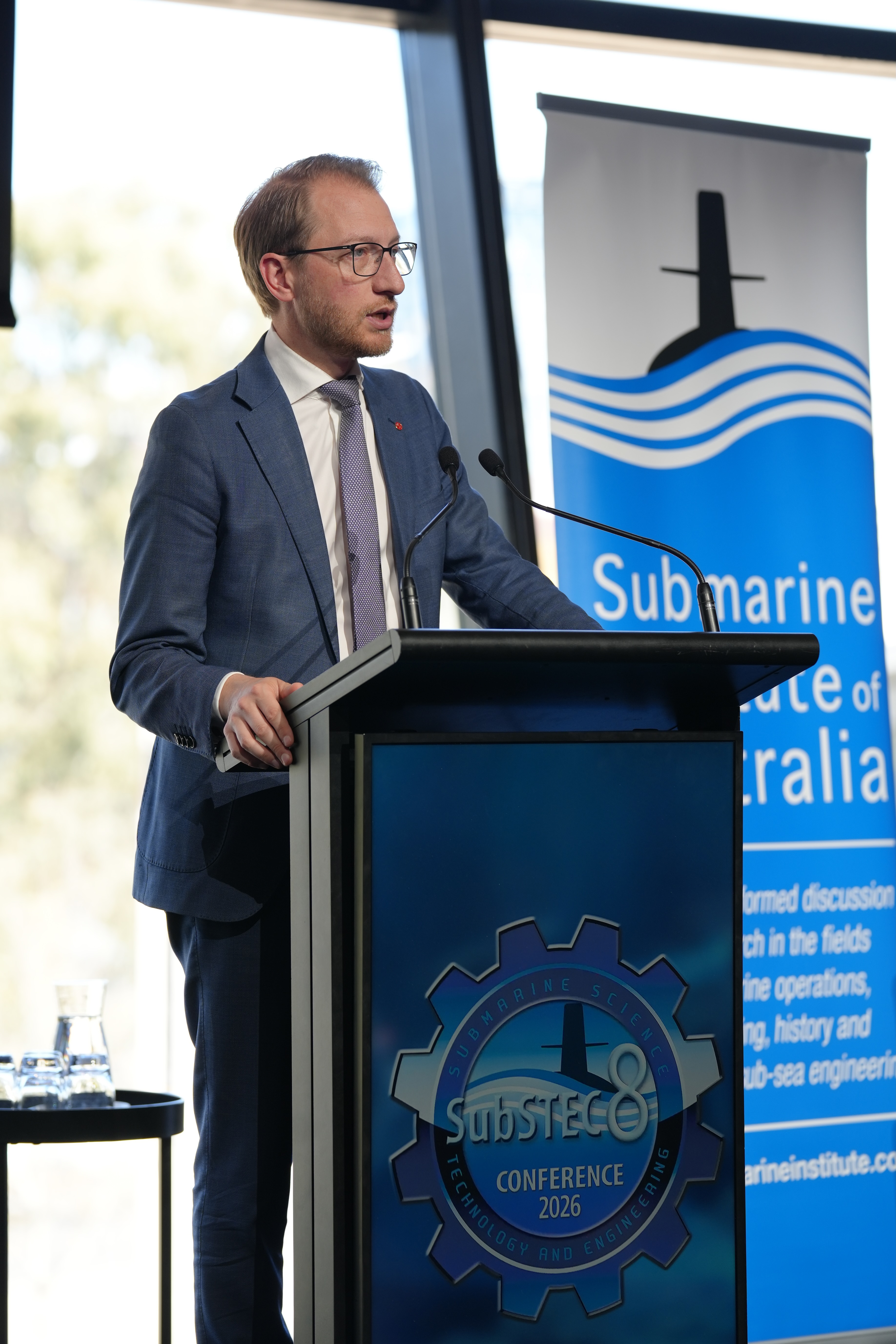
Thank you for the opportunity to address the 2026 Submarine Science, Technology and Engineering Conference.
I am pleased to be joined by leaders and experts across government, defence and industry.
I am delighted to be in South Australia today because it has long been at the frontier of Australia’s defence and manufacturing sectors.
And this state will continue its proud history leading Australia’s defence industry in hosting the single most important and complex project in our history, the construction of Australia’s SSN-AUKUS submarine at the Osborne naval shipyard, right here in Adelaide.
Five years of AUKUS
With little fanfare, last week marked five years since Australia, the United States and the United Kingdom announced AUKUS in September 2021.
This was a historic moment that established a new trilateral partnership to advance our collective security, particularly in the Indo-Pacific region.
If our global strategic circumstances were volatile then, in a period marked by post-pandemic upheaval, it is at a dangerously critical point now.
Recent conflict in the Middle East has laid bare how dangerously exposed we are to global shocks, particularly disruptions to our seaborne trade.
Russia’s brutal invasion of Ukraine continues to endanger Europe.
And the People’s Republic of China (PRC) is accelerating its military buildup in the Indo-Pacific, and its increasingly aggressive behaviour in our region continues.
The PRC’s test launch of a nuclear-capable missile in the Pacific earlier this year is just the latest example.
Our national security and economic challenges have never been more intertwined.
AUKUS Pillar II – the golden thread of AUKUS
Of course, AUKUS is not just a major industrial and engineering project.
AUKUS is fundamentally a technology sharing agreement.
If it achieves its full potential, it will effectively be a military-technology free trade agreement between our three nations.
To do that, we need to abolish barriers to capital, people and intellectual property between us.
That will allow us to bring together the greatest minds across our three nations to deliver innovative defence capabilities that give us an asymmetric advantage over our potential adversaries.
Sharing these technologies makes us all stronger, collectively and individually.
Pillar II has the potential to be a revolutionary step to enhanced collaboration in areas spanning advanced cyber, artificial intelligence, quantum technologies, undersea capabilities, electronic warfare, hypersonic and counter-hypersonic capabilities, innovation and information-sharing.
But Pillar II should really be regarded as a vital opportunity to realise the success of AUKUS, not as a secondary project of lesser importance, nor only as a hedge against Pillar I’s risks.
Pillar II also offers opportunities to keep our trilateral submarine capabilities ahead of the competition for decades to come.
Dr Sidharth Kaushal, a Senior Research Fellow for the Royal United Services Institute, described Pillar II as the “golden thread” running through AUKUS.
He told a UK parliamentary committee on AUKUS in September 2025:
“the key aspect of pillar 2 is that a lot of the capabilities it covers—for example, quantum technologies or hypersonics—are critical to ensuring the success of pillar 1. The ability of submarines to successfully counter-detect in the subsurface operating environment may well depend on things like quantum sensors and quantum navigation moving forward”.
And yet, in June 2026, the Australian Strategic Policy Institute estimated that China is leading high-impact research in 69 of 74 critical technologies that are critical for strategic power.
Stocktake
The fifth anniversary of AUKUS is an important opportunity for a stocktake.
What have we achieved so far?
And what are the obstacles we still need to overcome to ensure AUKUS achieves its full potential?
I am an AUKUS realist.
I strongly support the trilateral pact.
But I think we should be sober and honest about the challenges it faces.
We do ourselves no favours if we simply engage in uncritical AUKUS boosting or gloss over the obstacles.
So, I want to be candid with you today.
I am particularly worried about Pillar II, for two reasons.
Firstly, to sustain political support and social license for AUKUS in the long term, we need to be able to demonstrate progress under Pillar II while the necessarily slow and complex nuclear submarine enterprise evolves.
There are many bad-faith critics of AUKUS out there who seek to undermine support for this multi-generational project.
One of their attacks is that, so far, there’s not much to show for the significant outlay of taxpayers’ money towards AUKUS.
The truth is this is a disingenuous critique.
By their very nature, transformative defence procurement projects take time.
And many of these critics don’t actually want AUKUS to succeed.
Some of them would be even more concerned if it was delivering military capability faster.
But, five years in, there are not yet enough tangible capabilities we can publicly point to that have been delivered by Pillar II.
The sooner we can do so, the less influence these critics will have.
Secondly, Pillar II is a perfect forcing mechanism to test whether we are succeeding at removing the many regulatory obstacles to closer cooperation with the US and UK.
On that, the jury is still out.
Overcoming regulatory barriers
Unlocking these advanced military technologies quickly requires sweeping cuts to regulatory barriers and attracting private capital to invest in their development.
Anecdotally, I hear very mixed reports from defence industry about the success of reforms associated with AUKUS.
Some companies, particularly multinationals operating across the three jurisdictions, tell me the licence-free environment has allowed them to share data more quickly between arms of their business in each country.
Others, particularly smaller Australian companies, tell me there is still significant risk-aversion within our respective bureaucracies.
That decades of cultural aversion to sharing technology still puts sand in the gears even when legislation and regulations have changed.
We need to maintain momentum by ensuring all branches and levels of our bureaucracies get with the program and get out of the way.
We have secured defence trade exemptions for at least 80 per cent of defence exports from the US to Australia.
That is of course a welcome and important step for deeper collaboration between our countries in advanced capabilities.
And the inclusion of trusted partners in the development of emerging technologies – such as collaboration with Japan on maritime autonomy – underlines Pillar II’s future potential.
In May 2026, AUKUS partners announced our first major project under Pillar II:
developing common payloads and enabling systems for uncrewed undersea vehicles.
This capability is slated to be delivered from 2027, and the Coalition will keep a watchful eye on its progress.
That is welcome news but frankly – and I am not the first to observe this – it is far too little progress to show in five years.
We are yet to see Pillar II realise its full potential.
Fixing this must be an area of urgent attention for the Albanese Government.
Writing for the Diplomat on 15 September 2026, Kester Abbott and Tara Luckock of the United States Studies Centre estimate that “roughly 20 per cent of intra-AUKUS defense trade was not captured by licensing exemptions – and these sectors are directly relevant to Pillar 2 capability requirements”.
That red tape risks slowing progress on Pillar II capabilities like missile technology and undersea capabilities.
Clearly, greater effort must urgently be directed at removing as many regulatory barriers as possible to unlock the full potential of Pillar II technology, without delay.
I know our embassy in Washington has worked hard to that end.
But it also requires more proactive political leadership and attention by the Albanese government to remove any remaining regulatory hurdles that will frustrate progress on advanced capabilities.
And we must do so as fast as possible to ensure our war fighters are equipped with the best technology in the event of conflict in our region.
In times of peace, I can understand that regulatory controls on things like intellectual property may be necessary to protect industry and prevent leakage to our adversaries.
Those risks need to be balanced against the risk of delivering innovative capability too slowly, or not at all.
In the current strategic environment we need to behave as though we are in a pre-conflict world.
Now to be fair, due to their inherently sensitive nature, some areas of Pillar II work does not easily lend itself to a press release.
I am personally aware of progress in the classified domain that has not been publicly disclosed, and may not be able to be for some time.
But that makes other tangible progress we can point to even more important.
I urge the three governments to urgently prioritise disclosable projects that can demonstrate progress of AUKUS.
Unleashing private capital
A frequently aired complaint has been that Pillar II is “too broad and unfocused” and that AUKUS countries should narrow its focus to a much smaller set of capabilities, as suggested by Charles Edel and Abraham Denmark in a 2025 report on AUKUS for the Centre for Strategic and International Studies (CSIS).
I can understand these sentiments, and that is why it is so crucial for government to demonstrate leadership and focus to allay scepticism and ensure Pillar II’s success.
The nexus between economic opportunity and advancing our national interest are clear.
We cannot achieve the aims of AUKUS through government funding alone.
We have heard the Deputy Prime Minister, Richard Marles, complain how difficult it is for Defence to get funding from the Expenditure Review Committee.
Governments are the custodians of limited taxpayer funds and must use them carefully.
The government has outlined its intent to pursue alternative finance as part of a strategy to increase overall funding to Defence.
While the Coalition have been critical of how this has been used to inflate the government’s claims on defence spending, we support the concept.
In fact, we have traditionally pioneered it.
There is an opportunity to unleash the deep pools of capital in Australia to support our national resilience, including promoting defence technology.
Sophie Mayo in a 2024 paper for the United States Studies Centre, noted a more positive approach among private investors in defence in recent times:
“the deteriorating strategic outlook in the Indo Pacific and the war in Ukraine has shifted perceptions about defence as a ‘social good’ among the venture capital and broader investment community in AUKUS countries.”
That is a very welcome development, and I hope this trend continues.
But it is perfectly reasonable for investors to seek clear demand signals from their Defence customer.
A 2026 report on AUKUS by the UK’s Defence Committee noted:
“Evidence from industry revealed a high degree of frustration at the failure to clearly define the scope of Pillar 2…we heard that industry investment and efforts to attract private capital had been hampered, with techUK explaining that ‘the demand signal is too broad. You are looking at eight different areas. Where would you invest?”
We must heed these concerns and do everything we can to encourage private investment in defence, and that includes investment in emerging technologies that will give our potential adversaries reasons to think twice before doing our country harm.
One of the most common complaints I hear from defence industry is the difficulty accessing capital, particularly for emerging technologies.
Our venture capital market is shallow compared to the United States, some of our banks are too cautious, and I’ve been advised that ESG frameworks are a barrier to many of our superannuation funds from backing defence start-ups.
I’ve even personally been told by some lenders that they are very happy to back defence industry – just as long as it is “non-lethal”.
I hate to break it to them, but a defence force without lethal capabilities won’t perform very well in war.
I admire leaders like Steve Baxter, who has established Beaten Zone Venture Partners, for exactly this reason.
We just need a dozen more savvy and patriotic investors like him.
The Albanese government must step up and show leadership to remove any hesitancy that could thwart private investment into Pillar II initiatives.
Conclusion
Last week, Charles Edel and Jonathan Ahlstrom warned in an article on the fifth anniversary of AUKUS for the CSIS, that Pillar II “remains the pillar of promise rather than delivery”.
Five years after AUKUS was announced, its strategic necessity is clearer than ever.
But ambition must now be matched by delivery.
That means removing the regulatory barriers that slow collaboration, and mobilising private capital to develop and field advanced capabilities at speed and scale.
Pillar II cannot remain a pillar of promise, it must become a pillar of delivery.
One that takes the best technologies from all three nations and makes them available to all.
One that enhances Pillar I over the long term and equips our war fighters with the technological edge on which deterrence, or victory, depends.
If government, defence, and the private sector can collaborate and succeed in this task, then AUKUS will not only deliver cutting edge capabilities, but a safer and more secure Australia, region, and world.
ENDS