

Media
|
Transcripts
April 9, 2026
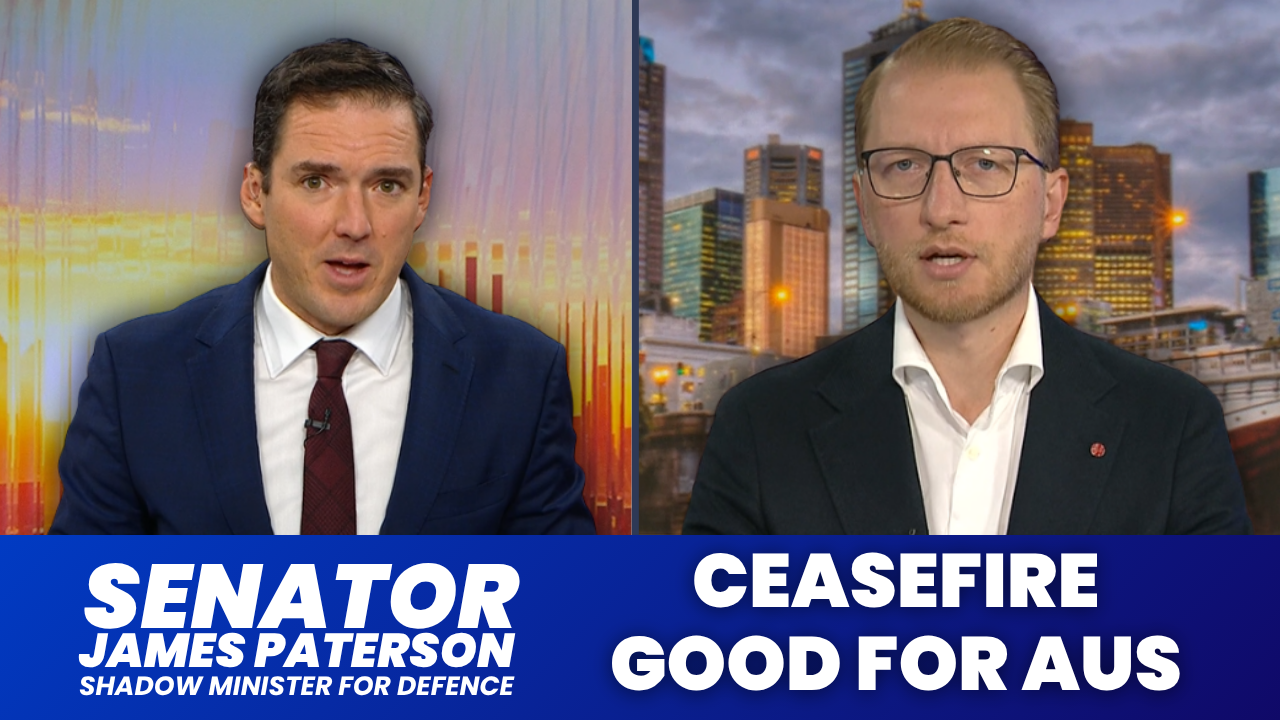
PETER STEFANOVIC: Joining us now for an immediate reaction to that, Shadow Defence Minister James Paterson. So let's start with Lebanon, as the Foreign Minister just pointed out a few times, she said that it should apply to both Israel and Hezbollah. Should Lebanon be part of the deal in your view, James?
SENATOR JAMES PATERSON: Well, Pete, what we have right now is a dispute between the parties to this ceasefire about what the terms of that ceasefire are. On the one hand, you have the United States, our principal security ally, and Israel, a friendly democracy, who say that Lebanon was not part of the ceasefire. And on the other hand, you have the Islamic Republic of Iran, a country which has sponsored terror attacks on Australian soil, whose principal organ, the IRGC, is listed as a terrorist organisation in Australia. A country with an illegal nuclear and ballistic weapons program that sponsors terrorism across the Middle East and which has struck non-combatant neighbourhood states around it in this conflict. If forced to choose between whether we believe the United States and Israel on one hand or the Islamic Republic of Iran on the other, I think that's an easy choice. I think we should, as Australia, prefer the side of our allies and friends.
PETER STEFANOVIC: Yeah, so the short way of saying that is that we're siding with Iran on this one.
SENATOR JAMES PATERSON: Well, I really hope that's not the case. I certainly don't think we should be endorsing the claims of the Islamic Republic. We should be sceptical about the public claims that they are making, whether it's about this ceasefire or any other matter. Now, of course, Australia's national interest is that the ceasefire holds, that the Strait of Hormuz reopens so that oil prices can come down, so that petrol and diesel prices can come down too. We want that to be sustainable and durable. And we certainly don't want to see the IRGC using the Strait of Hormuz as a toll booth to raise revenue in the future, which we know they would use to continue to sponsor their acts of terror, not just in the Middle East but around the world.
PETER STEFANOVIC: Well, I mean, I put that to the Foreign Minister a short time ago as well, and she kind of squibbed the question, but there is that issue of the Hormuz Strait. If ships get taxed, like you pointed out, we'd be funding the IRGC through our purchases, as you say, a listed terror group. So, how comfortable with that are you? And what do we do about that going forward? Because we buy so much oil indirectly through the Strait.
SENATOR JAMES PATERSON: I'm not at all comfortable with it and no peace-loving democracy around the world should be comfortable with that. The Strait of Hormuz is an international waterway. It is not the plaything of Iran and it should not be used by the regime to raise revenue to sponsor their terror against the world. And I think we must be resolute in insisting that that not be the case. That cannot be the terms of this settlement, that this becomes an opportunity for them to extort the rest of the world, including Australia, to fund their terror.
PETER STEFANOVIC: If they do though, what's our backup plan? Have we just got to find other markets?
SENATOR JAMES PATERSON: I think we have to work with our like-minded partners around the world to insist that the Strait of Hormuz be reopened on peaceful terms, that it resume being an international waterway, that the free passage of shipping, including oil, continue. But, yes, you're also right. This will no doubt drive further diversification away from sources of crude oil that are dependent on passage through the Straight of Hormuz. Now, it might be through the Red Sea. It might be around the Cape. There are other avenues. It might be from the United States. But it is going to be important for countries like Australia and for the countries that ultimately refine the majority of our petrol and diesel to identify more reliable alternative sources of crude oil.
PETER STEFANOVIC: And should that not energise the government to drill here, to increase refining capacity here? I mean, it's a pretty big lesson that we've learned in the last four or five weeks, isn't it, about fuel security?
SENATOR JAMES PATERSON: I agree with you, Pete. I think the world has changed. I think that the emphasis Australia previously had on placing emissions reductions, for example, as a higher goal than sovereign energy control has completely changed and should completely change. We should take advantage of every natural resource we have in Australia, including oil, and if we can economically drill for more oil in our country, we should prioritise doing so immediately.
PETER STEFANOVIC: If Iran, and this is more broadly, James, just your view on this, if Iran is allowed to effectively have control of the strait, if it isn't allowed to continue enriching uranium in some capacity, I mean, it's still standing at the end of the day, despite the onslaught from the power, the sheer power of the American military, does it win the war?
SENATOR JAMES PATERSON: Well, from Australia's point of view, that would clearly be a backward step. We don't want to see the status quo in the Gulf change such that Iran become effectively the de facto controller of the Strait of Hormuz. It was not before this war, and it shouldn't become so after this war. And certainly it would be a backward step if they were allowed to enrich uranium. It's very clear they're not doing so for peaceful or civilian purposes. And it's very clear that the United States' goals, both the original strike last year and the follow-up campaign with Israel this year, have been to further degrade that nuclear weapons program and their ballistic and drone production program. And it appears on the surface of that that those goals have been relatively successful. Iran has been comprehensively dominated in a traditional military sense, it has no control over its own airspace, it has no navy to speak of, its air and missile defence has been essentially dismantled. So significant military gains have been made there, but it would be unfortunate if we ended this conflict with the Strait of Hormuz being controlled or the enrichment of uranium continuing.
PETER STEFANOVIC: What about, you know, under the umbrella of defence now, I mean, the Foreign Minister saying that there's been no more requests of us as part of this 40-nation coalition to try and secure the strait. The U.S. has made no requests of us despite us getting a lashing from President Trump again this week. What more could we offer, and what do you make of all of that, of where we stand?
SENATOR JAMES PATERSON: It's difficult to reconcile the statements by President Trump and the statements of the Australian government about this, and only the Australian government can clear that up. The Foreign Minister and others have publicly said there have been no formal requests from the United States. All we can do from the opposition is to take them at their word that those requests haven't occurred informally or formally by any means through the United States. Whether or not Australia chooses to contribute, for example, to a multinational coalition after the end of the conflict to reopen the Strait of Hormuz depends on a couple of things. Firstly, it must be a sovereign choice for Australia. We decide what our national interest is. I think our national interests are clear that the reopening of the strait is something that we want to see. But it also depends on whether we have available, capable military assets to deploy to the region. Now, we know in 2023, when the Biden administration asked us to deploy naval assets to the Red Sea, that we declined to do so, and it was reported at the time the reason was because we didn't believe our surface combatant fleet was able to defend itself against Houthi terrorist attacks from missiles or drones. And I hope that in the intervening period, the Albanese government has taken steps to increase the defensibility of these naval assets in the region so that our choices are not constrained like that in the future, but only they can answer that question.
PETER STEFANOVIC: James Paterson, good to talk as always.
ENDS