

Media
|
Transcripts
March 16, 2026
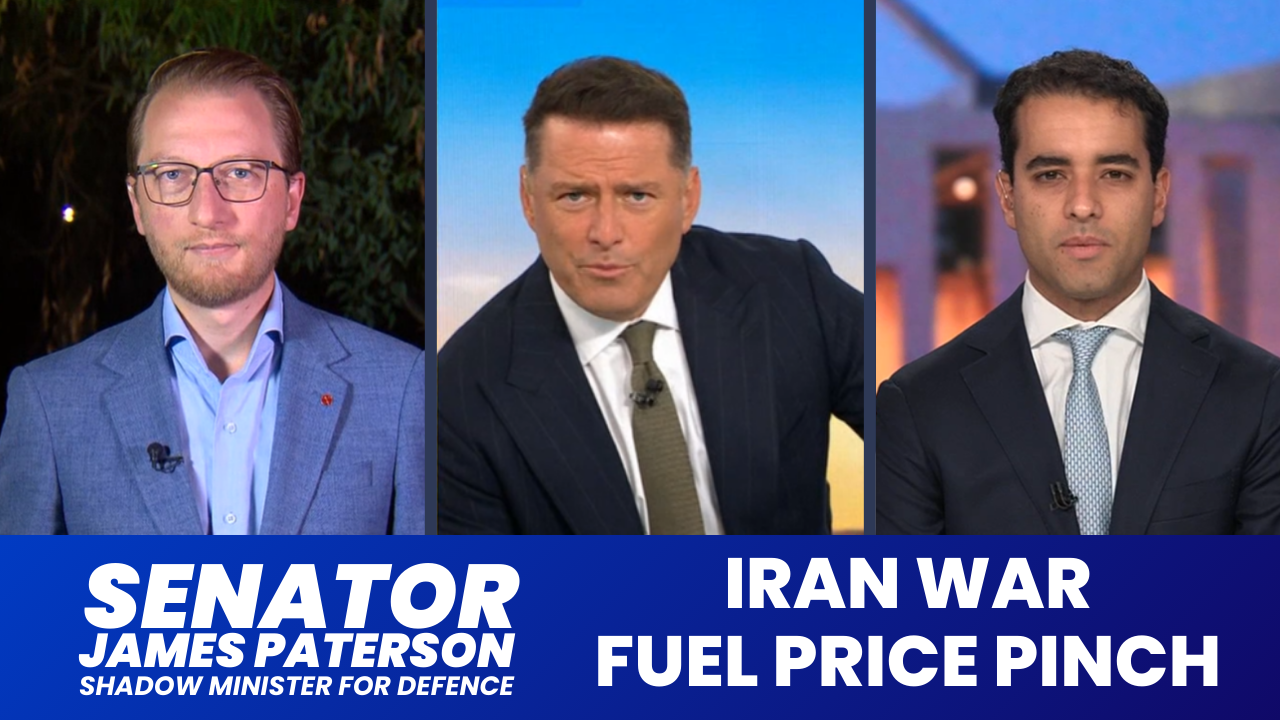
KARL STEFANOVIC: Australians this morning are understandably a little bit nervous, still weeks away from any reprieve at the bowser. Shadow Defence Minister James Paterson and Chief Political Correspondent for Nine Papers, Paul Sakkal, join me now to discuss. Guys, it's going to be a tough week, huh? James, I can't tell you the number of people who have texted me, sent me messages over the weekend, all across the country. They are anxious, and they are angry.
SENATOR JAMES PATERSON: Me too, Karl. And frankly, they're frustrated with their government, who on Monday last week was basically gaslighting them, saying there was no problems here, there was nothing to see here, we had plenty of fuel and plenty of diesel. You know, Chris Bowen started the week by saying this is right-wing scaremongering and misinformation. And he ended the week by saying it was a national crisis. But it turns out his release of extra fuel hasn't had the paperwork done yet. I mean, is this guy the most hapless federal minister we have ever seen?
KARL STEFANOVIC: We just need to get on with it, though, too, don't we? I'm so concerned about the days and weeks ahead. Do we need to bite the bullet and start rationing now, as unpopular and difficult as that would be?
SENATOR JAMES PATERSON: Look, I don't think we're at that point yet, but the reality is that the Strait of Hormuz is not going to be reopened anytime soon and the crude oil that comes from the Middle East to Asian refineries in places like Singapore and Korea and Japan is ultimately the source of a big proportion of the petrol and diesel that we use in this country. So, unless that strait can be reopened, unless that oil can flow, we will start to draw down on those stock holding obligations, those minimum obligations that we have at the moment.
KARL STEFANOVIC: Okay, I'm going to circle back to the Strait of Hormuz in a second, but Paul, just on James's point there, about the fact that it hasn't been ticked off yet, needs to be processed, and that distributed obviously in time, that's going to take time, the clock is ticking.
PAUL SAKKAL: The clock is ticking. It is important to say that while Chris Bowen went, got the tone wrong early last week in kind of denying that there was any problem here, which he backtracked on later in the week, it is important to say that fuel still is coming in in significant amounts. The problem at this stage is a demand problem. Panic buying has gone wild, partly because the government hasn't projected a message of calm. That could change in time, but it is important just to say fuel is coming in. But there's no doubt that our national resilience has been exposed throughout this. If the situation does get worse, we are not at our minimum standards. Barnaby Joyce, you saw calling for rationing yesterday. In the UK people are being told to only drive if they need to. There are schools and hospitals being shut down in other parts of the world. We're not alone, and I imagine this will provoke a significant focus on national resilience after this crisis in Australia.
KARL STEFANOVIC: Paul, I know what you're saying about the supply. You know, it may be well and good that it's coming in, but if you're sitting out there in any regional part of the country and your local station has dried up, and you're a farmer, or you're in the mining sector.
PAUL SAKKAL: It's no good for you.
KARL STEFANOVIC: It's terrible, mate. This is a terrible state of affairs. Look, it needs to be all hands on deck. James, manufacturers are telling clients prices have to rise, food will be next. You know, I think every emergency lever might have to be enacted at some point. Look in terms of what you were saying before about the Strait of Hormuz. Would you support a Navy vessel going, or do we just not have the capability?
SENATOR JAMES PATERSON: Look, as I understand it, there's been no request from the United States, and we're not anticipating one. If one came, we'd have to very carefully consider it against our national interest and particularly whether we have the relevant naval vessels available that could safely do that mission. I mean, you would need to have a naval vessel that's capable of protecting itself against drone and missile attacks. And in 2023, when a similar request from the United States came to help in the Red Sea against the Houthis terrorist organisation, we weren't able to provide any naval vessels because we didn't have ones that could protect themselves that were available for that mission.
KARL STEFANOVIC: Do we have them now?
SENATOR JAMES PATERSON: That's a question only the government can answer, only they can say what steps they took since the 2023 crisis to make our naval vessels better prepared to deploy to these circumstances, and only they've got the visibility of their availability. How many of them are in the water? How many of them could be deployed if we chose to do so?
KARL STEFANOVIC: I mean, I don't see how vessels are going to get through there at this point. Maybe there's a miracle solution, maybe everyone comes to Donald Trump's aid on this one, but Paul, it could be a disastrous week for the government. Interest rates can go only one way tomorrow, you'd have thought?
PAUL SAKKAL: Yeah, even just a couple of months ago, before this war started, Jim Chalmers was talking about a big reform budget, then inflation hit the government in the face, and now there's an extraordinary circumstance that will just fuel inflation even further. So the mood of the electorate is not what it was two or three months ago. That makes the government's life much harder. But over in the Middle East, they're in this kind of game of chicken at the moment, where oil prices are going like that [up], Iran's military capacity is going like that [down]. We will reach some point where President Donald Trump determines that he's had a win and can move on. The sooner that happens, the better for Australia.
KARL STEFANOVIC: Look, James, Labor has also got their hands full with One Nation at the moment. Now Pauline Hanson is beginning to take their votes as well. Your vote is still up the creek. You still want to bounce before you flat line, but you still haven't really got an effective cost of living plan for the public that they can digest.
SENATOR JAMES PATERSON: Look, it's going to take time for us to earn back that support that we've lost over recent years, particularly our traditional supporters who've left us. But one of the questions Australians have to ask themselves as they contemplate their vote at the next election, roughly two years away, is do they really think that One Nation can manage our $3 trillion economy? Do they think that Pauline Hanson and Barnaby Joyce can run a government in difficult times and make tough decisions in the national interest to protect our country? I mean, this is a party that, over its history, has lost about 70% of the MPs that it's ever had elected. They quit and went to other parties before they finished their first term. I mean, Pauline's last high profile recruit was Mark Latham. Look how well that worked out.
KARL STEFANOVIC: Look, Paul, who needs policies to win when the electorate is so ticked off?
PAUL SAKKAL: You're 100% right. And for the first time ever, or first time in a very long time, James and his colleagues are fighting a coherent, well-known political force that's arguing largely on the same topics they are. I mean, they're talking about ISIS brides at the moment, they are talking about the fuel crisis, and they're doing it often in more simplistic terms because they don't have to govern and find solutions. So the Liberal Party has stabilised under Angus Taylor. James will deny this, but he was the mastermind behind that switch, so a coherent economic focus leader has kind of got them back in the game, kind of, but they now need to do something to differentiate, show their voters why they are, you know, unique to One Nation, why they actually do have economic solutions and that might create some differentiation, which is crucial at this point.
KARL STEFANOVIC: I'm sure you will agree, Paul, that they are better off when James is out the front articulating arguments.
PAUL SAKKAL: No, no one would doubt that.
KARL STEFANOVIC: Alright mate, we will let him smile that one away. Thank you guys, appreciate it.
ENDS