

Media
|
Transcripts
April 28, 2026
Tuesday 28 Month 2026
Topics: Farrer by-election, National Press Club Address, Trump Administration, AUKUS
E&OE…………………………………………………………………………………………
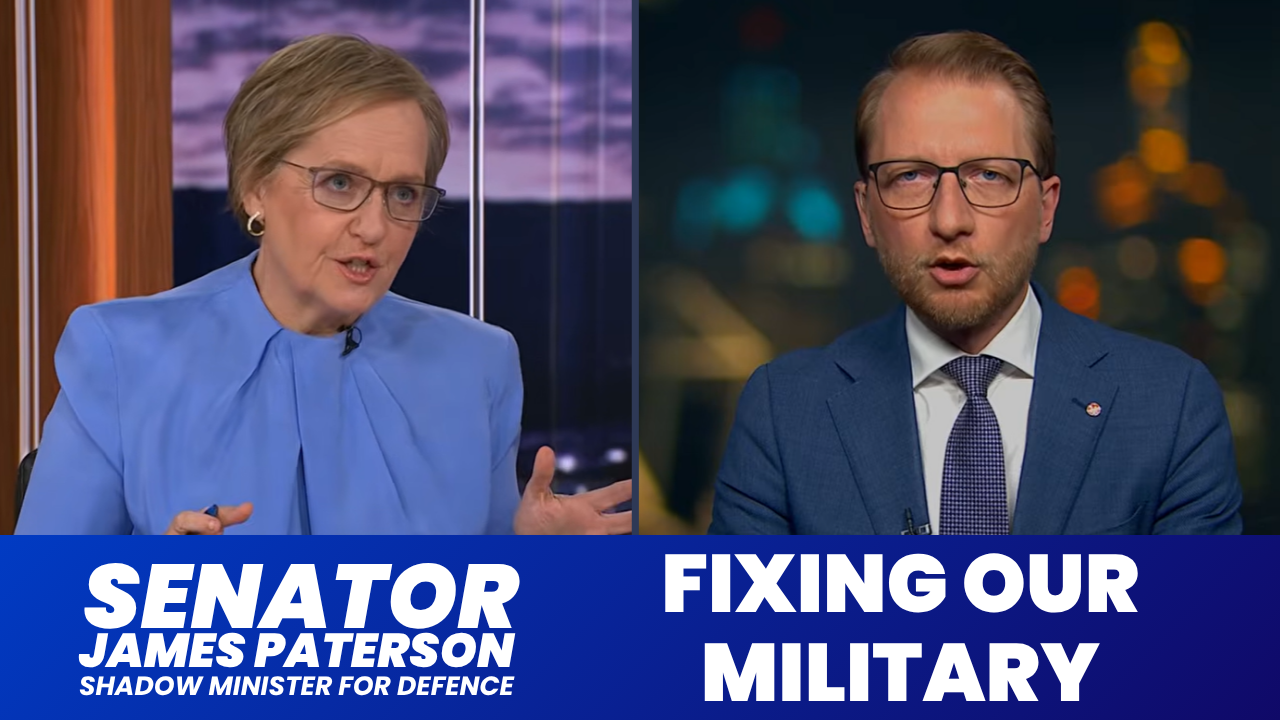
SARAH FERGUSON: Shadow Defence Minister James Paterson said today the government should be much more blunt about the military threats facing Australia, and that if we really knew how serious those threats were, we would be demonstrating in the streets for more spending on our defence. AUKUS submarines are part of that debate, following reports from the UK of delays, potential delays in production. James Paterson joins me now. James Paterson, welcome.
SENATOR JAMES PATERSON: Thank you for having me.
SARAH FERGUSON: First of all, is One Nation going to run over the Liberal candidate in Farrer?
SENATOR JAMES PATERSON: The Farrer by-election is going to be very challenging for the Liberal and National parties. We know we are not at an electoral high point nationally and we know that One Nation's appeal at the moment appears to be especially concentrated in regional and rural electorates. But we have an outstanding Liberal candidate, an outstanding National candidate. And if people do want to see change in this country, the best way to do that is to vote for a Liberal or National who can actually change the government, not a party of protest that can't deliver anything for an electorate like Farrer or indeed the country.
SARAH FERGUSON: Let's talk, James Paterson, about your speech that you gave today. It's essentially, as I said before, about truth-telling in defence. As I referenced there, you say if the Australian public knew how likely conflict is in our region and how ill-prepared we were for it, they would be marching, demanding higher defence spending. So, first of all, how likely is it, this conflict?
SENATOR JAMES PATERSON: I also said it was important not to be inflammatory or irresponsible, and so I don't want to do anything which alarms Australians, and I particularly don't want to do anything that singles out any diaspora communities or makes them feel uncomfortable. So I want to be measured but also direct. There's not a percentage that I can put on the likelihood of conflict except that it is higher than probably most Australians think. We have the context here. The People's Republic of China is engaged in the largest peacetime build-up of military capability since World War II, and accompanied with that build-up of capability is menacing military drills around Taiwan and rhetoric from Xi Jinping and other Communist Party leaders, which say reunification with Taiwan is a core objective of the Communist Party, and they are willing to use force if necessary. Now, I don't believe that Xi Jinping has made a decision to use force, but it is our national interest to discourage and deter him from doing that, along with like-minded partners.
SARAH FERGUSON: If candour is what you're looking for, then shouldn't you tell us, given those circumstances, the context that you describe, exactly what the Coalition would spend to defend Australia, particularly, and on what capabilities?
SENATOR JAMES PATERSON: I should provide as much information as I can responsibly from Opposition, but I also shouldn't be cavalier about making commitments without expert advice. So what I've said is that the best-informed Australians, like Sir Angus Houston and Professor Peter Dean, two of the reviewers for the Albanese government's Defence Strategic Review, have both since said we need to be spending 3% of GDP on defence, and the Coalition is committed to achieving that. The Albanese government has now shifted the goalposts. They're now using a different measure, which includes things like military pensions, which we never used before, but that accounting trick isn't a real increase in investment in defence capability, which is what we need. So we say we need 3% of GDP in real terms, not in pretend accounting.
SARAH FERGUSON: There's been a shift in the terms used by the US military about China. Well, maybe it's a shift, rather, in the analysis over recent years. This is how the commander of US Indo-Pacific Command put it recently to the US Senate. 'China has ambitions toward a global military that will project power beyond its near geography to set the rules for every relationship across the globe.' Is that what you see?
SENATOR JAMES PATERSON: I think it's very hard to disagree with that analysis. Obviously, the Chinese government's primary national security interest is its own homeland and its near abroad, including Taiwan, but it also clearly is building a military which is capable of projecting power far beyond that. By tonnage and the number of ships, it now has the largest navy in the world. And I think history tells us that it's very rare for great powers to acquire such significant military capability and then never use it. Now I hope that they don't use it. And we can help make sure that happens by working with other like-minded partners, Japan, the United States, the Philippines and others, who have a shared interest in the stability and peace of the Indo-Pacific. But we need to be doing more than we are now if that is what we want.
SARAH FERGUSON: How much is current US behaviour impacting public support for the alliance right now?
SENATOR JAMES PATERSON: I think it's inarguable that an unconventional US administration, in the second Trump administration, has reduced Australian public support for the alliance, as expressed in opinion polls, and that's consistent across the Western world. It's particularly evident in Europe. I don't think that actually changes the fundamentals of the US-Australia alliance. It's still incredibly robust at other levels. But I think we should be adult, and be honest, and acknowledge that that has had an impact on how Australians view the United States. And I hear them and understand why they have that concern. It doesn't mean though that Australia's national interest has changed, even if Australians disapprove of this administration.
SARAH FERGUSON: I understand that, but is it realistic at the same time to tell Australians that the alliance is essentially unchanged when what you're saying is there is less trust in its commander-in-chief?
SENATOR JAMES PATERSON: Well, I think the alliance is about more than just the personalities of any one commander-in-chief. It is more fundamental than that.
SARAH FERGUSON: Of course it is, but it's also about that.
SENATOR JAMES PATERSON: Yes, and I acknowledge that, and I'm not trying to argue with you on that, Sarah. Of course, that's a relevant consideration. But the US system is a deep system. It includes its defence establishment, its intelligence establishment, its Congress - it is a co-equal branch of government. And in each of those branches of the government, support for the Australia alliance is fundamental, because, frankly it's in America's national interest. What Australia offers the United States, it cannot get from elsewhere. Things like HMAS Stirling, which is the submarine rotational base that will be established in the next couple of years for US nuclear submarines to visit. Things like Pine Gap and other intelligence facilities, which are a critical part of the Five Eyes Alliance. Those are things which the United States gets from Australia, which it can't get elsewhere. And in turn, there are things that we get and continue to seek from the United States, which we can't from elsewhere, including the AUKUS partnership.
SARAH FERGUSON: Let's talk about HMAS Sterling, the military base in WA. The same Admiral Paparo said about it recently, in fact, in the same testimony. He said, it's on track for the US forces that will arrive there in WA next year. He said we could be ready to operate a rotational submarine squadron out of Australia tomorrow. Do you endorse that assessment?
SENATOR JAMES PATERSON: Well, it's certainly a very welcome assessment, and I can't do anything except take him on his word, except note that that is not the consensus of opinion amongst defence and strategic experts in Australia. There are many who are concerned that we are not on track to meet the milestones because it is a very ambitious infrastructure build in order to have its full capabilities available. So it's possible that a US submarine could visit now, but to get all of this sustainment and maintenance that we hope ultimately to provide to the US Navy, I think will take some more time.
SARAH FERGUSON: Why would Admiral Paparo say that it's in a good enough state to send a squadron there, but he anticipates it will be ready next year? It's incredibly important to him. Why would he say that if it's as behind as you suggest it is? And Angus Taylor also, who today said the base is all talk and not enough investment.
SENATOR JAMES PATERSON: Well, INDOPACOM is very bullish on AUKUS and very bullish on the alliance with Australia. They are some of our best friends and strongest advocates in the US system. And I'm glad they are positive and leaning in and want to do more with the United States. And I would never discourage them for doing so. I think it's in our national interest. But I think as Australians, we can also admit that we've got hurdles to meet. We've got work to do. And I don't get the sense of urgency, nor do I see the sufficient investment at a sufficient pace in order to meet all those hurdles.
SARAH FERGUSON: I want to talk about the reporting that's come out of the UK parliamentary inquiry into their involvement in AUKUS. The language they used is 'deeply concerning about delays in the investment pipeline.' Now, you're talking about planning for contingencies now. Is that because you think that we are not going to meet those milestones and we need to make decisions now for acquisitions that will fill gaps created by AUKUS next decade.
SENATOR JAMES PATERSON: What we've heard from the UK parliament is sobering, but it's consistent from what we've heard from congressional analysts in the United States as well, which is that AUKUS is achievable, but not on status quo policies, not without increased investment and focus and momentum. And so I want to both double down on AUKUS to make sure it is delivered, hopefully on time and on schedule. But also prepare for contingencies for any possible capability gaps that might emerge. Right now, as a country, we are trying to engage in a life-of-type extension for our Collins-class submarines, which, in simple terms, involves cutting it open, upgrading the components and putting it back together again, and that's a high-risk activity which could involve slippage. And I don't want any capability gaps to open up, particularly in the late 2020s or early 2030s, at exactly the moment of the greatest peril according to most defence analysts. So, I do think we have to start thinking about possible contingencies of complementary capabilities that can help fill any of those gaps should they emerge.
SARAH FERGUSON: And what would that capability look like? You're talking about stealth bombers.
SENATOR JAMES PATERSON: One idea I put on the table today, which I've encouraged the government to have a second look at, is the B-21 stealth bomber. It is a long-range stealth strike capability, which is one of the functions that a nuclear-propelled submarine would perform, and it has the advantage of hopefully deterring any economic coercion or military coercion on Australia's supply chains, particularly at the strategic choke points, the maritime choke points to our north and northwest. That's the kind of capability that could be an addition to a nuclear submarine capability, but also supplement it before it arrives.
SARAH FERGUSON: James Paterson, thank you very much indeed for joining us.
ENDS