

Media
|
News
April 28, 2026
The Labor government has lulled Australians into a “false sense of security” with technocratic jargon and weasel words, James Paterson has claimed.
The Liberal Senator outlined his vision to serve as an effective shadow minister for defence at the National Press Club on Tuesday, in response to Richard Marles’ speech earlier in April.
Mr Paterson commended the Deputy Prime Minister for calling out Chinese activities earlier in April.
He feared, however, Mr Marles and Defence Industry Minister Pat Conroy were drowned out by more vague colleagues.
"Too often (Mr Marles and Mr Conroy) are lone voices in the Albanese government willing to do this, and they are often contradicted by others, including the Prime Minister, who seem intent on reassuring us everything is fine," Mr Paterson said.
"Rote-learned platitudes about 'stabilisation' and 'disagreeing where we must' do the public a disservice. This is a historical moment that demands more than lamely repeating anodyne talking points.
"I understand and accept we have bilateral relationships which must be sensitively managed. But the government should be more candid more often about just how dire our strategic circumstances are."
Mr Paterson also urged the government to stop addressing Australians in “language that obscures the reality of warfare”.
“If penetrable and inaccessible language is a problem in the profession of arms, it’s an even bigger problem in the profession of politics. We are all guilty of it,” he said.
“This is not just a stylistic or philosophical critique. It has real-world consequences.
“If the Australian public knew how likely conflict is in our own region in the near future, and how ill-prepared we were for it, they would be marching in the streets demanding higher defence spending.”
The Coalition’s defence spokesman fronted the Press Club in response to Mr Marles' announcement the government would ramp up defence spending mid-way through the month.
Mr Marles committed $14 billion in extra spending to his portfolio by 2030, and emphasised a need for greater self-reliance.
The government was accused of sleight-of-hand bookkeeping, however, in claiming it reached a defence spend equal to 3 per cent of GDP.
Mr Paterson said the government was not nearly moving quick enough to address strategic inadequacies.
“It is almost impossible to find a defence or national security expert who thinks we are spending enough or moving fast enough,” Mr Paterson said.
“Accounting tricks aside, we will never sustainably reach a real defence to GDP spending ratio of three per cent if we are not honest with the Australian people about just how serious this historical moment is.
“Primarily, it is the responsibility of government to make sure Australians are well-informed about these threats.”
Mr Paterson said his “guiding light” was the national interest but stopped short of offering a bipartisanship carte blanche to the Labor government.
“I will never needlessly politicise issues for the sake of it. I will never engage in irresponsible alarmism, denigrate the efforts of our men and women in uniform, or do anything to ostracise or denigrate any of our diaspora communities,” he said.
“But I also will not participate in the false reassurance of the public about the threats we face or our state of readiness just to avoid ruffling feathers.
“If I do my job well as shadow minister, it should make the job of the actual minister easier.
“I intend to help make the case for real increases in defence spending from opposition so the next time it is considered in (Expenditure Review Committee), it gets a better hearing, because this is not the sort of portfolio where you might selfishly want the government to fail. I want them to succeed.”
In his speech, the shadow defence minister also claimed China was Australia’s predominant long-term security challenge.
He accused the economic superpower of “selective compliance” with rules-based order and treating rule-following as discretionary.
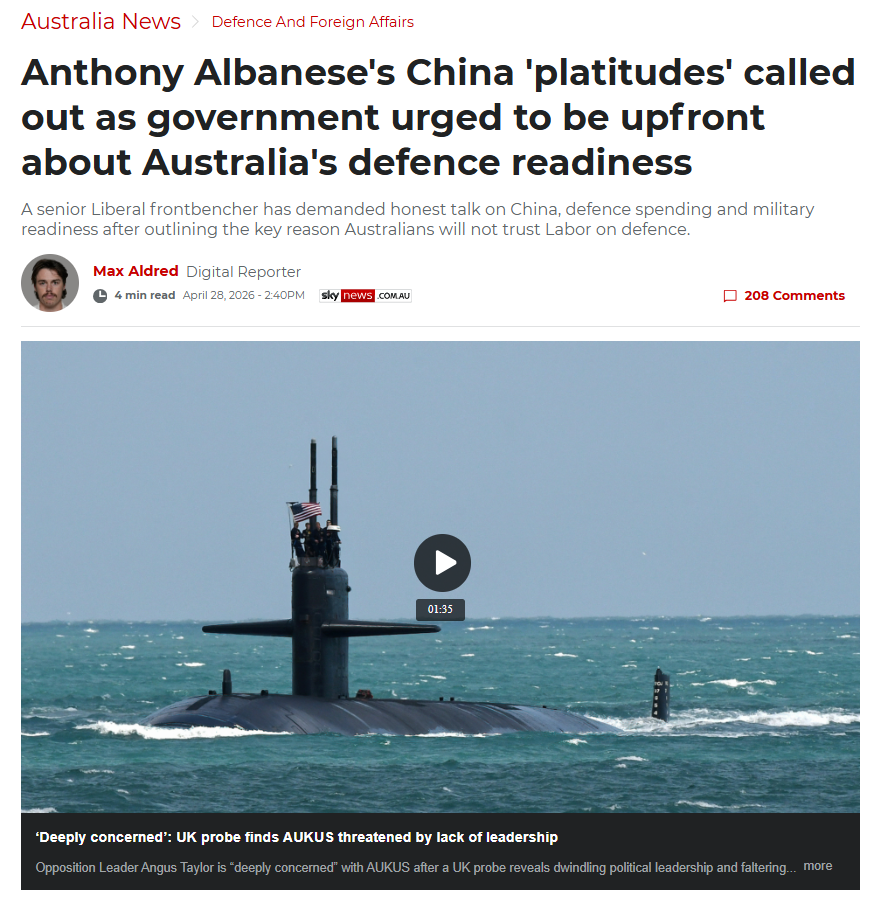
Mr Paterson maintained support for the Australia-US alliance, arguing the States anchored Australia’s “most meaningful” multilateral groupings – including Five Eyes, AUKUS and the Quad.
He added he was a “true believer” in the AUKUS submarine deal, due for fulfilment in several terms’ time.
However, Australia can no longer rely on Washington for security, he argued.
Instead, he congratulated Mr Marles’ 2026 National Defence Strategy for returning an emphasis to “self-reliance”.
“Even I recognise we can no longer just cling to the US alliance as our only or even primary security strategy,” he said.
He added extra strike capability should underpin Australia’s defence strategy as the nation awaited submarine capabilities.
He would not promise a Coalition government would make such purchases but urged the government to explore a range of options, including B-21 stealth bombers.
The Deputy Prime Minister also indicated his wish to fast-track the production of air and missile “capabilities”, under the NDS.
“We will accelerate the introduction of air and missile defence capabilities, including new investment in a medium-range, ground-based air defence system, recognising the increasingly contested air and missile environment,” Mr Marles said.
He also suggested a wish to tighten Australia’s sea defences after indicating earlier in April he was “reshaping the army”.
“As an island trading nation our sea lines of communication literally define our national security... the geography of our national security lies well beyond our coastline or even our immediate waters. We therefore need a defence force that can be out there: that can engage in impactful projection,” he said.
“And there is now a more stark economic asymmetry to modern warfare. Cheap one-way drones can overwhelm multi-billion dollar air defence systems.”