

Media
|
News
April 28, 2026
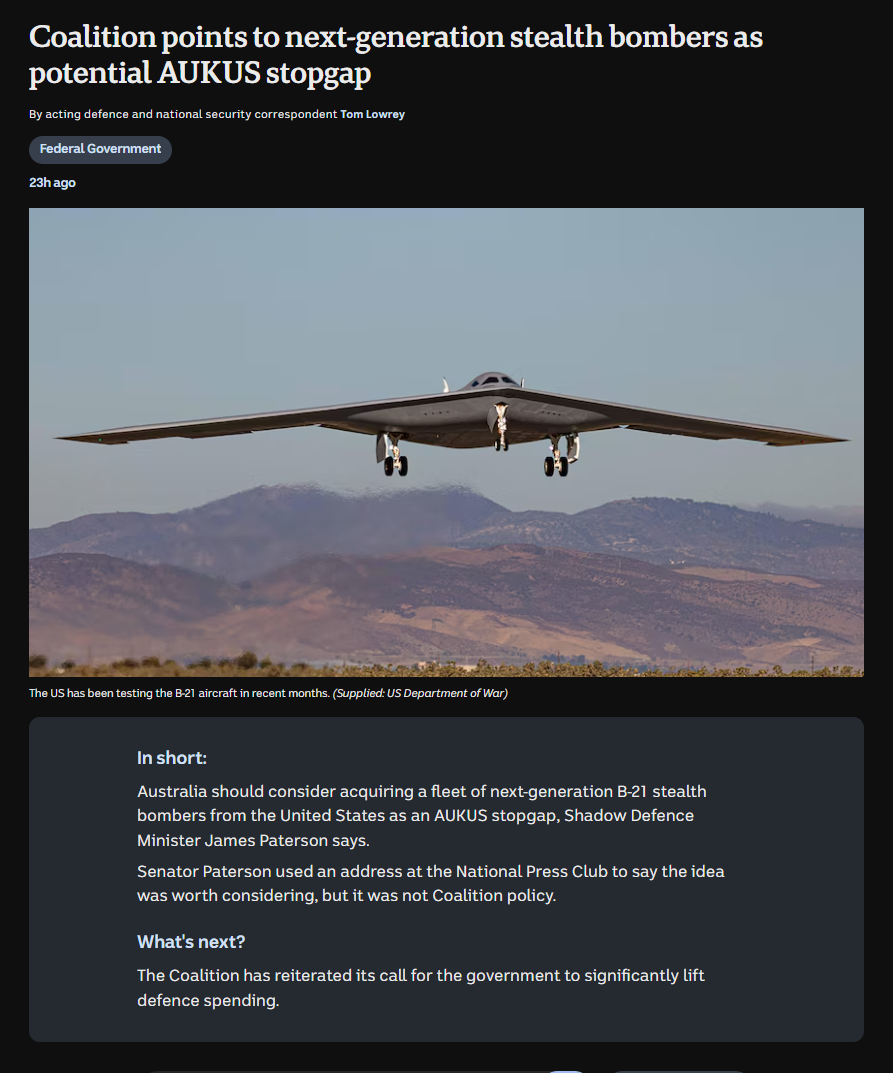
Shadow Defence Minister James Paterson has suggested Australia should consider acquiring next-generation B-21 stealth bombers from the United States to help bridge the gap until the AUKUS submarines arrive.
Senator Paterson said the bombers, which were in testing with the United States Air Force, would deliver a similar long-range strike capability while Australia waited for Virginia-class nuclear submarines to enter service.
Australia has not operated a bomber since the F-111 was retired in 2010, and the 2023 Defence Strategic Review recommended against Australia considering the B-21 Raider.
The B-21 is estimated to cost about $1 billion.
The US is in the process of acquiring 100 of the new planes to replace its existing B-2 bombers.
In a speech to the National Press Club, Senator Paterson said he was not committing the Coalition to acquiring the planes or demanding the government do so, but said it was worth considering.
"Only the government can know whether the [Royal Australian Air Force] is well-placed to acquire these planes and put them into service," he said.
"Perhaps there are good reasons why a B-21 does not work for Australia.
"If that is the case, I hope the government is very closely examining other similar options which could fill this serious potential capability gap.
"Because I do not want Australia to enter the moment of maximum peril in the late 2020s and early 2030s without this critical deterrent capability."
Some in US policy circles have previously suggested offering Australia the B-21 bomber to lift Australia's military capability while it awaits nuclear submarines.
Senator Paterson used the speech to mount a defence of the AUKUS nuclear submarine agreement, arguing that while it would be challenging, there were no realistic submarine alternatives for Australia to pursue.
But he said Iran's actions in closing the Strait of Hormuz to shipping had highlighted the vulnerabilities Australia faced in key shipping routes within the Indo-Pacific, and the need for deterrence.
"Our primary security threat is not an invasion of our homeland. It is coercion leveraging our supply chain vulnerabilities," he said.
"If we think closure of the Hormuz has been uncomfortable, just imagine a scenario where the Straits of Malacca are.
"Australia must have the ability to deter coercion like this."
Senator Paterson also used the address to reiterate the Coalition's call for a significant lift in defence spending.
The Coalition took a commitment to the last election to lift defence spending to at least 3 per cent of gross domestic product (GDP) (in budget terms, rather than the NATO measure recently adopted by the government).
Senator Paterson said AUKUS alone would require a significantly higher lift in spending than what the government was intending.
"If we try to deliver AUKUS without quickly and meaningfully increasing defence spending, we will cannibalise the other services, as [former chief of defence] Sir Angus Houston has warned," he said.
"Yet, as a percentage of GDP, the Albanese government has over the last four years failed to shift the dial on defence spending to make room for AUKUS.
"The only way to deliver AUKUS without lifting defence spending is to make cuts to the other services."
Senator Paterson also echoed some sentiments from Defence Minister Richard Marles, who addressed the press club a fortnight ago when handing down the new National Defence Strategy.
Mr Marles used that speech to make the case for the importance of the US alliance and global rules-based order, gently pushing back on ideas recently put forward by Canadian Prime Minister Mark Carney.
Senator Paterson said while there was little doubt the "unconventional" Trump administration had altered the Australia-US relationship, there was no alternative series of alliances that could take its place.
"It is impossible to imagine a coalition big or powerful enough to support our core national interests — like the peace and stability of the Indo-Pacific — without the US as part of it," he said.
"So, while I respect and understand why many Australians are confounded by the rhetoric and sometimes policies of the Trump administration, the idea that we can make our way safely in the world without them is absurd."