

Media
|
Transcripts
April 16, 2026
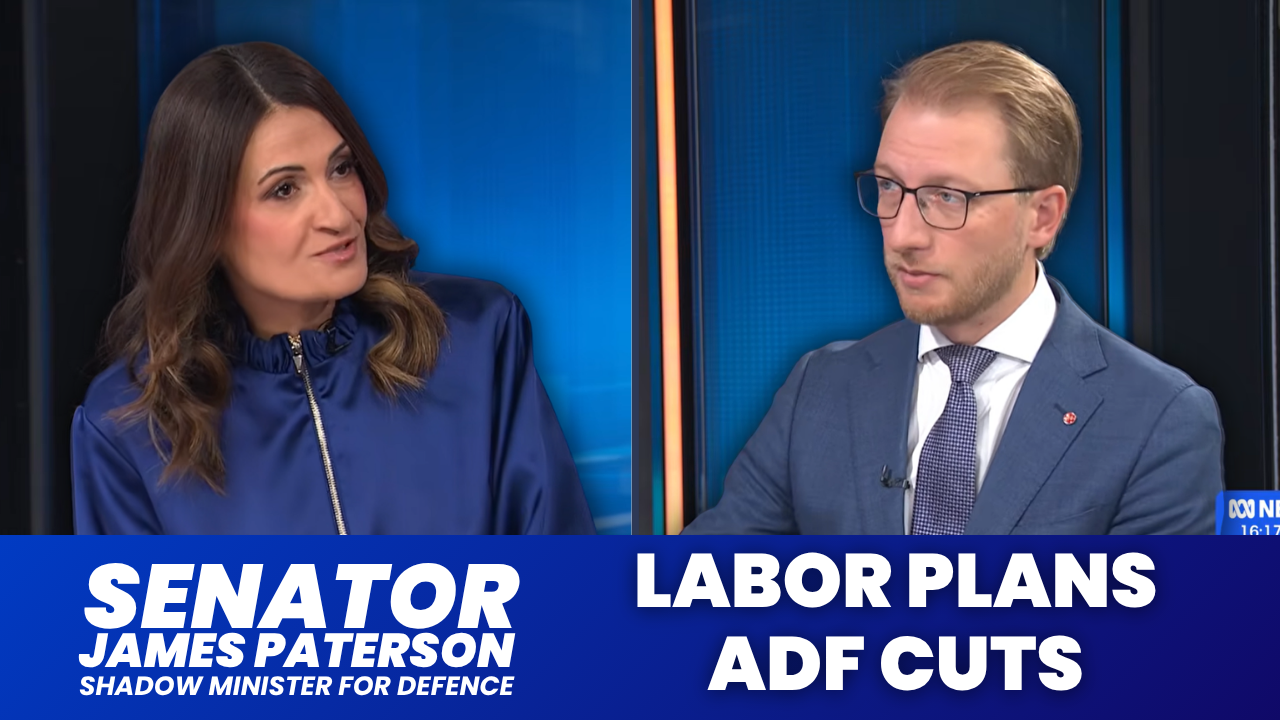
PATRICIA KARVELAS: For a response to the Government's National Defence Strategy and for the Opposition's view on the Viva oil refinery fire, I want to bring in the Shadow Defence Minister, James Paterson. Welcome.
SENATOR JAMES PATERSON: Good to be with you.
PATRICIA KARVELAS: We'll start on the fire, and then, of course, I want to move to this defence announcement today. How should the state and federal governments respond to what has obviously been a horrendous incident? But what do you expect them to do in response?
SENATOR JAMES PATERSON: Well, based on the statements made by the company and both the state and federal governments, it appears to be just an extraordinary and terrible coincidence. I think probably when people woke up to the news this morning, they feared it was something worse, but it obviously just appears to be a mechanical failure here. Look, governments don't run refineries, and they're not responsible for mechanical failures. I wouldn't suggest that. But it does demonstrate why we need to be pulling every single other lever available to get as much supply into our country as possible, because we only have two refineries left now. One of them may be out of action for a period of time, and it is critical, particularly to Victoria's refined fuel supply.
PATRICIA KARVELAS: Yeah, I mean, that's exactly what they're doing. The Prime Minister has just signed an agreement with Malaysia, which means Australia will be prioritised to receive additional fuel produced by Malaysia's state-owned oil and gas company, Petronas. Isn't that exactly what the Prime Minister should be doing?
SENATOR JAMES PATERSON: Well, it is certainly welcome, because we are a significant exporter of energy to countries like Malaysia, and in return, they send exports to us of refined fuels. I haven't seen the text of the agreement, but based on the media reporting about the agreement, it doesn't seem like it's a binding agreement, it is similar to the agreement that he reached with Singapore. So it's welcome, but it's not a guarantee. And of course, ultimately, the ability of Singapore, or Brunei, or Malaysia, or indeed South Korea, or anyone else to provide refined fuels to us depends on their access to crude oil out of the Middle East. And if the Strait of Hormuz remains closed to that crude oil, then we're all going to have a problem.
PATRICIA KARVELAS: Well, let me take you to the Strait of Hormuz then, because it's the logical next place to go. You've been more apprehensive about what Australia might do. Your leader, Angus Taylor, suggests that we should be actively considering being part of any deployment. Should we really?
SENATOR JAMES PATERSON: Well, there are two different deployments that are being contemplated here. The first is, do we join the United States blockade on the Islamic Republic regime, or do we join a UK-France-led multinational coalition after a peace agreement is reached to keep the straits open? Now, on the first, we should never rule anything out until we're actually asked by the United States, but I am very cautious, because that would effectively be joining offensive operations against Iran, and the Australian government has not made that decision yet. On the second, I think we should be very open to being part of a multinational coalition, because it would be after the cessation of hostilities, and because we do have an interest in a reopened and free Strait of Hormuz.
PATRICIA KARVELAS: And we already are. Would you say that the Albanese government is already engaging in that process?
SENATOR JAMES PATERSON: Well, they're part of the multilateral negotiations that are occurring, but they have made no commitment as to whether or not we provide a naval vessel or other ADF assets to that.
PATRICIA KARVELAS: Again, I don't think they've been asked yet, it hasn't got to that point of the negotiations.
SENATOR JAMES PATERSON: Well, it's the logical next step of these conversations, and I understand that the UK and France are attempting to assess what countries could contribute to that, and so we will have to make a decision on that if there is a peace agreement, and that's the biggest stumbling block.
PATRICIA KARVELAS: And should we be saying yes now?
SENATOR JAMES PATERSON: Well, that entirely depends on whether or not we have available, capable assets to deploy. So the first thing is are they available, are they being used elsewhere, and can they be moved from where they're being used? And secondly are they capable of defending themselves if the worst came to worst? If conflict was re-initiated by Iran or anybody else, could they defend themselves? And there is good reason to believe that at least some of our surface fleet would struggle to do that. We have other, more capable ships that might be able to do that, but they are in scarce supply.
PATRICIA KARVELAS: Let's talk about the defence announcement today. We're going to get to 3% of GDP, according to this calculation, which uses a sort of NATO measurement. Doesn't the defence minister have a point? If we're making an international comparison, you're going to use the same metrics, aren't you? Well, you're not comparing the same things.
SENATOR JAMES PATERSON: Sure, but an accounting trick doesn't make Australians safer, we're just counting the same amount of money we spent yesterday, today in a different way by including things like military pensions, which were never previously considered part of our percentage of GDP measure, and now apparently are. And so that makes it very difficult to assess the government's claims that they are increasing defence spending. Maybe they are, but based on the documents that have been provided to us so far and based on Deputy Prime Minister's speech today, that's not clear to me on the face of it and we may have to wait until we've got the budget and then Senate estimates before we can really understand whether there has been an increase and if so how much have they actually increased defence spending.
PATRICIA KARVELAS: Okay, but just on the metric itself, do you accept going forward using this new measurement that you will also use as an opposition?
SENATOR JAMES PATERSON: I'm not opposed to making similar comparisons to NATO countries and including that, but it shouldn't be used to obscure what is actually happening. We should be ruthlessly transparent about actual defence spending on real defence capability because a military pension being counted doesn't make our men and women in uniform any better protected if we deploy them overseas. Only actual military capability does that.
PATRICIA KARVELAS: No, but it's all part of the same kind of broad architecture of the same area, and actually, the coalition government really delayed veterans' pensions, and there was a big backlog that Labor actually has addressed, right?
SENATOR JAMES PATERSON: Well, I think you're confusing a couple of different issues there. Those are, of course, critically important. You know, veterans' claims should be processed and assessed quickly and appropriately.
PATRICIA KARVELAS: It's one of the reasons we're spending more on defence now, though.
SENATOR JAMES PATERSON: Well, it's one of the reasons why we're spending more on veterans' affairs, and that is appropriate. But it is not going to enhance our current capability. Only drones, and missiles, and tanks, and planes, and ships, that is what enhances military capability. And if they're not actually increasing spending on those things, they're just changing how they measure defence spending, then we are not any safer.
PATRICIA KARVELAS: Look, there is no doubt that there is a change and we're acknowledging that, but what I'm trying to nail down is, is this the new measure that you think is an acceptable one? Is it going to be bipartisan that this is the way we talk about it now?
SENATOR JAMES PATERSON: Only if it's transparent, only if it is really clear and you can really unpack what the actual change in real defence spending has been. If it's just being used as a smoke and mirrors exercise, then I think frankly that's not being honest with the Australian people, and it's an insult to our men and women in uniform to pretend that we're spending more if all we're doing is measuring it differently.
PATRICIA KARVELAS: There's been a long conversation about who our adversaries are. Sometimes, our adversaries can also be our friends when it comes to trade, and of course, the elephant in the room is China. Are you pleased that the Defence Minister identified the threat of China as one of the primary factors complicating Australia's strategic environment?
SENATOR JAMES PATERSON: Yes, I am, and I give him credit for that. I think it's really important that we have an honest and adult conversation with the Australian public. We are not needing to increase defence spending just because we want to, just because we feel like it. We need to do that because our strategic environment has changed. And the most profound change for Australia's national interest has been the massive expansion in military capability of the People's Republic of China. And while their intent may appear benign, intent can change very quickly, whereas military capability takes a long time to build up. So we have to take it very seriously when a country as large as China acquires as much military capability as it has.
PATRICIA KARVELAS: 3% of GDP, are you going to go further than today's announcement?
SENATOR JAMES PATERSON: Well, we have to get to the bottom of today's announcement before I can tell you how much further we may or may not go, but we are committed to 3% of real defence spending as a proportion of GDP. Not accounting trickery.
PATRICIA KARVELAS: Okay, well, but also not including pensions, as you were saying?
SENATOR JAMES PATERSON: Yes, so it may well be that if we remain committed to 3% of GDP, which we are, because that's what our best experts tell us we need to, people like Sir Angus Houston, that if we also include military pensions that it may be beyond 3% GDP, but we really have to wait and see what's in the budget papers and what the Defence Department can tell us in Senate estimates.
PATRICIA KARVELAS: The other element here, and this was actually suggested in the white paper, is this alternative financing as well, which the minister addressed today, might include taking equity stakes in companies or investing in government business enterprises. Do you think that's an appropriate way of also increasing the spend?
SENATOR JAMES PATERSON: I think we should absolutely be leaning in on more private sector investment in Australia's defence and national security, and I welcome that. And you can easily envisage, for example, defence infrastructure around our Henderson and Osborne facilities and their upgrades and expansions, that it could be appropriate to have private sector finance as part of that. But again, it's critical that it not be a substitute for ongoing taxpayer funding for the Department of Defence.
PATRICIA KARVELAS: $5 billion has been identified as an area to reprioritise. Isn't that reasonable, given there are some outlays in defence which perhaps may be becoming outdated, given modern warfare is changing so fast?
SENATOR JAMES PATERSON: So the government calls it a reprioritisation, but it's a cut, and it's a cut of five billion dollars within the forward estimates of the next four years. We don't know how much more they've cut in the medium term out to ten years and they need to be transparent about the rest of those cuts and exactly what they have cut. They haven't told us today what those cuts are but we know in the past Labor has cut infantry fighting vehicles, self-propelled howitzers, military satellites, the 4th squadron of F-35s, hunter-class frigates. Even reservist days of service have been cut from 200 down to 150 maximum. And you wouldn't need to make cuts like that if you were actually funding defence properly, which is why I'm not immediately accepting the figures that the government has put out today.
PATRICIA KARVELAS: But the new strategy is obviously on drones, missiles that have been identified. Is that the right direction, given modern warfare is changing so dramatically?
SENATOR JAMES PATERSON: Yes, it is the right direction, but it's four years since the invasion of Ukraine by Russia and a couple of years now since we've had conflict in the Middle East, so it's been very clear we're in the age of missiles and drones, and the government has been slow to move on this. Their two biggest achievements that they like to boast about when it comes to drones is the Ghost Bat and the Ghost Shark. Now, both of those drones, one underwater, one in the air, were started under Peter Dutton as Defence Minister under the previous government four years ago. So in terms of new capabilities that they've actually made decisions on, there's very little on the ground.
PATRICIA KARVELAS: I just want to take you to the Farrer by-election before I let you go. This week, your party announced your immigration policy. There's been a lot of speculation that that's largely about that by-election or about staving off One Nation, at least in the short term. What are your metrics for success? If you don't win the Farrer by-election, is that like a vote of no confidence in the direction the party's taken?
SENATOR JAMES PATERSON: Our metrics of success of our immigration policy are Australia's national interest. Does it make our country safer, more harmonious and more cohesive? And I think it is necessary to bring the numbers down and to lift the standards in order to do that.
PATRICIA KARVELAS: But on Farrer and the result there.
SENATOR JAMES PATERSON: To be candid with you, I think Farrer is going to be a challenging by-election for the Liberal and National parties. We are obviously having a by-election at a time at which we are at a low ebb politically, everybody knows that after the last election defeat and the slide in our polling since then. We have a long-serving local member in Sussan Ley, who has departed, who held the seat for 20 years. Usually, local members like that have a personal vote, and when they leave, it's hard to get back. So I think it's going to be a challenging by-election. Our candidate there, Raissa Butkowski, is outstanding, really impressive, articulate.
PATRICIA KARVELAS: When you say challenging, are you basically saying the Liberal Party needs to be frank with itself? You might lose that seat.
SENATOR JAMES PATERSON: Well, we could always lose any seat in a by-election, and particularly in these circumstances, that's of course a possibility. We know that One Nation is polling well nationally, and we know that their support is often concentrated more in regional and remote Australia, and that is the kind of seat that Farrer is.
PATRICIA KARVELAS: You backed Angus Taylor, and you very specifically did, you swung your support behind him on the basis that he would claw back voters back from One Nation, so wouldn't that demonstrate that his leadership and the new approach isn't working?
SENATOR JAMES PATERSON: Well, I said prior to the change of leadership, when I was contemplating changing my support of leader, that even if we did change leaders, that it wouldn't fix things overnight, that it would take time, and it's a collective responsibility. And all of those things are still true. When you lose a voter's support, when you lose their trust and their confidence, it takes a long time to earn it back. I think for every month they're gone, it's two months to earn them back. And it's been a long time now that we've had a slide in our support. And not only in this term of parliament, but obviously, the last election was a devastating result, and we lost government in 2022 as well. So we are trying to earn back the support of people who've left us for some time and that is not going to happen overnight. It's not going to happen in one by-election. It's going to take time.
PATRICIA KARVELAS: Thank you for coming in.
SENATOR JAMES PATERSON: Thank you.
ENDS