

Media
|
Transcripts
April 14, 2026
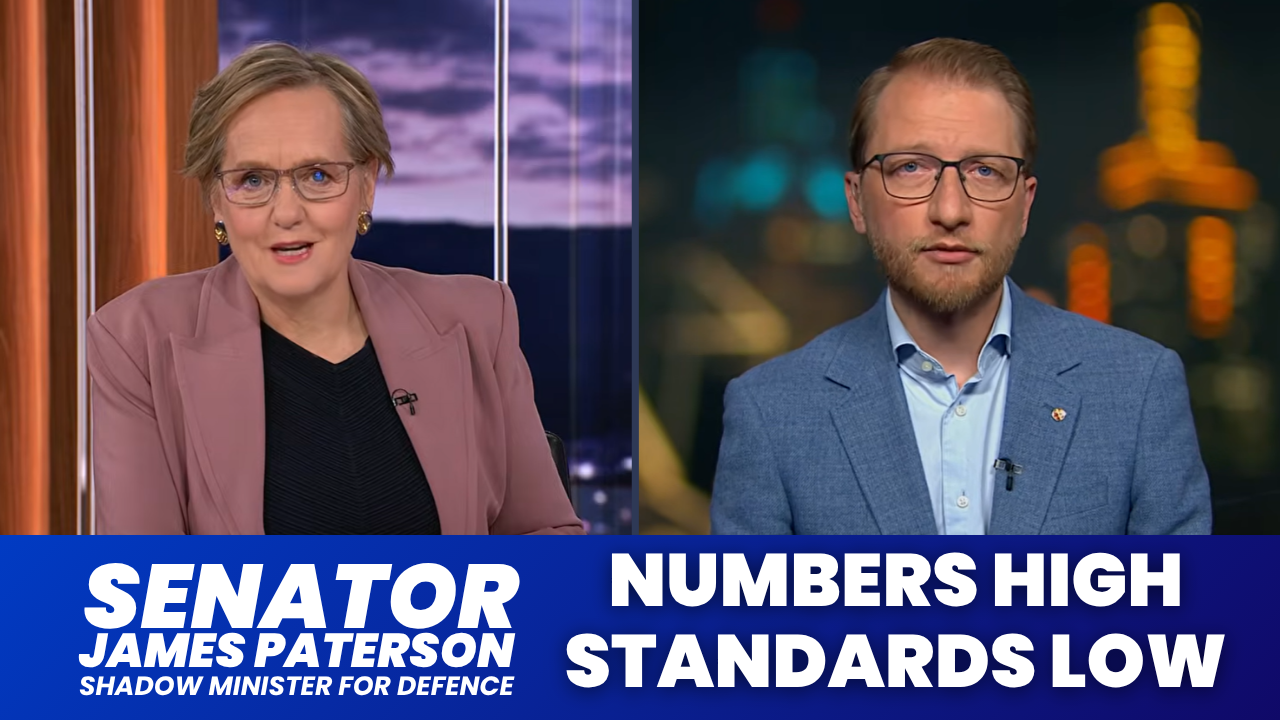
SARAH FERGUSON: Liberal Senator James Paterson is the Shadow Defence Minister. James Paterson, welcome to 7.30.
SENATOR JAMES PATERSON: Thank you for having me.
SARAH FERGUSON: The last time the Liberal Party tried to outdo One Nation on immigration, it harmed its own standing with migrants. Do you risk doing the same thing this time?
SENATOR JAMES PATERSON: Sarah, your department is the political analysis, my department is policy advocacy, and these are policies that are in Australia's national interest, because I think overwhelmingly Australians agree that in recent years the numbers have been too high and the standards have been too low. And the package that Angus Taylor announced today is about addressing that question of standards. Migration has been overwhelmingly beneficial for Australia, but unfortunately, we do know in recent years, there have been people who have come to this country who do not share our values, who do not believe in our way of life and who want to fundamentally change that. And we've got millions of people who would like to make their home in Australia. We can afford to be selective and choose the best migrants who are most compatible with our way of life and want to uphold our values.
SARAH FERGUSON: What, you just referred to immigration in positive terms, but today, Angus Taylor described calling diversity and multiculturalism strengths as merely a mantra that is essentially an empty slogan. What's your position on the use of those terms?
SENATOR JAMES PATERSON: Well, my position is that Australia is a country that has values, it has tradition, it has history, that it's worth upholding and defending. And if you're someone who lives elsewhere in the world who shares those values, you're very welcome to come to our country. If you want to uphold those values, if you want to strengthen us as a nation, we'd love to have you. But if you have a different world view, if you don't believe in parliamentary democracy, if you don't believe in the rule of law, if you don't believe in fundamental individual freedoms like, freedom of speech, and freedom of religion, and freedom of association, there are other countries in the word where you would be happier, and we don't want people like that here.
SARAH FERGUSON: But do you think that diversity and calling multiculturalism a strength is merely a mantra, an empty slogan?
SENATOR JAMES PATERSON: Well, I actually think the strategic climate that we find ourselves in and the disrupted era that we're in, I'm much more interested in unity than I am in diversity. I want unity of purpose, unity of values, unity of loyalty to our country. Of course, people can come in many shapes and sizes, and we would never discriminate based on religion, or on race, or on nationality, or sexuality, or anything irrelevant like that. But we should be selective when it comes to values. If you don't subscribe to Australian values, there are other places for you to live.
SARAH FERGUSON: Well, just on that values question, Angus Taylor said today that a Coalition government would make Australian values, the Australian values statement, legally binding. But as the situation stands now, the Minister for Immigration has the power, under Section 501 of the Migration Act, to cancel visas on values grounds. So what's different?
SENATOR JAMES PATERSON: Well, Tony Burke has been pretty reluctant to use that, and he often has to be shamed into using it by the Opposition or media reporting.
SARAH FERGUSON: But he has the power, doesn't he, James Paterson, now?
SENATOR JAMES PATERSON: Well, it's one thing to have the power, it is another thing to do it, and this is about signalling a very clear intent. I mean, under this government's watch, people who have committed serious, violent and sexual offences have been allowed to stay even while they're on visas in their last term. I mean, Tony Burke had to scramble last week to cancel the visas of radical Islamist preachers whom he had allowed to come to our country. So this is about making it very clear that we expect visitors to our country to uphold our values, and our system of government, and our rule of law, as well as those who want to permanently migrate here.
SARAH FERGUSON: Angus Taylor today also framed the Coalition's new policy around the Bondi terror attack. We just saw that in Jacob's package, and preventing another attack. One of those terrorists was born here. The other, the father, came here from India under a Coalition government on a student visa. How would your new immigration policy change any of that?
SENATOR JAMES PATERSON: Well, I think that is an illustrative example. One of the two Bondi terrorists came to this country from overseas and never became a citizen, and raised a child here who went on to allegedly commit a terrorist attack with him. That's a perfect example of how standards have not been high enough and how we should screen much more carefully to keep people like that out of our country. That's just one example. We could take the example last week of an immigration detainee who escaped while receiving care in a hospital, who has committed dozens of violent sexual offences against Australians. Those are not the sort of people that we want in our country, and I'm very comfortable being part of a political party that says we have standards and we will uphold them.
SARAH FERGUSON: Plenty more to discuss, obviously, about this new policy, but I want to ask you about what's happening in the Strait of Hormuz. Key NATO members, including the UK and France, have said categorically they will not join in a US blockade. The Australian government says it's yet to be asked. Is the Australian government right to refuse to join such a blockade under any circumstances?
SENATOR JAMES PATERSON: Look, I accept that this is an unconventional US administration, but the orthodox way to manage an alliance with our most important partner is not to pre-emptively and publicly rule out a request before it's even been received. We should wait until any request comes to Australia and assess it against our national interest and make a sovereign choice about whether or not we think it's in our national interests to contribute. But to go directly to this question, I am very cautious and frankly sceptical about whether Australia, it is in our national interest or whether it's within our capability, to join a blockade on Iran. That would be crossing a very significant threshold to effectively be participating in offensive operations against Iran. It would be a very grave decision to make.
SARAH FERGUSON: Tony Abbott suggested that the Prime Minister should be on the phone to the White House, offering any support that they need. Is he wrong?
SENATOR JAMES PATERSON: What's different about this US administration is that it didn't seek to build a coalition of allies prior to this invasion and attack on Iran. And I think with that comes different obligations. It would be one thing if there had been a build up and they had sought to build consensus and bring allies along with us and asked us to participate. We could have assessed that on its merits. But given the United States effectively unilaterally launched this operation, I think we are well within our rights to carefully assess any subsequent requests that come to us if they do.
SARAH FERGUSON: Did the US, as well as setting off on this conflict in the way that you just described, without building a coalition, did it also badly miscalculate by not dealing with the small boats and the batteries that can attack vessels in the Strait of Hormuz? Did they get that badly wrong?
SENATOR JAMES PATERSON: It's a fair question, Sarah, but I'm constrained, given my portfolio, publicly commenting on a sensitive alliance matter like that. What I can say is that clearly, the status quo right now is not at all beneficial to Australia or our allies and friends. If this conflict ends with the Strait of Hormuz being a tollbooth for the Islamic Revolutionary Guard Corps to extort the world, that would be a terrible thing. And so we do want the United States to succeed here and to be able to reopen the strait, and we should consider being part of an international coalition led by the UK and France once hostilities cease to make sure that that strait remains open and that the Iranian regime cannot extort the world.
SARAH FERGUSON: It's a pretty extraordinary situation, isn't it, when both the government and the opposition are reluctant to join a US military effort.
SENATOR JAMES PATERSON: Well, I think the other consideration we should be clear and upfront with the Australian public about is that the Indo-Pacific is the most important strategic region of the world for Australia. And right now, the US has drawn down, particularly its naval assets, from the Indo-Pacific to send them to the Middle East. And as the Chief of Defence Force, Admiral Johnson, said this week, that means that our role in the Indo-Pacific is more important than ever before.
SARAH FERGUSON: James Paterson, thank you very much indeed for joining us.
SENATOR JAMES PATERSON: Thanks, Sarah.
ENDS