

Media
|
Transcripts
March 4, 2026
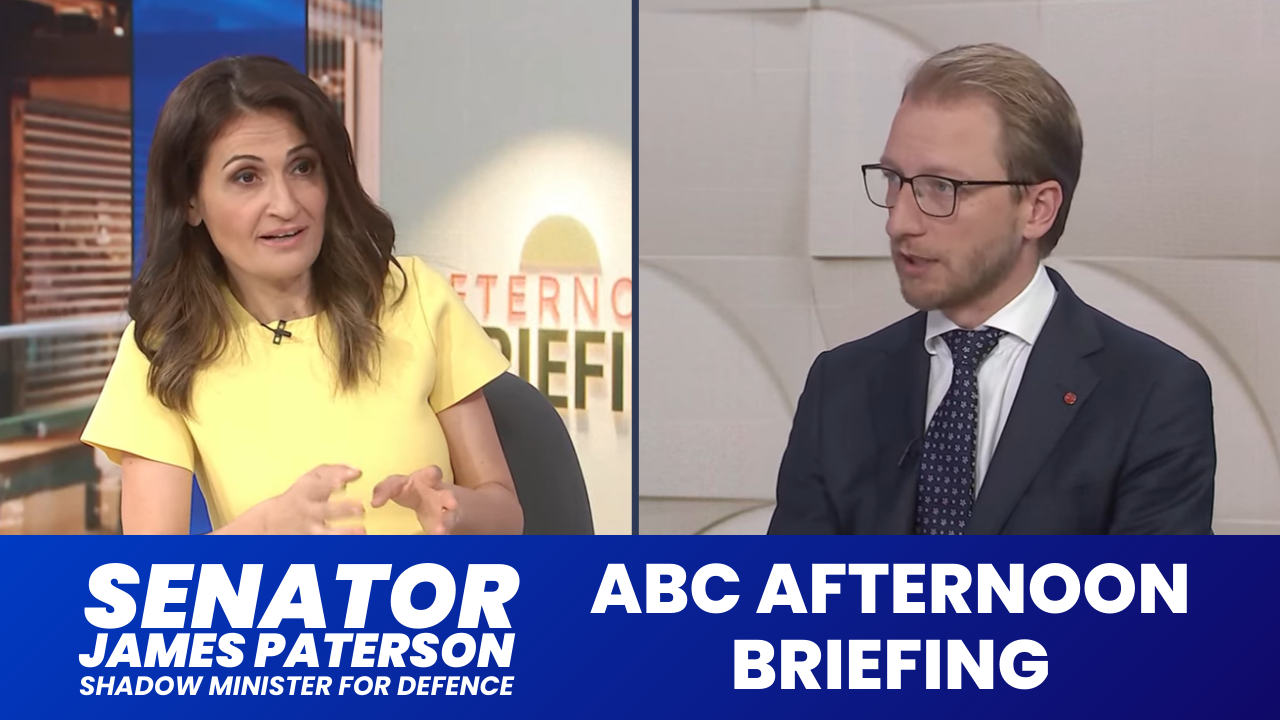
PATRICIA KARVELAS: Shadow Defence Minister James Paterson is my guest this afternoon. Welcome to the program.
SENATOR JAMES PATERSON: Thank you for having me.
PATRICIA KARVELAS: Now we've just had some breaking news this afternoon that the Minister for Multicultural Affairs, due to social cohesion concerns, is not going ahead with that grant. I believe that your side of politics was asking questions about this grant. It's six hundred and...
SENATOR JAMES PATERSON: Seventy.
PATRICIA KARVELAS: Thank you. You're amazing. Look at that. I was about to say 660,000. It's not. To the Taha Humanity Association. Is that a good decision?
SENATOR JAMES PATERSON: Well, it is a good decision, I'm glad that it's happened, but I think we do have to ask some questions about the due diligence of the Albanese government in making this announcement. I believe the announcement was made by one of their assistant ministers, Julian Hill, for an organisation which is in his own electorate. And so I would have thought that he would be familiar with the organisation, familiar with the views of the organisation and best able to warn the government that giving them public money might not be a good idea. So I really think Julian Hill needs to explain why he recommended and advocated for this grant and why he didn't warn the government that the views of people at this community centre might be incompatible with the government's objectives for social cohesion.
PATRICIA KARVELAS: But this is an organisation, this is, you know, clearly in his community there are many organisations like that. The only issue that you've raised is in relation to the mourning of the supreme leader. How would he know, that hadn't happened?
SENATOR JAMES PATERSON: I would suggest that any organisation that thinks it's a good idea to mourn the Ayatollah Khamenei, who is the leader of a designated terrorist organisation in Australia and a terrorist state that has attacked Australia and among other countries, any organisation who thinks he's worthy of mourning is probably an organisation that is rife with extremist views. It's probably not a mainstream organisation if they think that's an appropriate thing to do. And I'd be shocked if Julian Hill was unfamiliar with those issues at that organisation. And I think he should explain why he was an advocate for and why he announced this grant.
PATRICIA KARVELAS: Okay, we're going to move on from that issue. And I want to ask you about the government's decision to send these crisis teams into the region. Does it seem, I mean, it's the most full scale response we've seen. Is it adequate?
SENATOR JAMES PATERSON: It's welcome and appropriate, and we offer our unqualified bipartisan support for it. But I do have to say I think the government's response to this crisis has been a bit flat footed so far. We have 115,000 Australians stranded in the Middle East, many of whom might have chosen to leave had they been more directly warned by the government last week that this was a possibility. I mean, the Foreign Minister did not make a single public comment herself in the week leading up to these events about Iran. The Prime Minister dealt with it in one media interview on the ABC because he was asked, but he spent more time talking about Andrew Mountbatten-Windsor being the eighth in line for succession to become the King of Australia as if that was a far more imminent concern than war over Iran when there was enough information in the public domain to suggest that it was a likely prospect including the United States moving two carrier strike groups into the region.
PATRICIA KARVELAS: But that was all of the information on the public record, and I take the point you make, but the U.S. did not brief Australia before the event. Isn't that evidence of a bad ally?
SENATOR JAMES PATERSON: No, I don't agree with that, and we obviously had enough notice to know that we should withdraw family members of DFAT personnel from the region, which the government did on Friday. But on Friday, why didn't the Foreign Minister make a public statement? Why didn't she hold a press conference warning Australians in the Middle East, given that there are so many of them? I mean, there's 24,000, I understand, in the UAE alone, which has been struck by Iran. It was always a risk that Iran would lash out if it was attacked in the way that it has been. And I think there are Australians who, right now, probably would have been home had they been warned by the government adequately.
PATRICIA KARVELAS: In terms of the action itself, which you've backed in, so has the government, that is not the universal view, that's for sure. France has come out overnight to say that the military operations launched by the U.S. and Israel were outside of international law. Spain, of course, has already criticised the action. France says they are strictly in a defensive stance for their allies in the region. Shouldn't we have waited and shown that kind of nuanced approach to these strikes?
SENATOR JAMES PATERSON: No, on this I agree with the government. I think they were right to back these strikes because I think that are in Australia's national interest for a couple of reasons. One, Iran, the Iranian regime led by the Ayatollah Khamenei, is a despicable regime that has viciously persecuted and murdered its own people. Two, it is a sponsor of terror proxies around the Middle East. Three, it has struck Australia as part of that international terror campaign. And four, we know it continues to pursue nuclear and ballistic weapons that would further destabilise the region and the world. It is not a good faith actor. It is a not a stabilising force in the region. And I think it's a good thing that the U.S. and Israel have done what they've done.
PATRICIA KARVELAS: Do you think there are parallels to what occurred in Iraq in 2003?
SENATOR JAMES PATERSON: I heard Andrew Wilkie's interview on RN Breakfast this morning. I always listen to RN Breakfast when I can, but I thought he made some strange and factually incorrect observations. For example, he said that the Iraq war was launched in the lead-up to midterm elections in the United States, as this was. Well, actually, the Iraq War commenced in 2003 after the midterm elections, in the lead up to a presidential election, and it, in some ways, contributed to that presidential election being closer than it otherwise would have been. So I don't accept his analysis that this is politically motivated by the U.S. I think this is motivated by President Trump's assessment of U.S. national interest and U.S. values, just as our assessment of whether we should support it or not is based on that.
PATRICIA KARVELAS: Okay, so in terms of your support, is it unconditional? I mean, this is now continuing. There might be the strike to take out the Ayatollah, but if there's boots on the ground, if it continues, is that something you think is wise and in the interests of Australia and the world?
SENATOR JAMES PATERSON: Well, Australia would have to make decisions about whether or not we would seek to involve ourselves in that or how we'd respond to a request if one came. As I understand it from the government, there have been no requests, they're anticipating no requests, and it's not a conflict to which Australia is a direct party and is ever likely to be a direct party. We have interest in the Middle East but they are not as core to our national interests as the Indo-Pacific, for example. So I can't foresee how Australia would become directly involved. Where the U.S. takes it from here is up to them. What I would say, is that regime change is not something that can easily be done from the air alone. It has to be the Iranian people who take this forward. Now, it's very easy for us to say that in the comfort of a television studio thousands of kilometres away. These are life and death decisions for the Iranian People, but I think we should show our solidarity with them and support them morally in what they seek to do.
PATRICIA KARVELAS: Ok, and so that support is not unconditional, then in terms of whether you think it's in the interests of Australia?
SENATOR JAMES PATERSON: Well, it's up to the United States to decide how they choose to prosecute this conflict and Israel, of course, as well. It doesn't seem to me that it's likely that they would put boots on the ground. It seems to me that they want to support the Iranian people to take charge of their destiny. It's very difficult for the Iranian people to do that with a regime that is so brutal and has so persecuted civil society and independent power sources in the country for 47 years. But we hope that they are able to chart a different future for their country, because I think the Iranian people would, if given the chance to choose their own future, would choose a future which is much more peaceful, which is much more democratic, which is much more friendly to its neighbours than this regime has been.
PATRICIA KARVELAS: Thank you so much for joining us Senator.
SENATOR JAMES PATERSON: Thank you.
ENDS