

Media
|
Transcripts
March 9, 2026
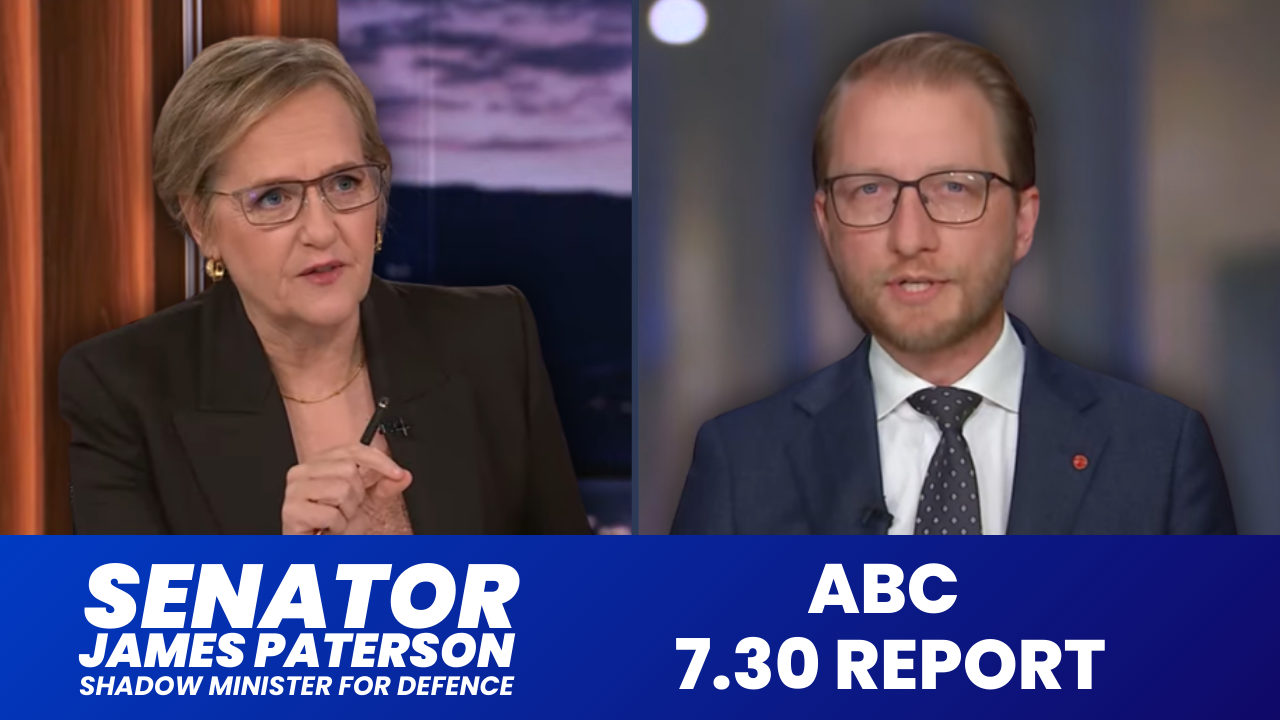
SARAH FERGUSON: Foreign Minister Penny Wong has said that the government is considering providing military assistance to Gulf countries under attack from Iran. The government hasn't said which nation or nations have sought help. James Paterson is the Shallow Defence Minister. Welcome to the program.
SENATOR JAMES PATERSON: Good to be with you, Sarah.
SARAH FERGUSON: Now, we understand the National Security Committee of Cabinet met this afternoon. Have you been briefed on a request from any of the Gulf countries for Australia to provide assistance, military assistance?
SENATOR JAMES PATERSON: No, not at this stage Sarah, we've made a request, and the government has been good in facilitating requests like this in the past, so I anticipate that it will happen soon, but it hasn't happened yet.
SARAH FERGUSON: Now, last week, you said you weren't expecting such a request and didn't think that it was in Australia's core national interest. Would the Coalition oppose a request of that nature?
SENATOR JAMES PATERSON: I think actually Sarah what I said was, I wasn't anticipating a request from either the United States or Israel to participate in their strikes against Iran and my view remains the same that Australia's core national interest is decided in the Indo-Pacific and that joining offensive military operations with Israel and the United States against Iran would have to meet an incredibly high bar to be justified. This, by the sound of it, from the Foreign Minister's limited public comments, is a different request. It sounds like a friendly nation to Australia, perhaps a Gulf state, that has been on the receiving end of some of the indiscriminate rocket fire from Iran has asked for our assistance to help them deal with that threat and I think we should consider that request, although we have to carefully consider whether or not we have the capabilities available to contribute there and that it would not in any way detract from our own core national interests in our own region.
SARAH FERGUSON: Is it truly possible to distinguish 100% between defensive and offensive in a conflict of this nature?
SENATOR JAMES PATERSON: Well, I'm reluctant to speculate too much but for the purposes of this exercise, let's say the request was for an ISR capability, an intelligence, surveillance, or reconnaissance capability like an E7 Wedgetail to be deployed to the region to assist in identifying incoming rocket fire or drone attacks from Iran to a Gulf state and to notify that Gulf state about that incoming fire so that they can deal with it. I think that would be plausibly a defensive capability. Some of the other distinctions that the government is seeking to draw in the public domain between offensive and defensive actions by Australia, I think, are harder to defend.
SARAH FERGUSON: Let's talk about the possibility of a request which may come for Australian frigates to take part in clearance operations in the Straits of Hormuz. Would that be in the national interest, according to the Coalition?
SENATOR JAMES PATERSON: Well, again, it would depend on who has made the request, what the request is, and what the availability of those assets are. I think it's well known in the public domain that Australia has very limited surface vessel availability through the Australian Navy and that we have a significant need for it here in our own region, both to protect our own economic and security interests in our immediate region, but also for the responsibilities we've agreed to uphold in international waters. For example, we participate in UN sanctions against North Korea and monitoring those sanctions against North Korea. And just last week, there was another incident involving a People's Liberation Army vessel in relation to an Australian Navy vessel as well.
SARAH FERGUSON: Do you have any concerns that Australia is spending too much money on AUKUS and not enough money on anti-drone warfare?
SENATOR JAMES PATERSON: I would express it differently. I strongly support every single cent that we're spending on AUKUS, but if we want to acquire AUKUS capability and also maintain other capable services in the ADF, including our Navy, Air Force and Army, then we need to increase defence spending because right now defence spending as a proportion of GDP has essentially been flat over the last four years under this government, it has not increased from the 2% of GDP that the last government took it to and therefore the expanding need for AUKUS capability, including the investment in defence infrastructure, like Henderson and Osborne shipyards, is cannibalising the capability of other services. And that's why so much capability has been cancelled by this government, particularly in the Australian Army.
SARAH FERGUSON: Let's talk about oil. We heard Donald Trump say today, short-term oil. He said this first on Truth Social, to be clear. Short-term increases in oil prices is a very small price to pay for world safety. Do you agree with him?
SENATOR JAMES PATERSON: Well, I hope that they are only short-term increases in oil prices. And as concerned as I am about increases on prices and the flow-on effects for Australian consumers and industry, I'm particularly concerned about any disruptions to oil supply. It is a foreseeable consequence of this conflict that the Strait of Hormuz has been effectively closed to naval traffic and that that has flow on consequences. And that's why successive Australian governments have thought it was important to legislate, as the previous government did, for minimum stock-holding obligations to make sure that, if there was an interruption to international supply, that we could survive that. So the government has very significant powers available to it. The Energy Minister, Chris Bowen, in particular, has very significant powers available to him to intervene into the market to make sure that that supply is there for Australian industry and consumers.
SARAH FERGUSON: The Nationals today say they want to revisit the policy of a cut to fuel excise. Obviously, people are starting to worry about the cost of fuel in Australia. Is that still Coalition policy?
SENATOR JAMES PATERSON: As you know, Sarah, we reset our policy playbook after the last election for obvious reasons, given the election result. It's not currently Coalition policy and if we were to formally adopt it, we'll do so through our proper processes. The government should consider...
SARAH FERGUSON: But if we have, obviously, energy is going to be, fuel is going to be a big deal tomorrow in Parliament, if the Nationals are pushing for that, is the Liberal Party open to assuming that policy again?
SENATOR JAMES PATERSON: Well, it is not a Coalition position as yet, because it hasn't gone through any of our processes yet. But really...
SARAH FERGUSON: The Nationals are obviously very keen to bring it back. What do you think?
SENATOR JAMES PATERSON: Understandably, a lot of their constituents and a lot of Australians are going to be hit by higher petrol and diesel prices in particular, and that's going to have consequences for their family budgets and their businesses. But the reality, Sarah, is we're not in government and the earliest we could possibly be in government is in about two years' time, by which time I hope this crisis has passed. Really, the obligation is on the Albanese government to say what they are going to do. Has Chris Bowen used any of the powers available to him under the legislation the previous government passed to deal with these supply shocks? If so, what has he done? He hasn't made that public today. Are they contemplating any cuts, temporary or otherwise, to fuel excise? Only they have the levers available to them to do that.
SARAH FERGUSON: Let's talk about the other event that happened overnight, which is the announcement that Mojtaba Khamenei will take over, has taken over as the supreme leader. Can I get your response to that? Because clearly, there was a lot of discussion about regime change, looking for a change in the way Iran is governed. Khamanei does not seem to present that. How do you respond to that news?
SENATOR JAMES PATERSON: Well, I thought the experts that you had in your previous package, who were warning about the risks of regime change from the outside and particularly only through air power, were right to be sober and cautious about it. Obviously, it would be a good thing if the Iranian people were able to take charge of their destiny and choose their own leader. But that's very easy for us to contemplate in the security of a television studio tens of thousands of kilometres away. It's a life or death decision for them. The best open source analysis I've seen is that Khamenei the younger is no different to Khamenei the older and that we should expect this to be relative continuity in terms of the regime. It's unlikely to be acceptable to the Iranian people, most importantly, nor the United States or Israel. The thing about authoritarian regimes, though, Sarah, that history shows us is they are quite brittle. They often appear very strong right up until the moment at which they break, and when they break, they shatter. That's why, before 1989, many people did not predict the fall of the Berlin Wall, and consequently the Soviet Union. The same could be the case here, and we will not know until after the fact why that's happened.
SARAH FERGUSON: Nonetheless, does it make you concerned for the duration of the conflict?
SENATOR JAMES PATERSON: I think the duration of the conflict will be dictated to by the United States and Israel's willingness and ability to continue to prosecute the conflict and the Iranian regime's ability to resist it and to continue to raise costs for its neighbours through these indiscriminate attacks, including on energy supplies. If at any point the Iranian region loses command and control and isn't able to continue to fire these rockets into its neighbours in the region, that will be a significant development. And if the United States or Israel make an assessment that continuing the bombardment aerially is not going to change anything on the ground, that would be a significant development.
SARAH FERGUSON: James Paterson, thank you very much indeed for joining us.
SENATOR JAMES PATERSON: Thank you for having me.
ENDS