

Media
|
Transcripts
April 28, 2026
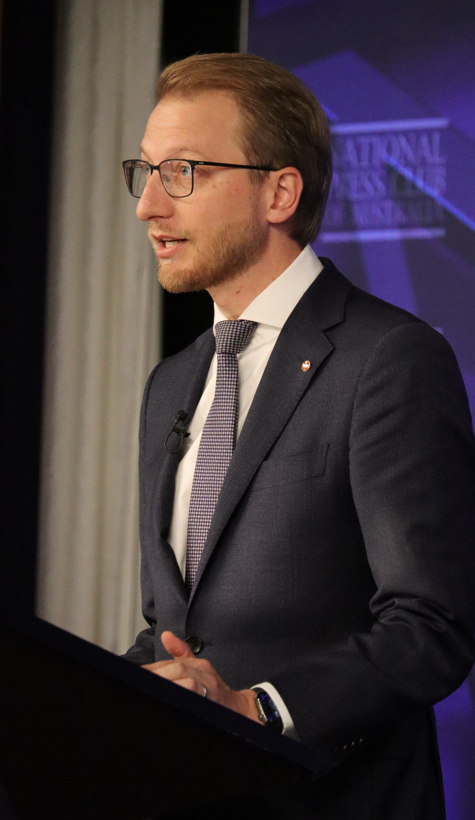
ANDREW PROBYN: Senator, before we take questions from the floor, let me drag you back to AUKUS. How much damage do you think Donald Trump has done to the social licence required for AUKUS and also damage done to the American alliance?
SENATOR JAMES PATERSON: We can clearly see from published opinion polling that Australians and other American allies are more sceptical about their alliance with the United States than they have been in any other recent moment of history, even going back to the invasion of the Iraq War, which was another test of the alliance here in Australia and with European allies as well. So it's no question that a US administration which is not constrained by convention, which is willing to do things that previous administrations would not, has an impact on public support for the alliance, and I think it's incumbent on political leaders to honestly accept that and recognise that and not try to pretend otherwise. But I don't think it changes the fundamentals of the alliance. The fundamentals of alliance are based on shared values with the American people and the Australian people. I don't think that's changed, and they're based on our fundamental interests, and they are as aligned today as they ever have been, particularly in the Indo-Pacific. The relationship between the United States goes far beyond just the relationship between the Prime Minister and the President. It is multilayered at every level of the bureaucracy of the Defence Force and the intelligence community, and I have no reason to believe, based on my visits to the United States, based on my discussions with our intelligence and security establishment, that that has been interrupted in any way, shape or form. So I think it is still fundamentally sound, but we have to recognise it's having an impact on public opinion.
ANDREW PROBYN: Right, first question, Tess Ikonomou from AAP.
TESS IKONOMOU: Thank you very much for your speech today, Senator. You touched on the need for public scrutiny. Are you prepared to commit the Coalition to greater transparency measures? And what safeguards do you think can be put in place to ensure the new Defence Committee does not replace public accountability?
SENATOR JAMES PATERSON: It's a really good question and I am an enthusiastic supporter of a new statutory defence committee because I have served on and chaired the Intelligence and Security Committee and I've seen how in a secure classified environment parliamentarians can provide robust oversight of the intelligence community away from the cameras and away from partisanship and I think that will help in the defence community too. But it cannot be a replacement for public scrutiny. When I turn up to Senate estimates in a couple of weeks' time I do not want to hear either the brass or the bureaucracy saying, well, Senator, we can only answer that question in the statutory defence committee behind closed doors, because an important part of accountability is being seen to engage in accountability. An important part of transparency is that it's not just for the club of insiders and politicians, it's for the public too. And so that's what I'll be demanding of this government. And should we have the honour of returning to government in the future, that's what I would expect too.
TESS IKONOMOU: And oppositions usually do talk about transparency when they're not in government. Just going back to the first part of my question, would you be committing, should the Coalition be elected at the next election, to ensure that there are greater transparency measures?
SENATOR JAMES PATERSON: Yes, at the very least, we should go back to what the previous Coalition government did, which was to cooperate with the Australian National Audit Office so that they could assess defence major projects. It was sometimes uncomfortable, it was sometimes embarrassing, but it facilitated a useful and informed public debate about our defence capabilities, which we are not having right now because this government has stopped doing it.
TESS IKONOMOU: Thank you.
BEN PACKHAM: Next question, Ben Packham from the Australian
BEN PACKHAM: Thanks, Senator Paterson. Criticising your predecessors' par for the course in politics, the Coalition did it, Labor does it. So if I could just take you to some of the criticisms that they make of the Coalition. They point to the massive over-programming of the defence budget under the Coalition. I think it was some 40%, which means that there was a whole range of capabilities in your investment plan that did not have money against them. And secondly, they also point to China's massive military expansion, that that began under the Coalition. The Coalition didn't respond by increasing defence funding at that time. They also point to the sort of conga line of Coalition defence ministers and defence industry ministers as well. Do they have some points here? And do you acknowledge that the Coalition made some pretty substantial mistakes in the portfolio?
SENATOR JAMES PATERSON: Ben, as I said, my purpose is not to defend a government that is now four years in the rear-view mirror and by the time we get to the next election will be six years in the rear- view mirror. I conceded in my speech that it did make some mistakes, but since you've raised it, in the defence of the former government, one thing it did do is restore defence spending to 2% of GDP. It inherited defence spending at 1.58% of GDP, the lowest level since 1938. And it responded to the change in the PRC by increasing defence spending to 2% of GDP. Now, we know more things now about the PRC’s capabilities and intentions, and it demands even further increases of GDP, and might I add, we know more things about the United States and its capabilities and intentions, and that demands further increases in defence spending. My point is, Pat Conroy is particularly adept at attacking the former government. How does that make us safer? How does it equip one service personnel with better technology to defend them? How does it make our country better informed about the challenges we face? It does nothing to service that goal.
ANDREW PROBYN: Tom Lowrey from the ABC.
TOM LOWREY: Senator, thanks so much for your address today. The US Congress in the past few weeks has heard repeated warnings about the pace of submarine shipbuilding in that country. The UK House of Commons has today warned about the pace of shipbuilding and funding for it within the UK. How worried are you about those warnings and the prospects there for Australia receiving Virginia-class or AUKUS-class submarines as expected? Do you share Richard Marles's confidence, that is the US at least, will be able to meet and even exceed those targets? And does that at all play into your suggestion today that Australia should acquire B21 Raiders essentially as a stopgap?
SENATOR JAMES PATERSON: I am confident that AUKUS will succeed, but not on baseline settings, not on status quo expenditure and investment in either of the three AUKUS nations, and I am not surprised to hear further warnings out of the Congress in the US, nor am I surprised to hear them out of the UK. And I think we're doing the public a disservice just by saying everything is fine, everything is on track. No need to be alarmed. I think we do need to make changes so that we can deliver AUKUS, and I think that we do need contingencies for potential capability gaps, given the challenges with the Collins life of type extension, given any possible slippage in the delivery of US nuclear propelled submarines. We need to say that we will have those alternative capabilities to rely on should events get out of our control, should we find ourselves in conflict in our own region in the future, before Virginia-class submarines or other capabilities arrive.
ANDREW PROBYN: Thank you, so just to just to clarify there, you're saying that we should get asked for the B-21s as that stopgap as that contingency, just in case AUKUS doesn't happen?
SENATOR JAMES PATERSON: I'm putting it on the table as one option that I think is worthy of consideration. It has been looked at before in the DSR. The advice at the time was it's not appropriate for Australia's needs. But that was prior to the election of the second Trump administration. And I think we've learnt more about the world and our region in that time, which means it should be re-evaluated. And I'm quite comfortable if the government says, no, B-21s aren't appropriate, but here's this other capability that we're going to invest in that delivers a similar effect. What I think is not sufficient is just saying we don't need it. We don't need any supplementary or complementary capabilities at all. Everything is fine. I don't think that's a serious approach to this issue.
ANDREW PROBYN: OK, next question. Joseph Olbrycht-Palmer, from Newswire.
JOSEPH OLBRYCHT-PALMER: Thank you, Senator, for your address. You touched on the situation that Europe encountered with Russia, and I think that crisis was made all the more worse because of the economic interdependencies of those two. Australia is overwhelmingly dependent on China for trade. They are our largest trading partner by far, and there's no one who can really step in. Any kind of conflict in the region would seriously disrupt our trading routes. I just wondered, do you think that Australia risks falling into the same trap that Europe did by not preparing for that economic fallout that we really couldn't mitigate?
SENATOR JAMES PATERSON: There are absolutely some dependencies in our bilateral trading relationship with the PRC, but they're not exactly the same as the dependencies that Europe had on Russia prior to the invasion of Ukraine. Europe was more reliant on Russia as a source of energy than Australia is from China. In fact, we are a major supplier of energy to the People's Republic of China, but it is a very large source of our export income. And there are some critical inputs that we get from China, for example, precursor chemicals for critical medicines that we need to be able to take care of our population. And I think the lessons of COVID have not yet been sufficiently taken into account in our supply chain security. And we are getting another lesson of that in the Strait of Hormuz. We clearly need to do much more to build more resilient supply chains. But ultimately, we are an open trading nation. We are at the end of a long supply chain. It has to pass through many maritime choke points. There actually is no alternative for Australia than trying to keep that rules-based order and that free flow of international trade open. And we need long-range stealth strike as a key deterrent capability to contribute to that.
JOSEPH OLBRYCHT-PALMER: You also touched on the US, as you kind of named the US as not really following international rules. Could you point to an example of where you think that is the case?
SENATOR JAMES PATERSON: Well, I mean, I'm not going to give you a view on international law, but I think we can all say that the operation in Venezuela to arrest President Maduro was not something a previous US administration would likely have done, certainly not in the post-Cold War era. And although I think there's a very strong moral case for the strikes on Iran, and the Coalition has provided support of that, a previous administration, if they were to do an operation like that, would have done it differently. They probably would have sought a UN Security Council resolution, they probably would have sought a larger coalition, as they did in the first and second Gulf Wars. So this is an administration which is unconstrained by conventions, which is comfortable deploying US power at short notice to achieve its national interest. And I think we need to be honest and recognise that, not just pretend that everything is normal, and we're still in that unipolar moment in the 90s and 2000s.
ANDREW PROBYN: Do you think that Xi Jinping wants to take Taiwan by 2027?
SENATOR JAMES PATERSON: That is one of the most hotly debated questions among the China watching community. I would say he's been very clear about his ambition to reunify Taiwan. I would also say that it would be obviously his preference to do that without the use of force, but he has also directed the PLA to be ready if he chooses in the future to use force to annex Taiwan. And Australia's national interest and Australia policy is very clear and very bipartisan; which is we support the maintenance of this peaceful status quo across the Taiwan Straits and we are opposed to any unilateral changes to the status quo. And it is one of the most critical national security priorities for Australia that we contribute to that credible collective deterrence effort along with our partners like Japan, the United States, and others.
ANDREW PROBYN: I hope I didn't steal your question Greeny, but Andrew Greene, from the West Australian.
ANDREW GREENE: Senator Paterson, I might, if I could, stretch my tenuous friendship with Andrew, ask a couple of questions. Firstly, your reaction to the announcement today of a new Defence Secretary. We've seen the Prime Minister announce Meghan Quinn, who doesn't appear to have a national security background but a strong industry background. So, your thoughts on that. And you mentioned integrated air and missile defence. It doesn't look like we'll have that in place before the AUKUS rotations begin next year. How concerning is that? And can you see any stopgap solution?
SENATOR JAMES PATERSON: Well, I congratulate Meghan Quinn on behalf of the Opposition on her appointment. It's a significant and historical appointment, and I have observed her through the Senate estimates process in her other senior public service roles, particularly in the Treasury portfolio, and my observation would be that she's a highly competent, professional public servant. Like you say, though, I'm not aware of previous service in national security portfolios. And when the Prime Minister was asked about this today, he pointed to her role in authoring the Asian Century white paper as evidence of her experience in national security. I would say that's a white paper that hasn't aged very well. It was incredibly optimistic about Australia's relationship with China in particular. To be fair to Secretary Quinn, though, the world has changed. Presumably, her views have been updated in that time. On your second question, yes, I am concerned. I do think we have inadequate integrated air and missile defence of our northern bases, of our critical infrastructure, of our major cities and defence facilities like HMAS Stirling. I think we have a responsibility to be a responsible steward of that rotational submarine force and adequately defend it, and I don't think the investment timeline is anywhere near aggressive enough to achieve that.
ANDREW PROBYN: Anna Henderson from SBS.
ANNA HENDERSON: Thanks so much, Mr Paterson, Senator Paterson, as I should say, and yes, Andrew, you've thrown me because of course you've taken my question.
ANDREW PROBYN: Uh, apologies.
ANNA HENDERSON: I firstly just wanted to get a little bit more in terms of a response from you to the announcement about the US new ambassador to Australia, what you think he would bring to the role if his nomination is successful, and whether you think this is going to be a new era for the relationship between the two countries, and the time that's elapsed in the meantime has been a problem in your view?
SENATOR JAMES PATERSON: We can certainly welcome that the Trump administration has nominated an ambassador, they've got a reasonable track record of getting their nominees confirmed through the Senate, so I hope that's a swift process. It is not unusual for there to be lapses in US ambassadors to Australia, and we have an incredibly competent diplomatic corps from the State Department, including in this room right now, who've done a sterling job representing US interests in the meantime. I don't know the nominated ambassador. I've read about some of his views and track record. I welcome the fact that he's a past Member of Congress and will be informed about the Administration's priorities, and we look forward to working with him.
ANNA HENDERSON: And just following up on Andrew's question, Senator, in terms of the reaction to Taiwan and what might happen next, we have heard from both major parties that it's the peaceful status quo opposed to any changes. But if there is that change, if that peace is broken, do you think Australia is obligated to take part in any kind of action?
SENATOR JAMES PATERSON: Look, I understand the interest, and it is a fair question, but in my speech, I called for the government to be more candid but not reckless, and it would be reckless for me to publicly speculate about a hypothetical contingency like that. What I would say is that Australia's participation in any international conflict is a sovereign choice for an Australian government to make at the time, by that government taking into account our national interest.
ANDREW PROBYN: China would be delighted that the US has expended so many missiles, wouldn't they?
SENATOR JAMES PATERSON: Well, I think, as I said in my speech, it is a concern that already depleted US missile stocks have been further depleted in the conflict in Iran, and there have been media reports that they have drawn down from their Indo-Pacific designated stockpiles in order to conduct the operation in Iran. It's also publicly known that the US has moved a lot of its naval fleet into the Middle East out of the Indo-Pacific, and I think that makes Australia's presence in the Indo-Pacific in the interim even more important.
ANDREW PROBYN: Next question, Kim Bergman from Defence Review Asia.
KIM BERGMAN: Thank you Senator. That was very interesting, very worthwhile. I'm glad that you mentioned Ukraine twice because I note that under the previous Coalition government, you were very robust in terms of support for Ukraine. But for reasons that none of us can understand, this government seems to have lost interest. If you return to government, what will your attitude towards Ukraine be?
SENATOR JAMES PATERSON: I think we have a strong interest in ensuring that Ukraine prevails because if Ukraine loses, if Vladimir Putin is rewarded for what he has done, that will establish a terrible precedent which will be closely watched around the rest of the world. It will represent a failure of collective will by Western nations to prevent this abrogation of borders simply by force. And I'm worried that it will give heart to other authoritarian leaders, including in our own region that our will will crack over time if you sufficiently persist. So I think support for Ukraine is not only a moral cause, a just cause, it's also in Australia's national interest, and without pre-committing a future government to specific expenditure or support, I think we should be doing more to help Ukraine.
ANDREW PROBYN: Brittany Busch from the Sydney Morning Herald and The Age.
BRITTANY BUSCH: Thanks, Andrew, thanks, Senator. You've outlined some of the serious obstacles that AUKUS is facing. You also called for greater transparency for the Australian public. Given those remarks, do you think that the new Coalition Labor Defence Committee needs to review AUKUS to examine the weaknesses in the pact from the Australian context?
SENATOR JAMES PATERSON: I think that core business for the new Defence Committee will be oversight of AUKUS. In fact, I can't imagine anything more important than the new defence committee taking an active interest in the progress of AUKUS in holding the Defence Department and the ADF to account for the critical milestones in AUKUS, like HMS Stirling being ready to receive that submarine rotational force, like the workforce issues that we know are there, like the submarine industrial base issues that are there. So I think it will be core business for the committee.
BRITTANY BUSCH: Does that look like a formal enquiry, like what we've seen out of the British Parliament?
SENATOR JAMES PATERSON: Look, I defer to the Chair and Deputy Chair, who will make decisions like that, but I can't imagine there will be many meetings of the new committee that wouldn't be concerned with AUKUS and AUKUS delivery.
ANDREW PROBYN: Well, given that, why wouldn't you have a review if you think that the Brits are going wobbly and there are people in America who don't really support it?
SENATOR JAMES PATERSON: I wouldn't agree with those two contentions necessarily, Andrew. What I've said is that there are obstacles that we have to overcome in order to deliver AUKUS. I'm not worried about the commitment to AUKUS in any of the three parties, of any of the three countries that are party to it. What I am concerned about is that we are not sufficiently spending to achieve it and that it's incredibly ambitious. And so, yeah, as I said, core business for the committee to review AUKUS, review the progress of AUKUS, not review the concept of AUKUS. I'm, as I said, I'm an AUKUS true believer.
ANDREW PROBYN: Corrie McLeod from InnovationAus.
CORRIE MCLEOD: Thank you for your address, Senator. I've got a question about Australian defence industry development. In the streets of Kiev at the moment, venture capitalists are sweeping into town, tech is being developed so quickly, software iteration cycles are weeks, not years. It really does shine a light on maybe the pace and way we build and adapt capability in industry development in Australia. What, if anything, needs to change for us to keep pace with the rest of the world?
SENATOR JAMES PATERSON: It's a really good question. There's no doubt in my mind that our defence procurement processes are broken in this country and not fit for purpose for the strategic environment we are in. They are perfectly fine and adequate for a peacetime environment where stewardship of taxpayer dollars is the number one objective. But actually, the number objective right now should be getting capability into the hands of warfighters. And I think the bureaucratic processes that we have slowed that down and made that more difficult. We need to be far more nimble as Ukraine and others have been in getting that capability from concept to delivery far more quickly. I am open-minded to see how the government's new construct of the Defence Delivery Agency works. But I am concerned that we are four years into the government and we're now doing a major MOG change as if our potential adversaries are thinking oh no, the Australians are doing a MOG, we better take it pretty seriously.
CORRIE MCLEOD: Thank you.
ANDREW PROBYN: Nic Stuart, AbilityNEWS.
NIC STUART: Thanks, Senator Paterson. Extremely powerful and muscular speech. You identified quite clearly the gaps in the current ORBAT. You've also suggested that we might consider B-21s as an alternative. That's a necessary means, particularly if there's a gap with the AUKUS subs. As you know, there is no point talking about this unless you identify, and you've clearly identified the costs of these programs, where does the money come from? Does it come from, you know, we all realise there's extra need now. Does it come from extra taxes? Or does it come from other expenditure programs? And you've identified what is necessary. You must have where the money can come from.
SENATOR JAMES PATERSON: It's a very fair question, but one that you'll understand I cannot unilaterally answer today on behalf of my parliamentary colleagues, particularly the members of the Shadow Expenditure Review Committee. What we have said is we are committed to 3% of GDP in the old money. We'll have to re-evaluate what that means under the new money, under the NATO standard, and we'll be transparent about that. And well before the next election, we'll demonstrate how it can be paid for. But we haven't made those decisions yet as a Shadow ERC. We've just made our intent very clear. And over the balance of the parliamentary term, we'll make our homework very clear so that it can be publicly scrutinised.
NIC STUART: So, well before the next election, we'll actually know a rough budget of where the money will come from and where it's going?
SENATOR JAMES PATERSON: Again, I'm not going to unilaterally announce timelines for costing releases on behalf of my economic portfolio colleagues. I was previously in one of those economic portfolios. I would have resented it if someone else had done that to me. So that is up to our Shadow Treasurer, Shadow Finance Minister and others. But in good time, we will be completely transparent about what we will spend and how we will afford it.
ANDREW PROBYN: And our final question is from Jason Koutsoukis, final but probably the best question.
JASON KOUTSOUKIS: Senator, thanks for your speech. Do you agree with the German Chancellor Friedrich Merz's comments that the US Is being humiliated by Iran?
SENATOR JAMES PATERSON: I wouldn't use that language, but I would say that Iran has demonstrated the power of asymmetry yet again, as Ukraine has to Russia. And the US has achieved some extraordinary conventional military successes in their campaign in Iran. They've set back the nuclear program, they've set back the ballistic missile program, they've set back drone production, they demolished the Iranian Air Force, the Iranian Navy, and Iranian air and missile defence. But the regime is proving resilient. And they've demonstrated that just one maritime choke point with relatively limited remaining military capability and relatively technologically unsophisticated capability, they can hold all of us to ransom and extort all of us after this conflict. And so I think that is a very sober reminder about the power of asymmetry for great powers, but actually for a middle power, it's quite encouraging. We can adopt the same principles to defend our interests too and it should be causing pause in the minds of really serious powers in our region about what could be done to make them have a very bad day on the battlefield, as Iran and Ukraine have done for the United States and Russia.
ANDREW PROBYN: But what does it say of America's eroded prestige that the Chancellor of Germany says that America has been humiliated by Iran?
SENATOR JAMES PATERSON: Look, I'm not going to provide a running commentary on diplomatic relations between Germany and the United States. That would be inflammatory, as I said in my speech. But as I've said before, I think we all understand the standing of the United States, in the West, particularly in places like Europe, is not what it was five or ten or twenty years ago. It has been impacted by an unconventional administration. This is the world we're living in. The good thing about the world we're living in, although it's a tougher world, is it's also a more honest world. I think we have a better understanding of people's interests and their intent, and I think, frankly, we're less naive about what we need to do to secure our own interests. Australia must step up in this environment. We cannot allow ourselves to become victims of naive thinking that someone else will just come to our aid, that our national interests will be taken care of by others. We have to take care of our own interests.
ANDREW PROBYN: And with that, join me in thanking James Paterson.
SENATOR JAMES PATERSON: Thank you.
ENDS