

Media
|
News
April 16, 2026
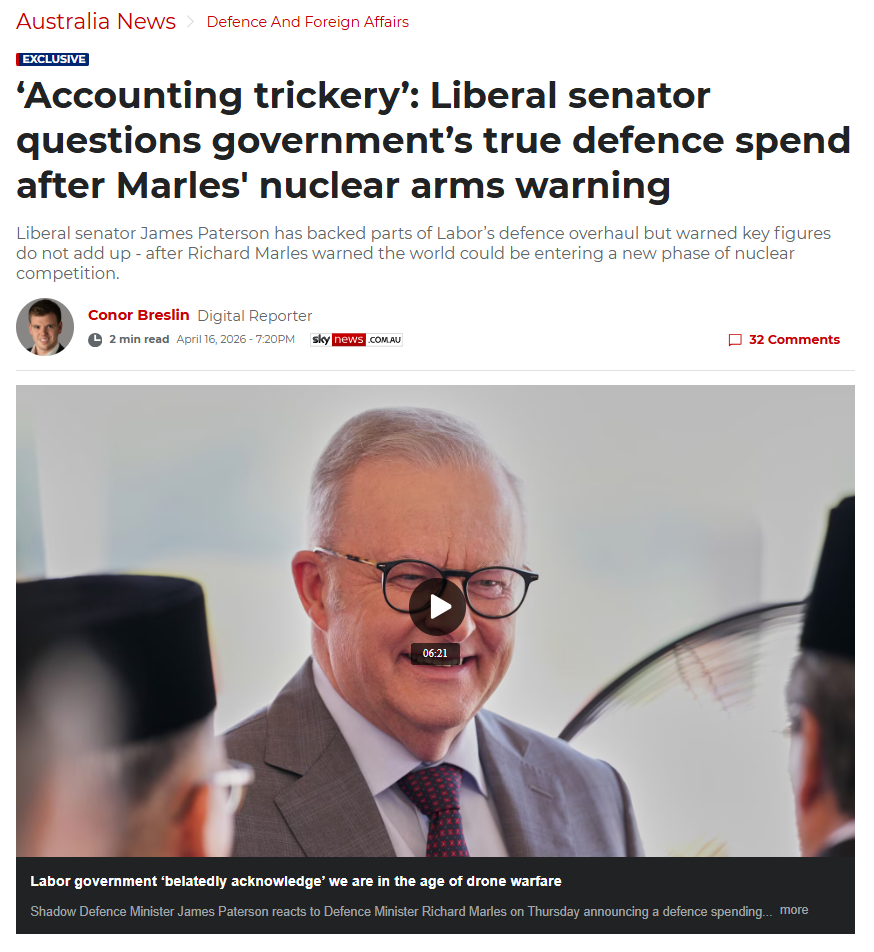
Liberal senator James Paterson has backed parts of Labor’s defence overhaul but warned key figures do not add up.
Defence Minister Richard Marles used a National Press Club address on Thursday to outline a long-term plan, including a path towards spending 3 per cent of GDP and a focus on new technologies such as drones and missile systems.
He warned the world could be entering a new phase of nuclear competition, pointing to the collapse of key arms control agreements and the expansion of arsenals by major powers.
But the Coalition has raised concerns about how the government is measuring its defence commitment, arguing the headline figures do not reflect real capability.
Mr Paterson said there were elements of the strategy he supported, including recognition of shifting warfare trends.
However, he said the speech also raised serious questions.
“I think there is a form of increased defence spending, although exactly how much is not completely clear,” Mr Paterson told Sky News host Chris Kenny.
Mr Paterson said the government had taken too long to respond to changes seen in conflicts overseas, particularly the growing role of drones and missile systems.
He also pointed to what he described as unexplained reductions in planned spending.
“You have $5 billion of secret cuts in the forward estimates that we don't know what that is for, and an unknown amount of further cuts in the medium term,” he said.
The government has argued its approach aligns with international benchmarks, using a NATO-style definition of defence expenditure.
That includes areas such as infrastructure, resilience and support systems.
But Mr Paterson rejected that framing, warning it risks overstating the level of investment in frontline capability.
The senator said the changing global environment required a more direct approach, with a stronger focus on tangible assets and preparedness.
“The world has changed since the 1990s and we should be sober and honest about that with the Australian people,” he said.
“That was a unipolar moment with one dominant global power in the United States and we're now in either a bipolar moment with China or a multipolar moment if you want to count other powers as well.”
He argued that shift demands a higher level of investment than what is currently being delivered.
“Very clearly it has changed and it demands something different of us, which is much greater investment in our own defence, national security, and real investment, not just moving money around and pretending that we're spending more,” he said.
Mr Marles had earlier defended the government’s position, saying the updated calculation allowed for accurate international comparisons and reflected the full scope of national security spending.
The strategy also includes tens of billions of dollars over the next decade, with a focus on missile defence, naval capability and industrial capacity.
Mr Paterson said the benchmark set by defence experts was clear.
“The Albanese government's trying to fudge that by saying; ‘well, we're almost spending 3 per cent of GDP if you count military pensions and other things’,” he said
“But counting military pensions as part of the defence budget doesn't deliver one new ship, one new plane, one new missile, one drone, it's just accounting trickery and our men and women in uniform deserve better than that.”
Beyond funding, he said Australia must balance its reliance on alliances with greater self-reliance.
“We will be a more self-reliant country that's better able to secure our interests in a dangerous world and a better ally to the United States if we spend more on defence,” he said.
The debate comes as Australia continues to invest in long-term projects such as nuclear-powered submarines under the AUKUS agreement, while also trying to respond to immediate threats.