

Media
|
News
October 8, 2026
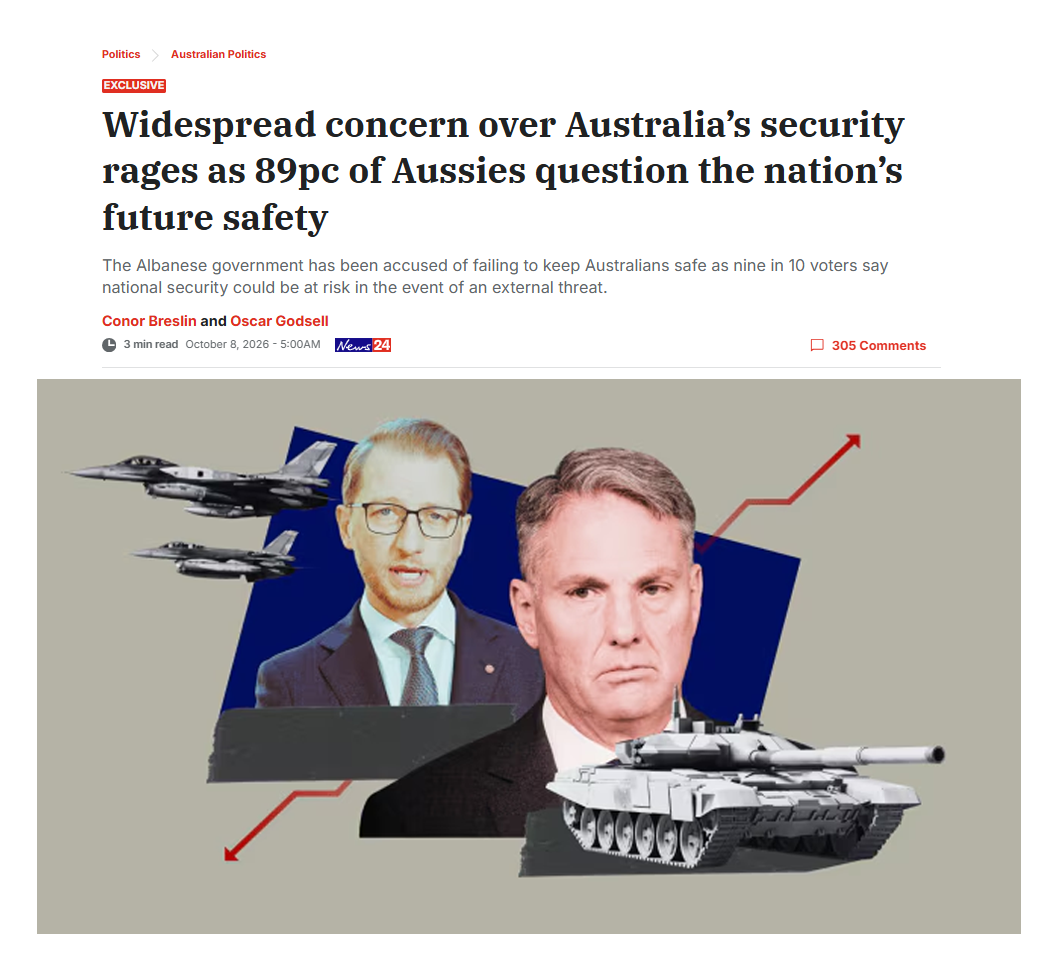
The Albanese government has been accused of failing to keep Australians safe as nine in 10 voters say national security could be at risk in the event of an external threat.
The latest News24.com.au Pulse / YouGov poll found just 11 per cent of voters believed Australia was secure from realistic external threats.
Fifty-six per cent said Australia was fairly secure now but were concerned it may not be in the future, while 33 per cent said the country was not safe and action was needed.
The results mean 89 per cent of voters either fear Australia’s security could deteriorate or believe the country is already not secure.
Concern stretched across the political spectrum, with 84 per cent of Labor voters selecting one of the two more concerned responses.
That climbed to 94 per cent among Coalition voters and 95 per cent among One Nation supporters, while 79 per cent of Greens voters also expressed concern.
Shadow defence minister James Paterson told News24.com.au the results show the government was failing its duty to protect Australians.
“It is a damning indictment of Anthony Albanese and Richard Marles’ abject failure to perform the first duty of any government: to keep Australians safe,” he said.
“The Australian people are not fools, they see the defence funding cuts, delayed capabilities, the slashed flying hours, and our largest warships tied up in dock.
“They see that our ability to defend ourselves from external threats has diminished under this government.”
Defence Minister Richard Marles was also contacted for comment but did not provide a response.
The Australian Strategic Policy Institute’s defence budget brief recently warned investment for Australia’s future military capability remains back-loaded.
ASPI estimated only about four cents in every dollar of the $53 billion promised by Labor was actually appropriated in the 2026-27 Budget.
About nine cents in every dollar was promised across the four-year forward estimates and another 54 cents sat in the later years of the decade.
About 33 cents of every dollar was linked to the Contingency Reserve and what the Budget describes as “alternative financing”.
ASPI warned the structure of the federal budget meant Australia was accepting reduced capacity from the ADF in exchange for future capacity.
ASPI argues the trade-off could mean fewer spare parts in stockpiles, reduced training intensity, lower platform availability and less time for personnel in the field.
The government has indicated traditional defence appropriations were on a trajectory to reach approximately 2.5 per cent of GDP by 2033-34.
The United States has urged Australia to increase defence spending to 3.5 per cent of GDP.
Last month, Mr Marles and US Secretary of War Pete Hegseth committed to bolstering the US military presence in Australia.
The News24 Pulse results showed concerns about Australia's security were widespread across age groups.
Voters aged 65 and over recorded the highest level of concern, with 93 per cent either questioning Australia’s future security or saying the country was not secure.
The figure was 90 per cent among 18 to 24-year-olds and 35 to 49-year-olds, and 89 per cent among those aged 50 to 64.
Women were more likely than men to express concern about Australia’s future national security.
Sixty per cent of women said Australia was fairly secure now but they were concerned it may not be in the future, compared with 51 per cent of men.
Thirty-two per cent of women said Australia was not secure and urgent action was needed, compared with 35 per cent of men.
Only 14 per cent of men and eight per cent of women said Australia was secure from realistic external threats.
The national security findings come as the Albanese government records its lowest primary vote in the history of the News24 Pulse.
Labor has fallen to 25 per cent, while One Nation has climbed to 28 per cent.
The Coalition is on 21 per cent and the Greens have risen to a record 15 per cent.