

Media
|
News
October 5, 2026
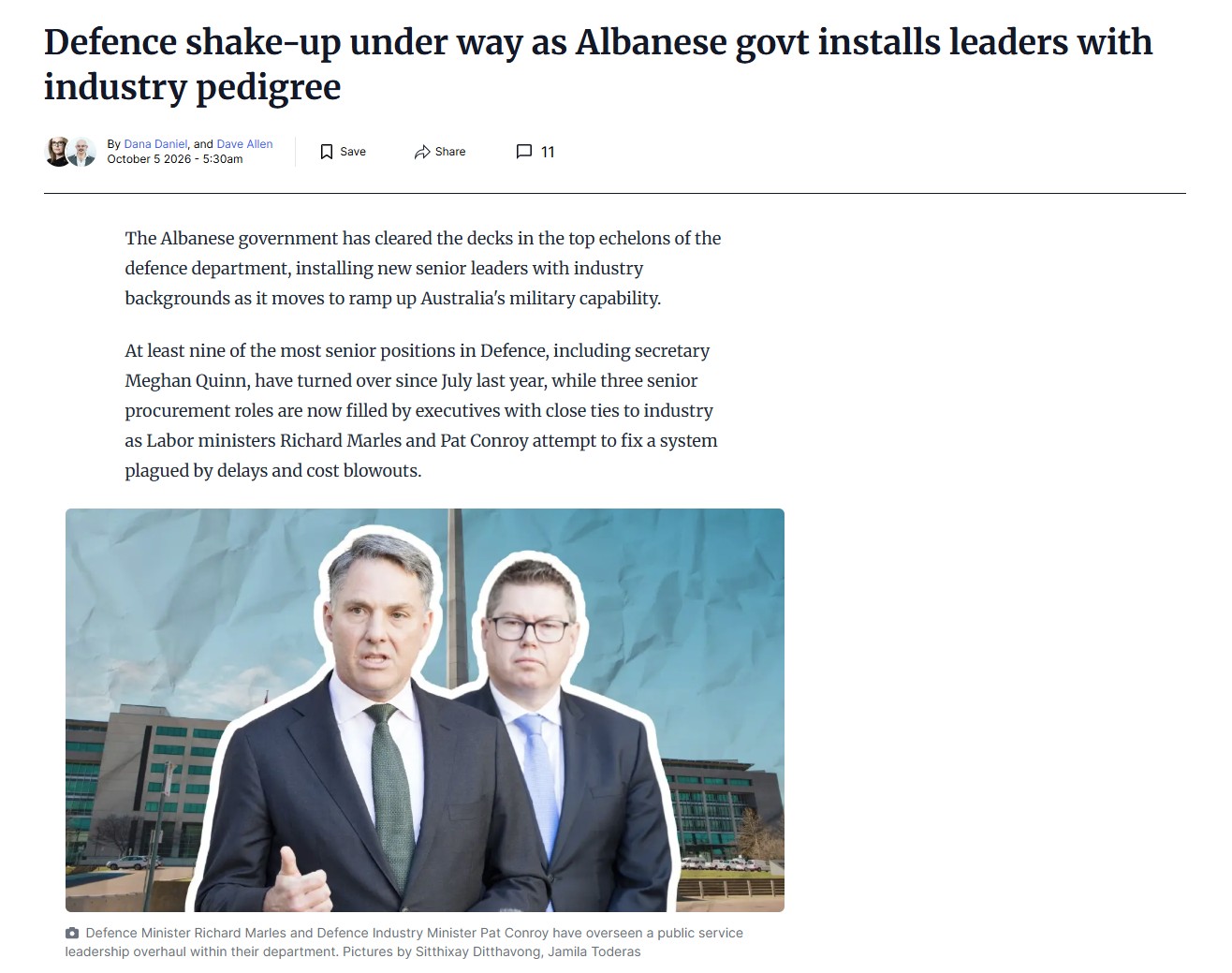
The Albanese government has cleared the decks in the top echelons of the defence department, installing new senior leaders with industry backgrounds as it moves to ramp up Australia's military capability.
At least nine of the most senior positions in Defence, including secretary Meghan Quinn, have turned over since July last year, while three senior procurement roles are now filled by executives with close ties to industry as Labor ministers Richard Marles and Pat Conroy attempt to fix a system plagued by delays and cost blowouts.
Former executives and engineers from defence contractors Babcock, Northrop Grumman and Raytheon are among the appointments made as Defence transitions its procurement and capabilities functions to a new super agency.
The changing of the guard prompted incoming Greens leader and defence spokesperson David Shoebridge to warn of a "revolving door" being used by industry to "work its way inside Defence", as ACT independent senator David Pocock calls for stricter rules on movement between government, the department and Defence contractors.
But a spokesperson for Defence Industry Minister Pat Conroy dismissed any perception of a conflict of interest, saying the new appointments instead were part of efforts to "modernise the Australian Defence Force ... while ensuring we spend taxpayers' money wisely".
"It's critical that we put in place the people, structures and systems to ensure Australia's Defence Force can deliver the capabilities we need at speed and within budget," the spokesperson said.
The new Defence Delivery Agency, announced in November and functioning on an interim basis as the government settles its final structure before it becomes a powerful standalone entity next July, aims to speed up military acquisitions.
It will be led by a National Armaments Director, who will report directly to Defence Minister Richard Marles and Defence Industry Minister Pat Conroy, and oversee a budget of $35 billion a year - about half of Defence's overall budget, which has almost doubled in a decade to $63 billion.
Mr Conroy in July said Defence procurement systems had failed the department's bureaucrats, causing projects plagued by delays and billions in cost blowouts.
But asked at the time if he would be willing to sack senior public servants for poor decision-making, Mr Conroy said, "Accountability will be king."
The Canberra Times is not suggesting any employees that have left the department were sacked.
An analysis of official records by this masthead shows the pace of new appointments at Defence accelerated after Ms Quinn became department secretary in May.
Ms Quinn replaced Greg Moriarty after his posting as US ambassador, having previously headed the Industry department where she oversaw the rollout of Future Made in Australia and the National Reconstruction Fund.
Key players in the ensuing leadership overhaul include Racheal Kuczma, formerly of Northrop Grumman, appointed acting deputy secretary of capability acquisition and sustainment in July.
Ms Kuczma had joined the aerospace company - which manufactures the US military's stealth bombers - in 2021 after a previous stint in Defence.
She had left the department after then Coalition prime minister Scott Morrison abandoned plans to acquire French Attack Class submarines, a project she had worked on, in favour of the AUKUS nuclear submarine treaty.
Dan Fankhauser, appointed acting chief of guided weapons and exploding ordnance procurement in September, previously worked at the Defence Materiel Organisation, the procurement agency established in 2000 by the Howard government then shuttered by Tony Abbott in 2015.
Defence is also hunting for a new chief finance officer after Steven Groves quietly vacated the position at the end of August, following eight years in the role. Samuel Volker is acting.
David Hanley, appointed as deputy secretary naval shipbuilding and sustainment last year, previously served as defence tech contractor Raytheon's vice president of global industrialisation.
Cath Patterson, a career public servant, was appointed as associate department secretary, beginning the role in September after Matt Yannopoulos moved to lead Finance.
Nadine Williams has served as interim National Armaments Director since July, having been seconded from the Department of the Prime Minister and Cabinet to lead a taskforce laying the foundations for the Defence Delivery Agency late last year.
Vice-Admiral Jonathan Mead of the Australian Submarine Agency (ASA) - tasked with managing and manufacturing Australia's nuclear submarines under the AUKUS treaty - remains its director-general despite having announced last year that he would step down in mid-2026.
Former Babcock engineer David Johnson joined the ASA in January as deputy secretary to lead Australia's Virginia-class nuclear submarine acquisition.
Retired RAN officer and NSW government maritime safety director Michael Drake was appointed in November to lead the newly established Australian Naval Nuclear Power Safety Regulator as director-general.
He is joined by deputy leader Dale Heineken, a US Navy veteran who previously served as a reactor officer on nuclear-powered aircraft carriers.
Former RAAF Air Commodore and director-general Military Legal Service Patrick Keane in April was also appointed Defence's advocate to the Defence Force Remuneration Tribunal - a part-time role that hauls in more than $1000 a day.
A Defence department spokesperson said recruitment had been conducted "in accordance with organisational requirements".
"Attracting and retaining highly qualified and experienced senior leadership is critical to achieving government priorities in the Defence portfolio," they said.
Mr Conroy has said the Defence Delivery Agency will reshape Australia's defence industry by funnelling government and private capital into sovereign manufacturing, urging his department to move faster and take more risks acquiring weapons and military technology.
"We've got a huge number of Australian defence SMEs - particularly small businesses - and we want to see them consolidating to tier one and tier two suppliers," he told The Australian Financial Review.
Australia currently has no tier one defence contractors - or "primes" - capable of developing major military assets from design to manufacture, leaving it reliant on international supply.
The 2026 National Defence Strategy warned Australia needed to shift its priorities towards fast-evolving new technologies like drones, hypersonic missiles and cyber capabilities, and host more of its military supply chain onshore as the global strategic landscape became more uncertain.
Senator Shoebridge said solving Australia's military acquisition and capabilities challenge did not mean the government should stack Defence with industry alumni, saying the department had become a "revolving door" of appointments between the ADF, the public service and contractors.
"These latest recruitment decisions show it is not just Defence people moving into industry, but industry working its way inside Defence," he said.
"The challenge going forward is about more than some recruitment decisions, it's about forcing accountability on Defence, and making the leadership personally accountable to the public for their repeated, grossly expensive, failures."
ACT independent senator David Pocock said the Defence Delivery Agency was an opportunity for Defence to overcome its "poor history of questionable procurement and delivery decisions".
But senior Defence officials, advisers and ministers should be subject to "lengthy cooling off periods" before they could transition to roles with military contractors, Senator Pocock said.
"I'm concerned that the revolving door between defence companies, government and the public service has contributed to those bad decisions," he said.
"If the same people sit on both sides of the deal, public confidence that value for money is being delivered is eroded."
Opposition defence spokesperson James Paterson backed the changes, saying it was "a very healthy thing to have patriotic Australians with defence industry experience come and help our country acquire the military capability we need better and faster."
"They bring private sector insights and expertise that are too rare in the public service," Senator Paterson told this masthead.
"They should be congratulated for doing so - not demonised for it."
The appointments have sent ripples of uncertainty through some in the defence industry.
Australian Industry Defence Network chief executive Mike Johnson said reactions had been mixed but that some had been caught off guard by the shift.
Challenges lay ahead, he said, and new appointments would need "very broad shoulders [and a] very deep commercial understanding" to drive more effective delivery of equipment to the army, navy and air force.
"We've not seen this sort of wholesale change for a very, very long time."