

Media
|
Transcripts
February 22, 2026
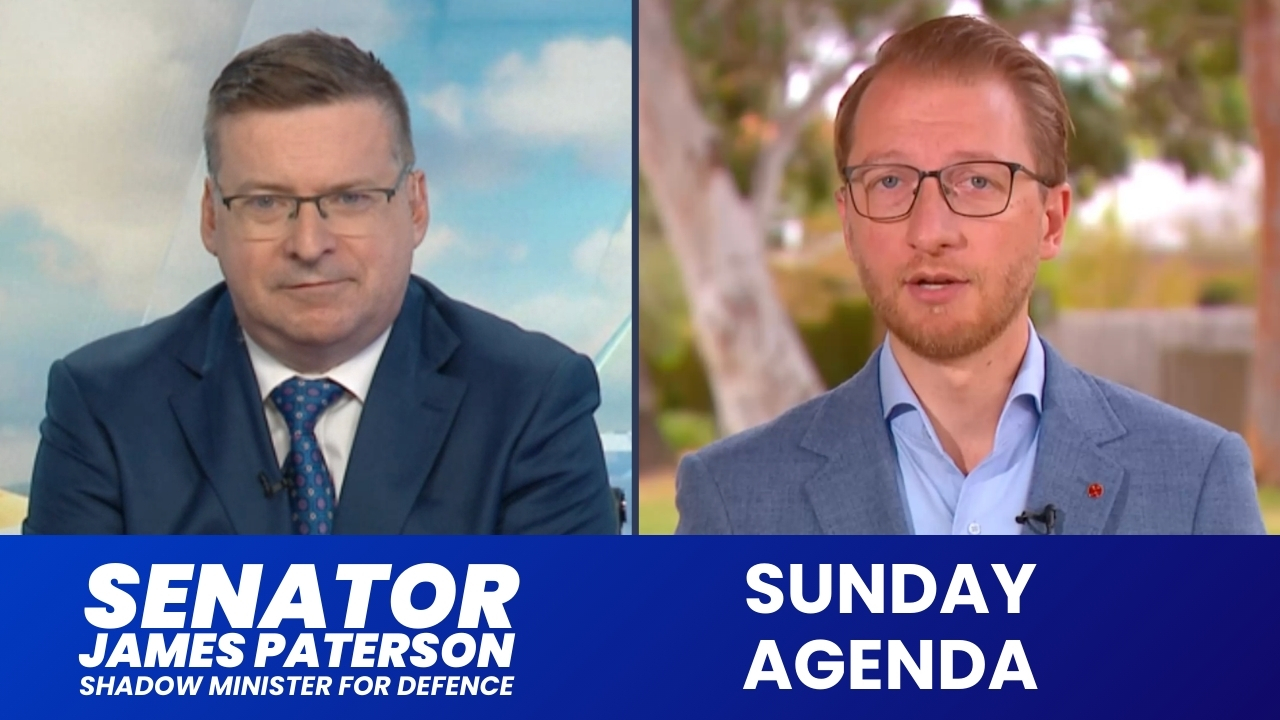
SENATOR JAMES PATERSON
SHADOW MINISTER FOR DEFENCE
SENATOR FOR VICTORIA
TRANSCRIPT
INTERVIEW
SKY NEWS SUNDAY AGENDA
Sunday, 22 February 2026
Topics: Appointment as Shadow Minister for Defence, new shadow cabinet, Labor should stop ISIS brides returning to Australia, South Australian election, defence spending must increase
E&OE…………………………………………………………………………………………
ANDREW CLENNELL: Joining me live now is the new Shadow Defence Minister, James Paterson. Thanks for your time, James Paterson, I can hear some background noise behind you there at the park, but let's start. Let's start with the 15 per cent temporary tariff. Donald Trump has announced overnight after the Supreme Court knocked back his 10 per cent tariffs. What do you make of it?
SENATOR JAMES PATERSON: Well, I think it's regrettable and unfortunate as it relates to the Australia-US trading relationship. It's contrary to our free trade agreement and the spirit of our friendship between our two nations. I would hope that the President would consider an exemption for Australia from that tariff, and I hope that the Albanese Government, with their new Ambassador, Greg Moriarty, shortly to start in Washington D.C., are able to secure that exemption for Australian.
CLENNELL: So you've been announced as Shadow Defence Minister this week. Is that a post you sought? Why didn't you stay in Finance, a position where you could have been part of the all-important economic team for the Opposition?
PATERSON: Well, we're going to have a very strong economic team under Angus Taylor, including Jane Hume, Tim Wilson, Claire Chandler and many other colleagues. And I'm very happy to be stepping back into the national security space, which is an area I've focused on for much of the last five years. I think some of the biggest, most existential questions facing Australia that will determine whether our children and grandchildren inherit a sovereign liberal democracy from us are going to be decided in defence and national security portfolios. The truth is that four years into the Albanese government, they've cut more capability than they've invested in and we're still only spending 2% of GDP ...
CLENNELL: I'll get to that.
PATERSON: ... on defence when our best-informed experts are telling us we need to be spending much more than that ...
CLENNELL: I'll get to that. James Paterson, James, James Paterson. I just wanted to ask you though quickly again, did you seek the role or did Angus just say can you do this?
PATERSON: Well, it's a matter for the Leader who serves in any portfolio, other than the Deputy Leader who has their choice of portfolio. I was delighted to be asked to serve in the Defence portfolio.
CLENNELL: Ok, Claire Chandler in Finance then, she's 35, she's said to have been someone that you've mentored in the past, what can you tell us about her?
PATERSON: I am a strong supporter of Claire Chandler. I think she's a great talent for our party. She worked for an accounting firm for about five years before she entered the Parliament, so she's incredibly numerate. But she's also someone who's shown a lot of courage and a lot foresight, frankly. During the pandemic period when we were in government, when there was a lot government spending, Claire stood up in the party room in an act of courage and said, I think we're spending too much and I'm concerned about the intergenerational debt burden. And of course, this government over the last four years has made that problem even worse. We are now on track to cross for the first time the threshold of one trillion dollars of gross federal government debt and Claire, speaking on behalf of her generation and younger Australians, will be loudly putting a spotlight on the Albanese government's fiscal failures which have led to that.
CLENNELL: There's been some chatter about the whole deputy set up. Jane Hume is the Deputy Leader of the Liberal Party. Andrew Hastie is the Deputy Leader downstairs in the House of Representatives. So when Angus Taylor's away, he would take the main seat. And Jane isn't even the Senate Leader. Michaelia Cash is. So how does this all work?
PATERSON: Look, this is not unprecedented. In 1989, when Fred Chaney was elected by the party room to be the Deputy Leader from the Senate, a Lower House member, Wal Fife, then the Member for Hume, later the Member for Farrer, funnily enough, was appointed as Deputy Leader in the House of Representatives for chamber purposes. It is important in terms of having precedence of the call, being able to stand up at the Despatch Box and get the call from the Speaker of the House to have someone who serves in that role. And I think Andrew, along with Dan Tehan, who will be our Manager of Opposition Business, will be a formidable team in the House of Representatives, taking it up to Labor, who have a very significant majority, and not allowing them to abuse that.
CLENNELL: We haven't spoken on air for some time, including this meeting, since this meeting you had with Andrew Hastie and Angus Taylor in Melbourne, where you basically outlined to Hastie that Angus Taylor had the numbers and not him. Andrew Hastie has been a friend of yours. What was the reason for your decision to choose Angus Taylor over Andrew Hastie and what happened in that conversation?
PATERSON: Andrew, you won't be surprised that I'm not going to go into private conversations with some of my closest colleagues and friends. I will say, though, given that there's been such a lot of public reporting about it, that many of the things that were said to happen in that meeting did not, in fact, happen in that meeting. For example, I never called anybody in that meeting to ask them about who they supported. It was a good and respectful discussion, but it was just one of the inputs into the decision that Andrew Hastie subsequently made not to stand for leader, and I respect and support his decision.
CLENNELL: Why did you choose Taylor over Hastie though? Was it just an experience question?
PATERSON: Well, I don't think it's really helpful to me or my friendships or the Liberal Party to publicly canvass that, except to say that I have a very high regard for both Angus and Andrew. They are two of my very closest friends in the Parliament. I'm delighted to see them in the positions they are now. I think Angus is going to give us a real fight against the Labor Party in this very difficult period for the Liberal Party. And I'm particularly pleased to see Andrew back on the frontbench, particularly in a portfolio like industry and sovereign capability, which has been smashed onto this government's watch over the last four years, particularly if they've pursued Net Zero with such ideological vigour, it's done enormous damage to our manufacturing industry in particular. And who better than Andrew Hastie to travel around the country and make that point.
CLENNELL: Do you feel like a kingmaker?
PATERSON: That's not a title I've ever sought for myself. Frankly, I think it's been overblown in some of the media reporting. My focus is on the new responsibilities I have as the Shadow Minister for Defence to make sure that our country can defend ourselves.
CLENNELL: We're getting poll after poll here where people are going to One Nation. What makes you so confident that Angus Taylor can arrest this slide?
PATERSON: Well, it's not something that's going to be fixed very quickly. It is not going to be something that is going to fixed overnight and the first and most important thing we have to do is acknowledge that many of our former supporters who are right now parking their votes under One Nation when they are asked in a poll have good reason to be dissatisfied and frustrated with the Liberal Party. They have been saying to us that they don't understand what we stand for, that it's not clear what our purpose is. That we appear divided. And we have to demonstrate that in fact we are very clear about what we stand for. We're very clear about who we're fighting for. We're very clear about what our priorities are and that we present a united and cohesive front, both within the Liberal Party and within the Coalition with the National Party, if we're going to earn back that trust and support, which will take time.
CLENNELL: What are your fears out of the South Australian election in terms of what could happen to the Liberal Party there?
PATERSON: Well, obviously the polling coming out of South Australia is very dire and it's understandable on some levels, given the circumstances, given the issues with previous opposition leaders at the state level in South Australia. Given that Premier Malinauskas is one of the most popular state premiers in our country, if not the most popular state leader in our country. But I've got to pay immense credit and respect to Ashton Hurn for the way in which she has stood up in the most difficult circumstances. That is not something that any person in their sane mind would seek, but she has stood up and taken responsibility and I think she's brought real energy and drive to the South Australian Liberal Party and I wish them all the best.
CLENNELL: You're saying no one in their sane mind would want to be South Australian Liberal Leader?
PATERSON: Yeah, I mean look at the circumstances, look at the polls, it was a very discouraging time to step up and it's a great credit to Ashton Hurn for the fact that she's been willing to do so and that she has brought such drive and energy to the leadership of the South Australian Liberal Party over the last few weeks.
CLENNELL: Do you think they could get wiped out there?
PATERSON: Well, I certainly hope not, but the polls are very discouraging. I think South Australians have to think very carefully about what they want from their Parliament after the next state election. Do they want a Premier and a government that is completely unchallenged, that has no checks on their power? Do they want minor parties having the largest voice in the future of South Australia? Or do they want a strong and stable opposition that can take it up to the South Australian government that can hold them to account for their failures, particularly when it comes to things like hospitals and ambulance ramping, which they promised that they would fix?
CLENNELL: Are we going to see some of your immigration policy this week? I've been told it might come out in pieces as opposed to one policy. And it seems to me this is one of the things that people want to see if they want to shift their vote from One Nation.
PATERSON: I think Angus Taylor has sent some very important signals about where he stands on immigration. He has said that under Labor, numbers are too high and standards are too low and we intend to fix both of those things. Yes, we will have more to say about aspects of this in the coming weeks, but of course a more comprehensive policy we are working on right now and will be released in due course. And it will demonstrate what our priorities are, which is we're going to shut the door to anyone who hates our country and our way of life. We do not want to be bringing people into our country who frankly don't support our values and want to change this country rather than become part of the Australian dream.
CLENNELL: So we might see some of the policy this week?
PATERSON: I'm not going to canvas specific dates and specific deadlines. Only to say that I think the direction and the principles have been very clear from Angus from his first press conference about 10 days ago, and that we will have more to say in the coming weeks.
CLENNELL: You heard the PM in his interview there. He says you're all lying and there are proper checks. There are serious checks on people coming to this country. What's your reaction to that?
PATERSON: Well, it was just a classic word salad from the Prime Minister who obfuscates and fails to answer direct questions when put to him. For example, your question about whether or not passports can be denied to Australian citizens who are applying for them. It's very clear under the Passports Act 2005, Section 14. Very clear that the government can refuse a passport to an Australian citizen if they receive advice from a competent authority like ASIO or the AFP that that person is a threat to security and that denying their passport would deal with that threat to security. So this is not what the Albanese Government has been saying for months in relation to this cohort or the previous cohort. They've said by law they’re required ...
CLENNELL: Yeah but my question then was what if they said by looking at a report. Hang on. But my question was also does this mean you haven't had that advice? You can see that could be the case?
PATERSON: Well, I think it's very unlikely to be the case because the government has announced that they're pursuing a temporary exclusion order for at least one of this cohort. Now, to apply for a temporary-exclusion order, to apply one, also relies on advice from a competent authority like ASIO or the AFP. So if they have advice to apply for a TEO, then they should also have the same advice to deny a passport. But frankly if they think the law is not adequate, if they think there is not enough room for them to deny passports, well then, we have already said we will work with them to strengthen the law. Jonno Duniam, our Home Affairs spokesman, has said we will work in a bipartisan way to make sure the government has all the powers it needs to block these people. And it will be a test of the government. Are they going to take up that offer? Are they going to take action to protect Australians? Or do they secretly want to have these ISIS brides - so-called - ISIS supporters brought back into our country?
CLENNELL: He says they might face the full force of the law, they intimated they might be charged when they come here. What's your reaction to that?
PATERSON: Well, forgive me if I'm not filled with confidence by that answer that they “might” face the full force of the law. These are people who left our country. A prosperous, peaceful, liberal democracy to go and join ISIS, the Islamist caliphate that viciously persecuted ethnic minorities and religious minorities, including with rape and torture and murder, who went to a declared area in defiance of Australian law. Every one of them should face charges if they ever find their way back home, but frankly, the priority should be keeping them offshore where they can do no harm to Australia.
CLENNELL: What about the PM's argument you repatriated 40 of these people here when in office, including fighters?
PATERSON: One of the reasons why the former government introduced the temporary exclusion order regime and used it on eight different occasions was to prevent people from returning to this country. Now this government has only ever applied for one temporary exclusion order. So I think the record of the former government is clear ...
CLENNELL: Did the Morrison government screw that up though? Do you agree with the decision of the Morrison government to do that?
PATERSON: Well, the Morrison government allowed orphaned minors to return with no parents so that they could be properly protected in Australia. Now, this government is not even contemplating ...
CLENNELL: And fighters.
PATERSON: ... separating the parents who voluntarily went...
CLENNELL: But but he says and fighters.
PATERSON: I don't think actually any fighters ...
CLENNELL: You don't accept that?
PATERSON: I don't think it's true that any fighters, actually. Just let me answer. I don't think it's true that any fighters returned under the Morrison government. But the reason why those laws were introduced was to prevent any further coming in the future. I think that was the right decision, but those powers need to be used, and this government seems very reluctant to use them.
CLENNELL: The PM wouldn't comment whether ASIO boss Mike Burgess opposed a Bondi Royal Commission. Do you think he did oppose the Royal Commission?
PATERSON: No, I don't think he did, not for a second. I think the Prime Minister lied to Australians when he told them that “all the current experts” were advising against a royal commission. It emerged in Senate estimates a couple of weeks ago that the Attorney General's Department, who are the experts on royal commissions, were never even asked for their advice about whether or not the government should call a royal commission. The truth is the Prime Minster didn't want to call a Royal Commission, and he had to be embarrassed into calling a royal commission by some of Australia's most eminent sports stars and community leaders and he wanted someone else to blame. I would be absolutely astonished if any of our security agencies recommended against a royal commission.
CLENNELL: Do you think ASIO made mistakes and the Royal Commission will find that?
PATERSON: It's impossible to answer with any confidence without having seen the evidence that's going to come before the Royal Commission. I know that ASIO, and along with all of our intelligence agencies, are incredibly diligent, patriotic and focused, but they are also not perfect. And it is possible that mistakes were made, but let's wait and see what the Royal Commission finds in regard to that.
CLENNELL: You've decided to take on defence and at the last election this was the central policy really of Peter Dutton, we saw how that went. He said we should forgo tax cuts because the money was needed for defence spending. So what's your approach going to be this time?
PATERSON: Well we will outline how we will pay for any commitments we make in the usual time, in the usual way, closer to the next election. But it is very clear that the best informed experts like Sir Angus Houston and Professor Peter Dean, who completed the Defence Strategic Review for the Albanese Government, that what we are spending right now on defence is not adequate. 2% does not meet the strategic environment that we face. They have both said that spending closer to 3% of GDP is necessary, if we want to have AUKUS, which we obviously strongly support, and also a capable ADF in other domains. Because right now, AUKUS spending on future capability is cannibalising current capability, particularly in the Australian Army.
CLENNELL: How much would it cost to take it to 3% over 10 years, do you know?
PATERSON: We're going to do the proper modelling of what a ramp up in defence spending would look like and what the costs would be and how we would pay for that in an orderly way and we're going to go through Shadow Cabinet and Shadow ERC processes ...
CLENNELL: Do you know what it would roughly cost?
PATERSON: ... We will publicly announce that for scrutiny at the appropriate time ...
CLENNELL: Do you know what it will roughly cost?
PATERSON: ... It's a very significant cost. It's about $57 billion a year that we spend on defence at 2% of GDP. So if you're going to go to 3% of GDP, that's a 50% increase and about another $20 billion a year. I will come back on your programme and I will go through the detailed costs once we've been through an orderly Shadow Cabinet and Shadow ERC process. I'm happy to talk about what we will spending it on, how we will pay for it ...
CLENNELL: Why are you so certain? Why are you so certain at this juncture that you can find enough budget savings to pay for that when you're also probably going to have an agenda about lower taxes? I mean you seem quite certain.
PATERSON: Because we have to, Andrew. Because it would be irresponsible not to find the money to pay for defence. Frankly, I hope it's not necessary for us to find it. I hope the Albanese government, frankly, finds it over the next two years. I hope that Richard Marles, next time he goes to ERC and asks for more money, I hope he gets a yes from Jim Chalmers and Katie Gallagher rather than a no, as he's previously got. Because he knows, and everyone in the Defence Department and everyone in our ADF knows, we are not spending enough for the moment that we face. And that's why this government has cut things like self-propelled howitzers, infantry fighting vehicles, military communications satellites. They've even cut reservist days down from 200 a year to 150 a year. They are gutting the capability of our ADF right at the time when we need to be ramping up our investment in the ADF.
CLENNELL: Do you think China wants to invade us or might want to invade us at some point?
PATERSON: I don't think that's a realistic risk in the short to medium term, but of course the thing about military capability is you have to watch what people's capabilities are rather than just what their intent is. Because capabilities take a long time to build but intent can change in an instant. We learnt that with Russia's invasion of Ukraine. One day Vladimir Putin had no intention of invading Ukraine and the next day he did and we need to take the threat that any power in our region could use the military might that it is amassing to threaten our interests.
CLENNELL: James Paterson, thanks so much for your time.
PATERSON: Thanks Andrew.
ENDS