

Media
|
News
February 20, 2026
Friday 20 February 2026
Ben Packham
The Australian
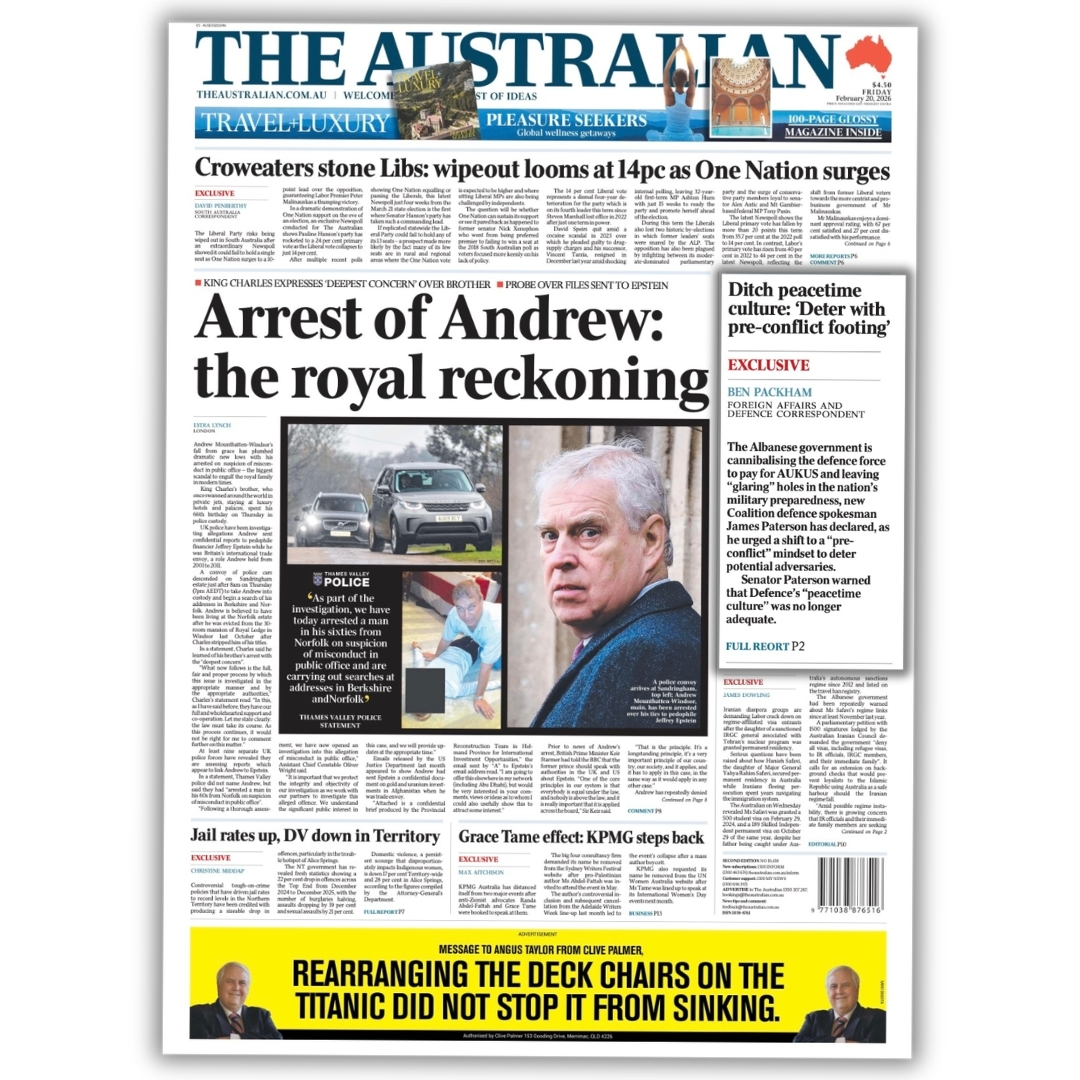
The Albanese government is cannibalising the defence force to pay for AUKUS and leaving “glaring” holes in the nation’s military preparedness, new Coalition defence spokesman James Paterson has declared, as he urged a shift to a “pre-conflict” mindset to deter potential adversaries.
In an interview with The Australian, Senator Paterson warned that Defence’s “peacetime culture” was no longer adequate, calling for urgent investments in new drones, missiles and missile defences. He said Labor had failed to learn from the Ukraine conflict that “you can’t just flick a switch” to deliver military capabilities, instead procuring vital hardware at “glacial pace” despite unprecedented strategic threats.
“It takes years and years and years to rebuild that industrial capability,” Senator Paterson said in his first in-depth interview since taking the new role.
“So the idea that you can just ramp up defence in five minutes before a crisis … is dangerously reckless. We need to have a pre-conflict mindset. Our strategic objective is to deter conflict. And the best way we can deter conflict is to demonstrate we have serious capability and strong intent and resolve.”
As China invests billions in warships, submarines, long-range missiles and lethal autonomous systems, Senator Paterson warned: “It’s very rare that great powers amass enormous military capabilities and then never use them.”
The Coalition has vowed to lift defence spending to 3 per cent of GDP from its current 2 per cent – a commitment that stands under new Opposition Leader Angus Taylor, though the exact timing of the spending is subject to review.
Senator Paterson said the Coalition was resolute in supporting the AUKUS nuclear submarine plan, initiated by the Morrison government. But days after the government pledged $3.9bn towards $30bn in AUKUS infrastructure in Adelaide, he said the government was hollowing out Defence’s present-day capabilities to pay for a deterrent that would not be delivered for decades.
“The problem with all that investment is not that it’s not worthy or important; it is and we strongly support it,” he said.
“It’s that it doesn’t deliver any immediate capability for the ADF. It is all in the medium and long term, but it’s costing real money upfront, and because they’ve failed to lift the defence spending really at all as a percentage of GDP … the only way to pay for this upfront infrastructure investment is to cannibalise existing capabilities.”
Senator Paterson said he was “gravely concerned” Australia had fallen behind in procuring uncrewed weapons systems, which were transforming war.
“One of the ways which a middle power can augment its military capability is with autonomous and uncrewed systems,” he said.
“And we are miles behind our peer competitors in this area and appear to have failed to have taken advantage of the innovation happening in the Ukraine conflict, where they’ve demonstrated incredible force multipliers by massively scaling up drone production and deployment while we’re still admiring the problem.”
He said the Coalition backed the government’s two major uncrewed vehicle programs: the Anduril Ghost Shark and Boeing Ghost Bat, both initiated by the Coalition. But he said he was concerned neither project had delivered new capabilities to the ADF after four years of Labor government.
“I mean, it’s just glacial, the pace, and the strategic environment demands much more than that,” Senator Peterson said.
He said there was a “glaring hole” in the ADF’s rollout of air and missile defence capabilities, which were downgraded as a priority in the government’s last defence investment program.
“We know the investment that the People’s Republic of China is making in long-range strike … and we need to be able to demonstrate to them that it would be a waste of their time and energy to try and threaten Australia that way,” Senator Paterson said.
“And the only way we can do that is having integrated air missile defences, particularly for our cities and our northern bases.”
Senator Paterson said he was similarly concerned about inadequate missile stocks for the ADF, arguing munitions purchases “can and should be fast tracked”. He said he was alarmed by revelations in The Australian that life-extending upgrades to the Collins-class submarines could be scaled back. He said the upgrades, due to start this year, were essential to maintaining the nation’s submarine capability before the arrival of nuclear-powered boats.
“It’s just an essential capability, and we need our adversaries to know that we’ve got that capability – so I am gravely concerned about that,” he said.
His appointment to the portfolio follows a merry-go-round of frontbenchers through the defence portfolio – in government and opposition – which Labor has used to attack the Coalition’s national security credentials.
The Victorian senator, one of the opposition’s strongest performers, said holding the defence portfolio was a “dream job”, and he hoped to become a long-serving defence minister.
He said Defence Minister Richard Marles and Defence Industry Minister Pat Conroy delivered “laudable rhetoric and speeches” on the deteriorating strategic environment, “but I just don’t see the actions to match it”.
“I think there’s a big degree of obfuscation and hiding behind complicated numbers in order to cover up the fact that they haven’t increased defence spending, and it’s harming our capability,” he said. “We have peacetime defence spending levels and we have a peacetime procurement culture and approach in defence.”
Labor’s planned overhaul of Defence procurement was well and good, he said, but after four years of government, it was yet to make “any material difference to the way in which we procure defence capability in this country”.
The accusation follows an Auditor-General’s report that found more than $80bn in weapons and equipment procurements were running a cumulative 33 years late, and that the government was obscuring the true state of the delays by refusing to publish key project details.
Senator Paterson vowed to use a powerful new defence committee, which would be able to receive confidential information from the bureaucracy, “to get to the bottom of these things”.
“Frankly, defence needs scrutiny,” he said. “I have enormous respect for all of our men and women in uniform, and enormous respect for our defence bureaucrats, who are patriotic and work hard, but it’s an area of government which spends a lot of money and has a poor track record on delivery of major projects on budget and on time, and scrutiny can only help improve that.”