

Media
|
News
February 20, 2026
Friday 20 February 2026
Dana Daniel
The Canberra Times
Defence has conceded that it will struggle to resource a new mega-agency taking control of procurement as the Albanese government vows to "strip away" red tape and speed up approvals.
"It is a big hill to climb to lift the level of APS and military skill sets around capability," Defence Reform Taskforce head Nadine William told Senate estimates.
The department is preparing to hand over the functions of its capability, acquisition and sustainment groups, along with naval shipbuilding and sustainment, guided weapons and explosive ordinance, to the new Defence Delivery Agency (DDA) that will begin operating on July 1.
The DDA will be led by a national armaments director who will report directly to Defence Minister Richard Marles and Mr Conroy and become fully independent a year later, under a plan announced in December as the department's "biggest overhaul in 50 years".
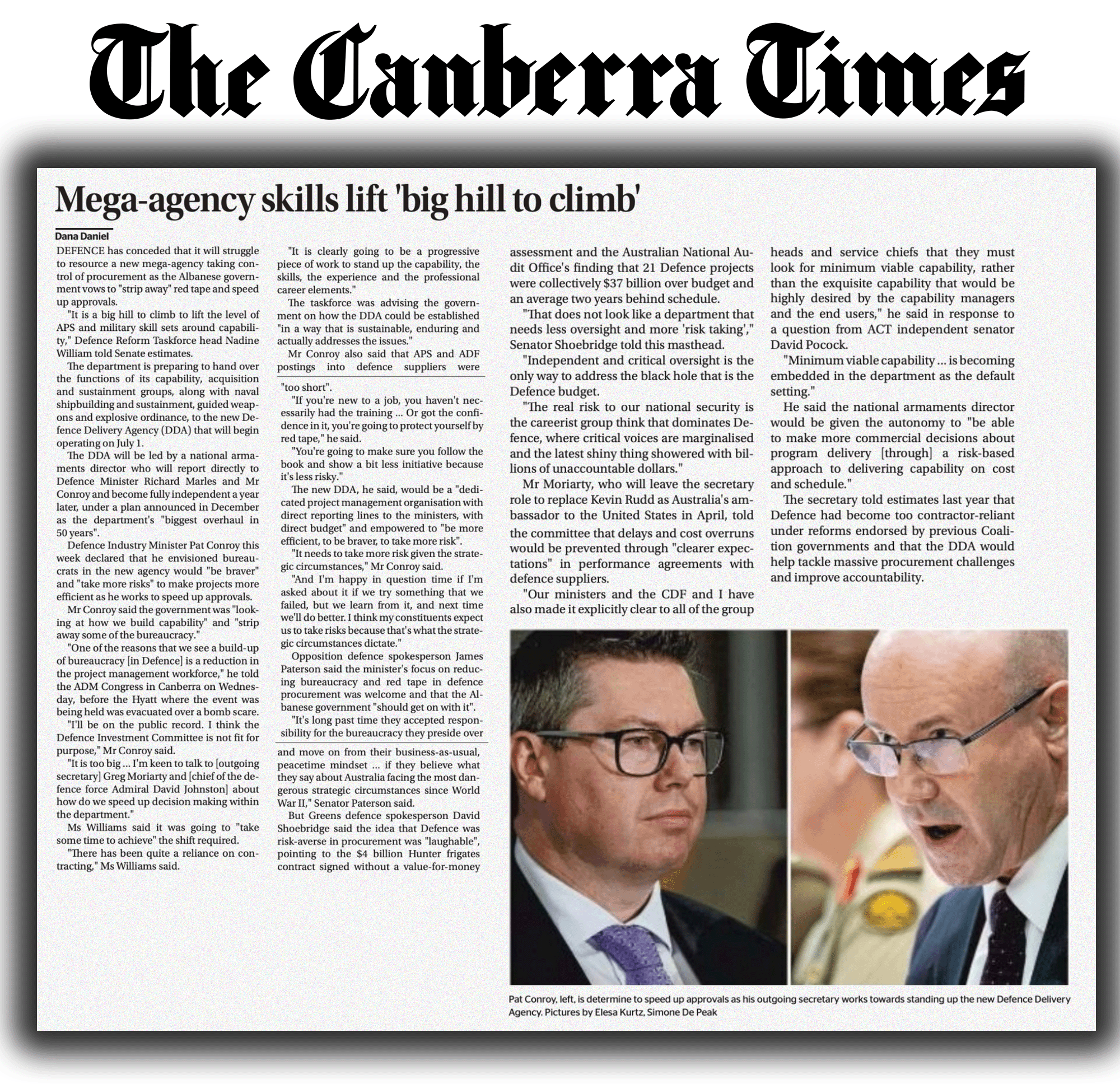
Defence Industry Minister Pat Conroy this week declared that he envisioned bureaucrats in the new agency would "be braver" and "take more risks" to make projects more efficient as he works to speed up approvals.
Mr Conroy said the government was "looking at how we build capability" and "strip away some of the bureaucracy." "One of the reasons that we see a build-up of bureaucracy [in Defence] is a reduction in the project management workforce," he told the ADM Congress in Canberra on Wednesday, before the Hyatt where the event was being held was evacuated over a bomb scare.
"I'll be on the public record. I think the Defence Investment Committee is not fit for purpose," Mr Conroy said. "It is too big ... I'm keen to talk to [outgoing secretary] Greg Moriarty and [chief of the defence force Admiral David Johnston] about how do we speed up decision making within the department." Ms Williams said it was going to "take some time to achieve" the shift required. "There has been quite a reliance on contracting," Ms Williams said.
"It is clearly going to be a progressive piece of work to stand up the capability, the skills, the experience and the professional career elements." The taskforce was advising the government on how the DDA could be established "in a way that is sustainable, enduring and actually addresses the issues."
Mr Conroy also said that APS and ADF postings into defence suppliers were "too short". "If you're new to a job, you haven't necessarily had the training ... Or got the confidence in it, you're going to protect yourself by red tape," he said. "You're going to make sure you follow the book and show a bit less initiative because it's less risky."
The new DDA, he said, would be a "dedicated project management organisation with direct reporting lines to the ministers, with direct budget" and empowered to "be more efficient, to be braver, to take more risk". "It needs to take more risk given the strategic circumstances," Mr Conroy said. "And I'm happy in question time if I'm asked about it if we try something that we failed, but we learn from it, and next time we'll do better. I think my constituents expect us to take risks because that's what the strategic circumstances dictate."
Opposition defence spokesperson James Paterson said the minister's focus on reducing bureaucracy and red tape in defence procurement was welcome and that the Albanese government "should get on with it". "It's long past time they accepted responsibility for the bureaucracy they preside over and move on from their business-as-usual, peacetime mindset ... if they believe what they say about Australia facing the most dangerous strategic circumstances since World War II," Senator Paterson said. But Greens defence spokesperson David Shoebridge said the idea that Defence was risk-averse in procurement was "laughable", pointing to the $4 billion Hunter frigates contract signed without a value-for-money assessment and the Australian National Audit Office's finding that 21 Defence projects were collectively $37 billion over budget and an average two years behind schedule.
"That does not look like a department that needs less oversight and more 'risk taking'," Senator Shoebridge told this masthead. "Independent and critical oversight is the only way to address the black hole that is the Defence budget. "The real risk to our national security is the careerist group think that dominates Defence, where critical voices are marginalised and the latest shiny thing showered with billions of unaccountable dollars."
Mr Moriarty, who will leave the secretary role to replace Kevin Rudd as Australia's ambassador to the United States in April, told the committee that delays and cost overruns would be prevented through "clearer expectations" in performance agreements with defence suppliers.
"Our ministers and the CDF and I have also made it explicitly clear to all of the group heads and service chiefs that they must look for minimum viable capability, rather than the exquisite capability that would be highly desired by the capability managers and the end users," he said in response to a question from ACT independent senator David Pocock.
"Minimum viable capability ... is becoming embedded in the department as the default setting." He said the national armaments director would be given the autonomy to "be able to make more commercial decisions about program delivery [through] a risk-based approach to delivering capability on cost and schedule." The secretary told estimates last year that Defence had become too contractor-reliant under reforms endorsed by previous Coalition governments and that the DDA would help tackle massive procurement challenges and improve accountability.