

Media
|
Transcripts
May 28, 2026
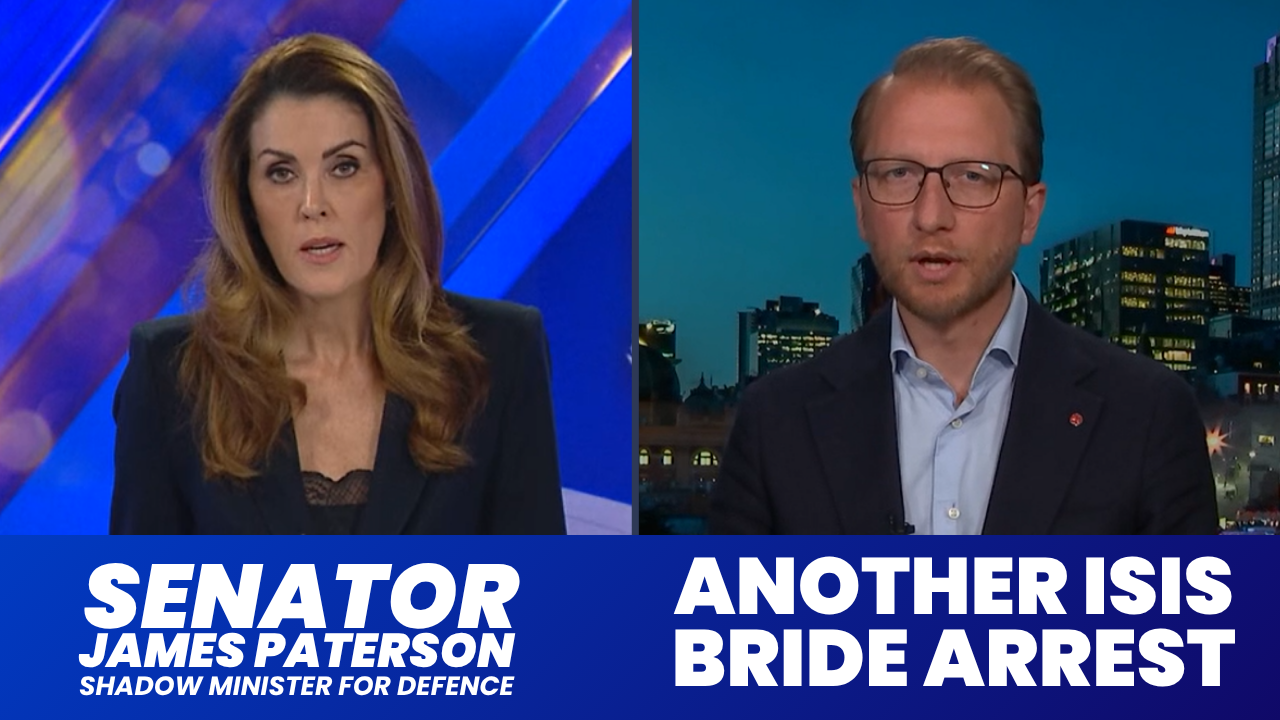
PETA CREDLIN: Another one of the ISIS-linked women with terrorism offenses, Rayann El Houli, 34-year-old from Broadmeadows in Melbourne's north, quietly returned to Australia from Lebanon in September last year. Well, today we learn she's been charged with remaining in a declared conflict zone and being a member of a terrorist organisation. Here to discuss this and more, Shadow Defence Minister James Paterson. Well Senator, it's never been clearer, we have an open door policy, it would seem, to alleged terrorists in this country.
SENATOR JAMES PATERSON: That's right, Peta, and it's certainly welcome that this person has now been charged with these very serious crimes, and it'll be up for court to decide their guilt or innocence. But the very fact that this person has been charged with, as you say, a Declared Area Offence, which means they were in an area prohibited by the Australian government, and you can only be in there if you have a permitted reason - like being an aid worker, for example - and also has been charged of being a member of a listed terrorist organisation, shows that this cohort of people do pose a potential security risk to Australia. And that means that the Australian Government had options open to them to prevent their return to Australia. They could have cancelled or refused their passports under the Passport Act, given that they potentially represented a threat to Australia, and they could have applied for temporary exclusion orders to keep them offshore while these investigations took place so that if they did return, they could've been charged immediately upon their return, not been free to move around the community as this person appears to have been for about eight months.
CREDLIN: Let's get into some detail about what will happen now that these individuals are home in Australia. Listen to this from the New South Wales Premier today:
[CLIP START]
PREMIER CHRIS MINNS: We're asking for funding from the federal government in relation to the settlement of returnees. That's been the arrangement in place between New South Wales and the Commonwealth for different tranches of returnees, and I want a bit of help covering the costs. Now those costs are partly in relation to counter-terrorism investigations. They're also about ensuring that kids in particular get back into school.
[CLIP END]
CREDLIN: OK Senator, there is so little transparency here. When you hear that there from the New South Wales Premier, what do you think it means? Are we talking about, obviously, legal aid for these women as they are appearing in court? Are we talking about housing support for them? Are we talking about tutoring or language classes? I would assume some of these children may not speak English; they will go to school? What about the De-Rad programs? Who's running them? How much are we spending? I mean they are living - most of these people - freely in the community. The woman in Broadmeadows is a good example. Where's the detail and the honesty from our government?
PATERSON: Well, that's exactly right, Peta. The answer to your question is all of the above they would be eligible for. In addition to that, they're also eligible for unemployment benefits if they are unable to work, and it's often the case that they are not able to work. But probably the biggest cost that's imposed on the taxpayer and on the government is if they are a person of concern that requires monitoring by ASIO or the Federal Police. The resources required to go into monitoring these people in the community in terms of dollars is really significant. It is not a cheap thing to monitor someone in the community. And in addition to that, these are resources that are taken away from ASIO or the AFP that could be allocated to other tasks. So it's a very significant burden on the taxpayer and it is another reason why, if it is possible to keep them out of the country, that is your first port of call, because obviously when they're outside of Australia they're not accessing any of those benefits and they're not imposing any of the costs on our security agencies.
CREDLIN: Okay, well what about the Prime Minister and Tony Burke, the Home Affairs Minister, repeatedly saying they're getting no assistance, and we learn today, obviously, they were ushered out of airports and were clearly assisted in that regard. They were put up in hotels, they were guarded by terror police, and then they were picked up by family members or driven to other home addresses after the media interest died down. That seems like assistance to me.
PATERSON: It certainly is, and of course one of the family members of one of these ISIS-linked women publicly thanked the Australian government for their assistance in bringing them home. So, I think when even supporters of these women acknowledge that the Australian government has assisted them to bring home, ordinary Australians can see that's exactly what this government has done. And we know from the leaked minutes from Tony Burke's meeting with the charity that was advocating bringing these people home, that he was saying that there could be other ways of achieving their objectives, that it would be helpful if this was kept out of the media, that there would be no resistance from the Australian government if the charity sought to bring them home, and that was while there was a Home Affairs official in the room observing the meeting. At some point in the meeting, Tony Burke said, "could you please leave the room so I can have a private discussion with the charity?" God only knows what happened in that private discussion. So, I think it's very clear, this government wanted these people home, they opened the door for them to come home, they removed the obstacles for them to come home, and they are responsible for them now they are home.
CREDLIN: James, I know we've got Senate Estimates running on this week, and obviously into next week, and you may well be pursuing it in that place, but how much are we spending? How many millions do we spend on these de-radicalisation programs, and who runs them? Because, I seem to recall in previous eras, money was given to Muslim organisations to run these programs. I think Australians would want to know, perhaps, that they were government run, not given to stakeholder bodies?
PATERSON: The last time I looked at this was a couple of years ago when I was in the Home Affairs portfolio, and the answer is many, many millions of dollars, sometimes given to charities and NGOs, sometimes given to contractors and companies. But I think the key thing is there's a really big debate about whether or not these programs ever work. There are experts in the field who say it is simply not possible to deradicalise someone with a deradicalisation program; if they are genuinely and sincerely committed to their ideology, there is nothing you can do to move them off that ideology. And to be clear, this is the Islamist ideology - extremist ideology - that believes that non-Muslims should be subjugated by Muslims, and that violence is an acceptable way to bring about that ideological, religious objective. So, I think we need to have a deep dive on this and I want the Bondi Royal Commission to take a very close look at this. How many millions of dollars have we spent over the last few decades? And how many people have actually been successfully rehabilitated and cured of that evil ideology?
CREDLIN: I'll leave it there. Thank you, James Paterson.
END