

Media
|
News
April 27, 2026
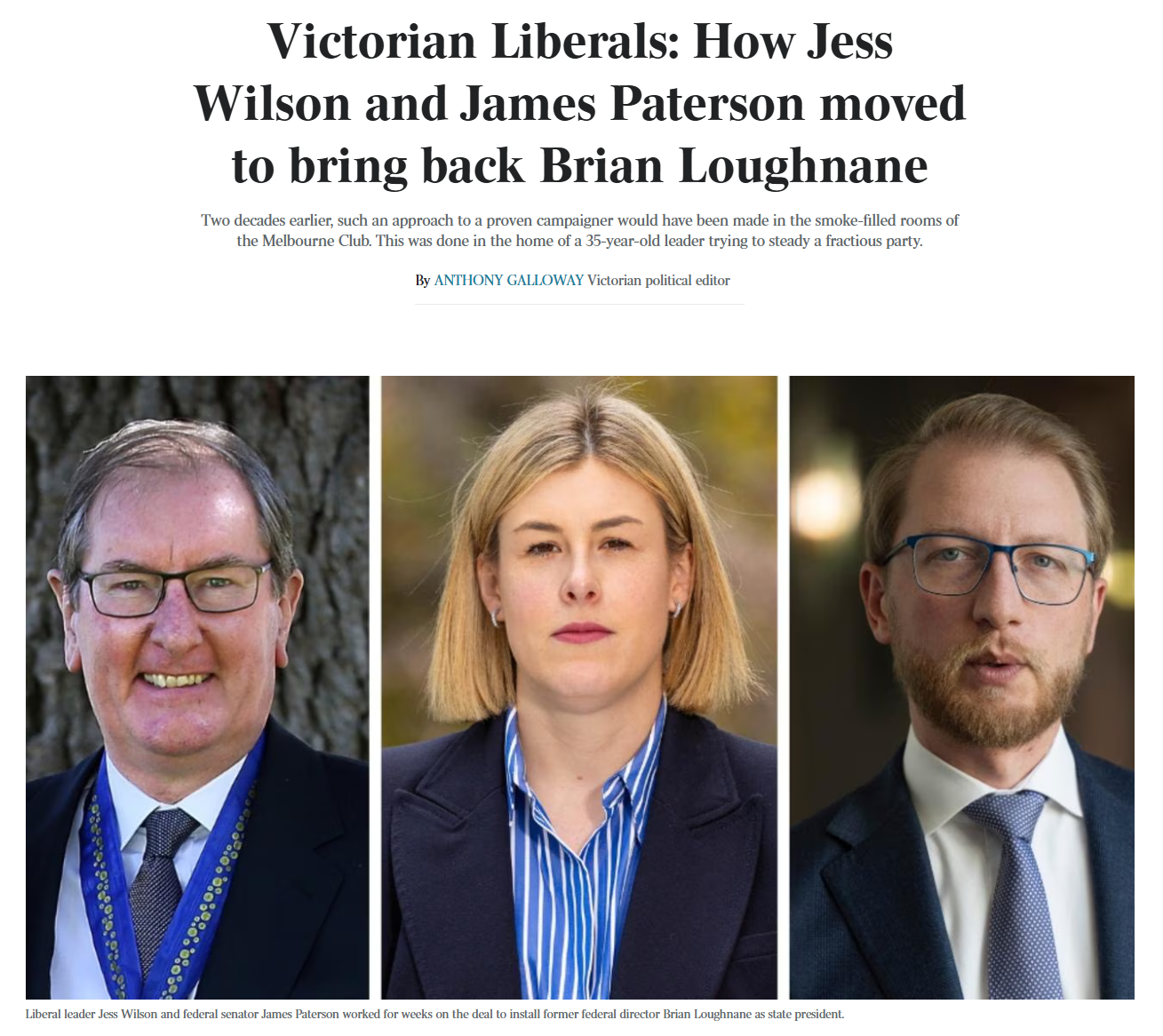
Brian Loughnane sat at Jess Wilson’s kitchen table in Melbourne’s eastern suburbs, listening as the Victorian Liberal leader and her friend, federal senator James Paterson, made their pitch.
It was Saturday morning, April 11, and the conversation carried consequences well beyond the room. Wilson and Paterson wanted Loughnane, the party’s former federal and state director and one of its most experienced campaign strategists, to take over the state presidency of a division long plagued by internal conflict. Two decades earlier, such an approach would have been made in the smoke-filled rooms of the Melbourne Club, but this was conducted in the home of a 35-year-old leader trying to steady a fractious party, as her young son Patrick’s toys lay scattered on the floor.
For Wilson and Paterson, Loughnane was the ideal candidate: a seasoned operator who had overseen the federal party’s landslide victories in 2004 and 2013, and who might impose a measure of discipline and professionalism on a divided state division.
But he needed convincing.
Part of their pitch was that his candidacy was needed to avoid a federal takeover of the division, which Wilson was intent to avoid heading into this year’s election.
But Loughnane needed only to consider the circumstances confronting the incumbent, Philip Davis, to understand the risks of taking on this unpaid role. Davis was being sued by members of his own state executive over a $1.55m loan to former leader John Pesutto, a dispute that had come to symbolise the party’s internal dysfunction. In fact, the Victorian division’s factional warfare stretches back more than a decade, defying successive attempts at reconciliation and leaving no figure yet able to unite its warring camps.
If Loughnane were to step in, it would be on his terms. Any nomination would need to be uncontested, carry support across the party’s factions, and be strictly time-limited. He would guide the party’s organisational wing to the November state election, then leave shortly after.
Along with the two senior Victorians, federal leader Angus Taylor also urged Loughnane to take on the position.
Wilson and Paterson then went about the delicate task of winning over the opposing factions in the party, in the hope that a reluctant recruit might yet be convinced to take on one of the most thankless roles in Victorian politics.
On the day Wilson claimed party leadership from Brad Battin in November, she reached for a familiar political metaphor.
“Today is a line in the sand,” she told Sky News host Peta Credlin, pitching her unopposed elevation as both a reset and a chance to steady a party that had just turned to its third leader in a year. Credlin, Tony Abbott’s former chief-of-staff, also happens to be married to Loughnane.
Wilson spoke of unity, of a “broad church” leadership team, and of a party at its best when its competing factions pull in the same direction. The moderate Wilson had taken the leadership with the support of conservative backers including upper house MP Bev McArthur, who became upper house leader, and Paterson, a key powerbroker in the national Right.
The problem for Wilson was that while she had successfully brought the parliamentary team together, the organisational wing was still in an internal war.
The rebel group of conservative members, led by state executive member Colleen Harkin, was suing the party and its leadership over the loan to Pesutto to cover his defamation of Liberal MP Moira Deeming over her appearance at a Let Women Speak rally in March 2023.
Davis ally and state director Stuart Smith had also recently resigned after leaked messages published in The Australian showed him mocking the party’s women’s council and 76-year-old McArthur.
While Wilson, 36, and Davis, 73, are both associated with the moderate faction, they are not aligned. When she took the leadership, there was no immediate move against Davis, who had only narrowly fended off a challenge from Greg Mirabella to retain the presidency two months earlier.
But in the months that followed, the relationship steadily deteriorated.
The balance shifted decisively on March 29, when Deeming was dumped from the upper house ticket in favour of Dinesh Gourisetty. Within hours, it emerged Gourisetty had provided a character reference for a convicted sex offender, rendering him ineligible. Davis, as chair of the applicant review committee that vetted candidates, came under renewed pressure. His internal critics, including Harkin and fellow state executive member Marcus Li, moved quickly to call for his resignation.
Even then, Wilson’s camp held back. It lacked a viable alternative, and state conference was looming on May 23.
The turning point came a week later.
Former Liberal state president Philip Davis.
In an interview with The Age on Sunday, April 6, Davis accused what he implied to be a cabal of conspirators – internal critics, Sky News, Credlin and News Corp newspapers – of seeking to remake the party into One Nation-lite.
For Wilson and her allies, the intervention was the moment they decided Davis needed to go. It reinforced a growing view within her camp that Davis could not bridge the divide in the party, and was only further entrenching it.
The difficulty was finding a replacement.
Several senior Liberal figures, including former federal ministers Mitch Fifield and Greg Hunt, ex-state cabinet minister Mark Birrell and former party president Ian Carson, had already been approached and declined.
The night after Davis’s comments were published, Credlin sharpened the pressure on Davis publicly, questioning whether he was up to the job of uniting the party.
“If Phil Davis can’t do that, then he should just resign and let someone who knows how to win … do the job that he, self-evidently, is not up to,” she said on her Sky News program.
Loughnane was always Wilson and Paterson’s dream candidate given his stature in the party and campaign expertise.
The pitch was very much modelled on Wilson’s own ascent to the leadership, in which she was backed by both conservatives and moderates and avoided a “winner’s takes all approach”. But the moderate wing, in particular, needed convincing.
On the night of Friday, April 17, Paterson and Loughnane met in Melbourne’s CBD with three of Davis’s vice-presidents – Holly Byrne, Cathrine Burnett-Wake and Geoff Gledhill – and treasurer Karen Sobels. The meeting with the key moderates, held before a gathering of the party’s state assembly, proved pivotal.
While those who have known Loughnane and Credlin for decades say it is unfair and simplistic to view them as a single entity, some still wanted reassurance that Credlin wasn’t gaining the presidency “by stealth”. Quiet assurances from those who had worked with Loughnane helped settle those doubts.
Moderates figures who worked under Loughnane during federal campaigns tell The Australian they needed little persuasion, viewing him as a disciplined operator above factional politics.
While not all welcomed the loss of factional control, few were prepared to stand in the way of Wilson’s preferred candidate.
Loughnane’s name was also floated with Liberal luminaries including Jeff Kennett, Peter Costello, Michael Kroger and Ted Baillieu, who were all supportive.
By April 23, after The Australian revealed Wilson’s approach, Wilson and Paterson began calling MPs across the party. There was near uniform support for the move – unheard of in the Victorian division.
But less than 48 hours before nominations closed, the outcome remained uncertain.
Loughnane lodged his nomination on Friday. But there was one final complication.
Four other candidates – Davis, Gledhill, Nigel Kibble and Ian Quick – also nominated. Kibble, Quick and Gledhill quickly withdrew. But as Wilson marked her 36th birthday on Saturday, it was still unclear whether the deal would hold.
On Sunday, Davis withdrew.
People who had spent years fighting each other agreed to back Loughnane, a decision senior figures hope demonstrates a determination to move on from the petty internal fights of the past for the sake of winning the state election.
For Wilson, it was the final piece to fall into place as she prepares for the real contest against Jacinta Allan in November.