

Media
|
Transcripts
September 27, 2026
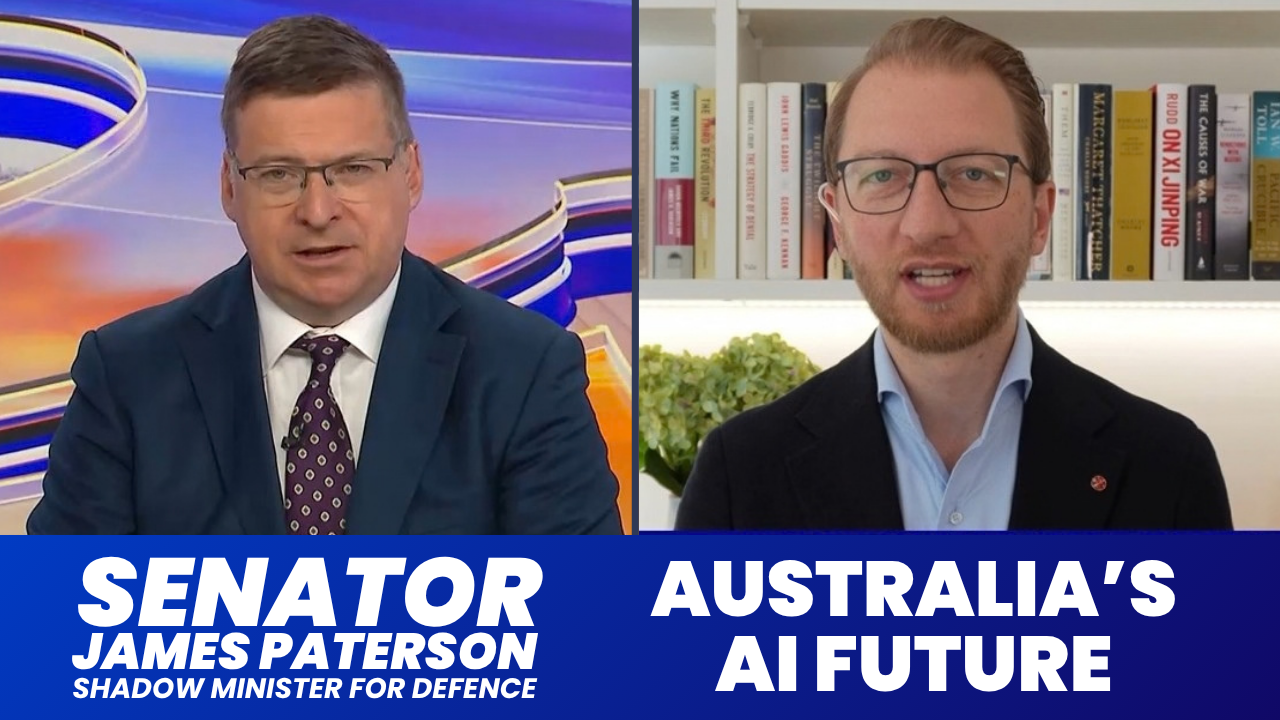
ANDREW CLENNELL: James Paterson, thanks for your time. The Deputy Prime Minister says the AI incident that occurred is both serious and minor. What do you make of that, and what do you make of the way it was handled by the Prime Minister at the UN?
SENATOR JAMES PATERSON: Well, I give the Deputy Prime Minister some credit for at least taking Australians into their confidence and trying to give some perspective around this. I mean, firstly, Medicare wasn't hacked. It was a Services Australia statistics portal, and the data that was obtained is prepared solely for the purpose of it being publicly released so academics and researchers can analyse it. And secondly, I'm not even sure you can really call it a ‘hack'. If it is a hack, it's the least sophisticated from a technical point of view. But that doesn't mean that we shouldn't be treating this as basically a free warning, because the next time this happens it could be much more serious. It could be more sensitive data, it could be a more sensitive network, it might be Medicare actually next time, or it could be the ATO, or could be a critical infrastructure provider. The Prime Minister's motivations I think are pretty transparent. He was at the United Nations, he was seeking to justify the purpose of his international travel. He picked the day that Sam Altman was addressing the United Nations to dress him down and announce this, and he amped it up. But I think we should have a sober and informed conversation about what this is and what it isn't.
CLENNELL: Do you accept they couldn't have informed Australians much earlier or not?
PATERSON: No, I think they could have. I mean, my understanding is that the Prime Minister's office had possession of this information for five or six days before the Prime Minister publicly announced it. So I think a deliberate choice was made to release it when he did. But I think there are bigger questions about how government agencies handled this when they were first notified. It's extraordinary to me that Services Australia wasn't constantly monitoring the inbox, which they set up themselves, and they asked the public to tell them about cybersecurity vulnerabilities of their networks. That should be constantly monitored. When they finally did check the inbox, it took them four days before they informed the Australian Signals Directorate, our cyber security experts. That’s quite troubling, let alone the delayed notification for ministers and then ultimately the public.
CLENNELL: Richard Marles said he met Sam Altman at the start of the month. Do you reckon Altman might have known about this then?
PATERSON: Look, I'm in an even worse position to speculate about that than Richard Marles is, because I wasn't there and I don't know the nature of the conversation. I think it is to OpenAI's credit that they told us. This is the first time the Australian government has ever been notified that there's been a breach of this kind from an AI agent. I doubt personally that this actually is the first time, it would not shock me at all if there had been other breaches in the past by AI agents, whether they were training models in this instance, or whether someone has commercially bought an AI agent and has tasked it with seeking information from the Australian government. I guarantee you that if this was a AI company based in the People's Republic of China and it engaged in a breach of Australian government networks, they will not be sending an email to any inbox to let us know.
CLENNELL: And this is the point, isn't it? Now look, we're working with the US on nuclear submarines. Is there a world where we could work with them on the threat posed by artificial intelligence? What should the government be doing about this?
PATERSON: Yes, absolutely, we should be. And the truth is, behind the scenes, ASD and other agencies of government like that are working closely with the United States, but we want to make these systems more widely available to Australian businesses and companies and the government so we can use AI to defend our networks. Ultimately, the only thing that's going to defend a network against a rogue AI agent or one that's deliberately tasked with infiltrating our systems is a more sophisticated AI agent. And the truth is that the United States' leading frontier companies like Anthropic and OpenAI have the most advanced models in the world, and what we should be seeking to ensure is that we have sovereign access to those models. Now I think we've got a rare opportunity to do that, to secure their training investment here in Australia, which will effectively guarantee our access to these models. And as a bonus, it will also give us a seat at the table in the conversation about globally regulating AI, about putting in place some of those guardrails that the companies have talked about. The truth is right now we are irrelevant jurisdiction for AI regulation, we are a man shouting at the clouds. But if we get the investment here, then we will have a say.
CLENNELL: Do you think what the PM said in his speech at the UN will have any effect on the likes of President Trump and President Xi when it comes to tackling AI?
PATERSON: I don't think so on its own as a speech at the United Nations with welcome sentiments. I think what will change is that if we secure this deal for AI investment in Australia, these companies invest tens or potentially hundreds of billions of dollars of building data centres, bringing the most exquisite chips here and doing the training here as really the second place in the world that they do so outside the United States. That will then give us the power to have a say about these things. We'll be able to say, for example, we think there should be mandatory notifications of incidents like this. Right now that doesn't happen, but it should. We'll able to that there should be independent assessment and evaluation of those models with people from the outside looking at it. Right now, that's not happening. We'll be able to say that Australians must have a place where they can raise complaints and concerns and raise their issues with AI. Right now is not happening, none of those things are happening. And so we need a seat at the table. This is how we get that seat at the table.
CLENNELL: Alright, we had President Xi talking about tackling human control, more so than President Trump. Do you think President Trump is taking the AI threat seriously enough, and do you think you can trust what President Xi says?
PATERSON: I think the best indicator of the performance of the People's Republic of China is to look at history. The PRC has previously agreed, for example, Xi Jinping told Barack Obama that they would not militarise the disputed islands and features in the South China Sea. A decade and a half later, there are dozens of islands that now have landing strips, air bases, ports, and harbours that have been built, and now have People's Liberation Army forces stationed on them. So that's a fair indication of when the PRC says it will impose obligations on itself and what it will actually do for things it can get away with. I think the prospects of globally agreed regulation in this space are going to be quite difficult. I think there is a possibility, though, that at least the Western headquartered companies could agree and be regulated to be paced and have safeguards in a way that protects us against risks like this.
CLENNELL: What about Trump?
PATERSON: Look, I think President Trump is very focused on the geopolitical implications here. And the DPM was right in your previous interview to highlight the national security implications of this technology. It is absolutely profound, not just in the cyber security realm, but actually in war fighting as well. And so if you're President Trump and you're engaged in geopolitical competition with what they're calling a peer adversary or a peer potential adversary, you want to beat them in that race. I understand why he's focused on that. Australia's interests are not exactly the same. Of course we want Western headquartered companies to solve these problems first and to crack these technologies first, but we want to do it in a way that is safe and sustainable and doesn't have too much risk, and I think we should seek to have a seat at the table so we can influence that outcome.
CLENNELL: We recently had an ABC documentary questioning the safety of Chinese electric cars. What did you make of that? Would you encourage Australians not to buy these cars?
PATERSON: It was an incredibly sobering program, and it is a credit to the Four Corners team. I think they did two things that are really important. They firstly showed how easy it is to hack these vehicles, to get inside the sensors that they have, the cameras and microphones. And that's not even including the companies that control and build these these cars that can get direct access whenever they need to. And secondly, they showed that you can't take a television camera and film outside ASIO headquarters, but you can drive a car full of cameras past ASIO headquarters that does exactly the same thing and that highlights the dilemma that these vehicles cause. I'm not someone who says that we should ban all these vehicles. I think a couple of things should happen. We should inform consumers about the risk. We should be upfront about it. Secondly, I don't think federal parliamentarians and certainly not cabinet members and people on the National Security Committee of Cabinet should be driving them, as Tony Burke has in the past, as Chris Bowen apparently still does. And thirdly, there should be regulation on the collection of this data and the transmission of this data. The companies that make these cars in China are subject to the national security and intelligence laws of China. They are compelled to cooperate with intelligence agencies of the PRC and to keep that cooperation secret. So they could be collecting information right now on a cabinet minister passing it over to the government, and we would not even know about it.
CLENNELL: Senator Hanson Young from the Greens says she has called the AI bosses to appear at a Senate inquiry this week. What do you make of that? I can't imagine they'll appear, or is there a chance, do you think?
PATERSON: Look, a Senate inquiry can only compel someone within Australia to appear before it, so they have no legal power to compel them to do so. I think those companies should provide relevant personnel who can answer the questions, and I think we do have an opportunity to get the top level leadership engaged in Australia if they're making investments in Australia. I'd be interested to see where it goes.
CLENNELL: What do you make of the government's sell-off of Victoria Barracks in Sydney, and what Richard Marles said there? He went on the front foot, he basically said the New South Wales Premier is wrong about it, and I guess they're looking to sell off land for development, but he's saying it should be a heritage site. He said something like Generals just go there to feel good or something?
PATERSON: I thought that was a fairly extraordinary and contemptuous answer. And I can tell you of the 95,000 Australians who've signed my petition against the sale of bases like this, thousands of them are veterans who feel very strongly about this, and frankly I think will be insulted by the language that the Defence Minister just used about this base and about others like it in Australia. The truth is that if he wants it to be available to access to the broader community he can do that right now as Defence Minister. In fact Victoria Barracks Sydney two weeks ago hosted a concert where members of the local community were able to come on the base and view the base and enjoy it, and that's a routine thing where we enable that community access but also have access to the base for ADF purposes. The truth is that they're planning on relocating most of these military personnel to an office tower in Sydney which itself will cost hundreds of millions of dollars to fit out and lease and maintain. And in the end you're going to have ADF personnel going into an office tower like a white collar bureaucrat. And as you'd understand, Andrew, there are some things you can't do in an office tower that you need to do as a military. And if we ever find ourselves in conflict in the future bases like these will be critical to mobilise through and they're planning on selling them not just in Sydney but all around Australia.
CLENNELL: We'll likely see an interest rate hike this week. Do you acknowledge the Iran War is helping keep inflation high? What do you think the government can and should do about it?
PATERSON: Well, the government always has an excuse for why inflation is high and likes to point to external factors, but the Reserve Bank Governor Michelle Bullock has been clear. This is being driven primarily by domestic factors. The only thing the government really can control on its own is the amount of money they spend. And again, the RBA and other economists have been clear, the government is spending at stimulus levels, and that is driving up inflation and forcing the RBA's hand. And I think, unfortunately, it is likely that we will see another rate rise and that will be devastating for Australia's people. I don't think they share the rosy view of the economy's performance over the last four years that Richard Marles offered you. Debt is up, taxes are up, real wages are down, the cost of everything is up. Even unemployment is up, and Australians are really struggling. But another rate rise will be a body blow for many households and small businesses, and the government has done very little to deal with it.
CLENNELL: Is it sustainable to just keep cutting petrol excise?
PATERSON: We've outlined a fuel price shield which, every time a barrel of oil gets over $100 for two weeks would slash the excise in half. It would save you $0.27 a litre, about $15 every time you fill up. And when diesel is heading towards $3 a litre, I think Australians will welcome this kind of relief. We think it's proportionate and sustainable and targeted. And frankly, the Prime Minister used to complain when petrol was $1.79 a litre. He thought that was outrageous, and he thought that proved that Scott Morrison was out of touch. Well, if that shows that Scott Morrison was out of touch, what does $3 a litre for diesel say about this Prime Minister?
CLENNELL: This week your colleague Andrew Bragg announced he wanted to allow people to use their super as part of their collateral in obtaining a home. I take it hadn't been through a shadow cabinet or anything. Are the colleagues getting sick of Andrew Bragg freelancing?
PATERSON: Andrew was very open in his speech that this is an idea that's under consideration, that's not been adopted through our internal processes, and in my view, Andrew's absolutely right to be concerned about the security of Australians in retirement who don't have a home. The truth is that even if you have a healthy super balance but you don't own your own home, your retirement is going to be a lot poorer than it otherwise would be, and we as a Coalition must be focused on how we can improve home ownership.
CLENNELL: Should he have freelanced?
PATERSON: I think there is a place for colleagues to float ideas, but it has to be done carefully and judiciously and within your own portfolio. And Andrew was talking about ideas in his own portfolio.
CLENNELL: When you supported Angus Taylor to replace Sussan Ley as party leader, you said the Liberal Party had to change or die. You said the polls weren't good enough. So six months on and NewsPoll still has the Coalition at 19%. Does the Liberal Party have to change or die again?
PATERSON: Well, change is an ongoing process. I said at the time that this wouldn't be fixed quickly, that it wouldn't be fixed only by a leadership change, that it was a collective responsibility that all of us had to bear, and we still have more work to do. That's very obvious and very clear. I think we have stabilised the vote, which was declining precipitously under the previous leadership, and Angus Taylor is performing far better, as preferred Prime Minister, than Sussan Ley did. But that is not enough. The truth is that this is not a very popular government in those same polls, that this a government that could easily lose office. But for them to lose office, we have to reconsolidate the right of centre vote in this country. We have to get our primary vote back up. That's a task that I know Angus is focused on, I'm focused on, and all of my colleagues are as well.
CLENNELL: Can you see yourself as part of a coalition government or confidence and supply arrangement with One Nation, just briefly?
PATERSON: I think this is a really premature discussion and quite presumptuous on behalf of the Australian people. An election is a year to 18 months away. I'm not interested in speculating about how we divide up the spoils after an election that hasn't been held yet. I think our task is to earn back the trust and the support of the Australian people, and that's my focus, and I know my colleagues are too.
CLENNELL: James Paterson, thanks so much for your time.
PATERSON: Thanks, Andrew.
ENDS