

Media
|
Transcripts
November 15, 2026
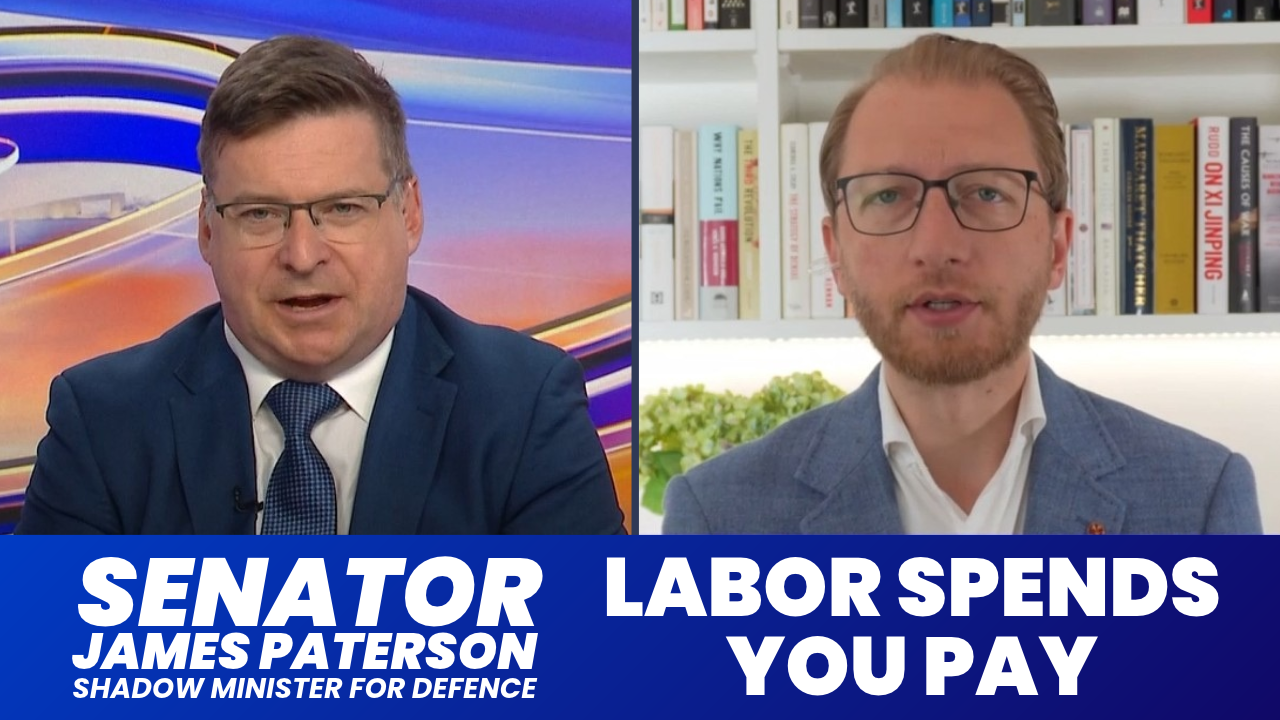
ANDREW CLENNELL: All right, joining me live from Melbourne, Shadow Defence Minister James Paterson. Thanks for your time, James Paterson. Firstly, I want to get a reaction to this announcement by the Prime Minister of a defence agreement with the Philippines, anticipated today.
SENATOR JAMES PATERSON: Good morning, Andrew. Look, obviously, I don't have the details of the agreement yet, but closer military relations with the Philippines is in Australia's national interest. We have strongly shared values and shared interests with the Philippines. We're both living in a contested region of the world, and Australia working more closely with the Philippines to help deter conflict in our region is a good thing. We're seeing some shocking incidents in recent years where the Chinese Coast Guard and maritime militia have been harassing Philippine fishing vessels and also Philippine naval vessels. I think it's really important that Australia stands shoulder to shoulder with the Philippines to resist that aggression, which is contrary to international law and which is dangerous and destabilising for the region.
CLENNELL: What could be achieved with a Quad meeting involving Donald Trump? What should Anthony Albanese be after here?
PATERSON: Look, a Quad meeting would be a very constructive thing. It's been some time since the Quad met at the leaders' level. There have been foreign minister level meetings, but not at the leaders level. I think that is constructive because the four Quad nations of India, the United States, Japan and Australia really do have a very strong shared interest in stability, and peace, and openness of the Indo-Pacific. And it sends a very strong signal to anyone in the region, including the People's Republic of China, that we will work together to maintain and uphold the peaceful status quo, to maintain the norms in the Indo-Pacific. It sends that strong signal, and I think that's a very important part of it.
CLENNELL: Should he be bringing up Iran?
PATERSON: Look, I think that is a topic that we should all have an interest in, obviously, some sort of resolution to the Iranian crisis would be welcome. But I have to say, my own assessment is that there is no easy exit to the Iran crisis. I think the Iranian regime, because it remains intact, because it remains able to threaten shipping, is going to be a persistent threat for some time.
CLENNELL: Do you believe there was a nuclear threat that required that sort of action?
PATERSON: It's very difficult for me to assess without access to classified intelligence. I think certainly the original strikes last year did do some damage to Iran's nuclear ambition. I'm not really able to independently assess whether any further strikes were necessary. But I think we should be clear, this is not a good regime. This is a regime which has threatened Australians, which has conducted attacks on our soil, which has attacked journalists and political commentators through cyber espionage. This is not a good regime, it is not a friend of Australia.
CLENNELL: And US cabinet members having to live on military bases at the moment. I might point that out as well. What do you think the PM should be pushing for when he meets the Chinese president and prime minister this week?
PATERSON: Look, we have an important relationship with the People's Republic of China. It is an important part of our economic success, obviously, and we want that to continue. But it's also very clear that the PRC is engaging in destabilising actions in our region, that it is threatening and coercing our friends in the region, including the Philippines, it has engaged in cyber attacks in Australia and espionage in Australia in the past. And if we want to have a normalised relationship with the PRC, then those acts of aggression need to stop.
CLENNELL: What are you hoping for from the historic discussion between the US, Chinese and Russian leaders this week?
PATERSON: Well, that's a very interesting question, Andrew. Look, I think it's very clear that the PRC has been supporting Russia's invasion of Ukraine, and it would be in everybody's interest if that stopped because that has been an utterly destructive war which is harming the innocent people of Ukraine.
CLENNELL: You think Donald Trump will push for that?
PATERSON: Well, it's not for me to provide advice to Donald Trump, but I think we do have a shared interest in the end of that conflict. I think Donald Trump does want to see an end to that conflict, the best way for that conflict to end would be for Russia to end its ambitions of subjugating Ukraine's sovereignty and integrity.
CLENNELL: What do you think of this hot mic moment with Anthony Albanese and Chris Bowen at the COP?
PATERSON: Andrew, I didn't run for the federal parliament to appoint myself as a morality police. What I would say is that locker room talk like that has a time and a place, and it's not at international summits when you're the prime minister of Australia talking to your energy minister. If you want to engage in that kind of banter, do it at a private barbecue, not before the assembled media at an international conference.
CLENNELL: Do you find it embarrassing?
PATERSON: I think it's unfortunate. I don't think anyone thinks it enhances Australia's international standing or respect for the Office of the Prime Minister.
CLENNELL: Do you have any confidence in the AI announcement around national security that the PM and other ministers made during the week, particularly around requiring AI companies to report any wrong activity?
PATERSON: I think there were some sensible steps made in that announcement that the opposition does not take any issue with, and I do think there should be mandatory notification, if there are AI incidents, when AI companies become aware of them. I think there should be independent verification. I think those are appropriate steps. I think what was missing is that this is, I think, at one point envisaged to be a package deal. It would include both incentives for AI companies to come to Australia and invest in Australia, and particularly to do training of their frontier models in Australia and strong regulation and oversight to make sure that it's safe. If you only have the regulation and not the incentives, then those companies aren't going to invest in Australia, and we don't get to have a say. The best leverage that we'll have over those companies is if they bring their models here, if they're bringing their chips here, if they are bringing their people here, we need incentives to make that happen. So I think this is only half of the answer so far.
CLENNELL: What do you make of the Microsoft outage and the outages to flights in America yesterday?
PATERSON: They're very troubling in a digital world. We rely so much on services like these and companies like these. And I think the reality that we are all starting to understand is that. The always on digital economy, of being always able to have access to their services, just can't be guaranteed in this environment. In this instance, it doesn't appear that it was in any way a cyber incident or a cyber attack. It just appears it was a kind of technical fault from an update, but it's very easy to conceive in the future that disruptions like this could occur due to cyber incidents. So we actually need to have redundancy and resilience in place in these systems. We need to have alternatives so that our companies can keep operating, so that we can keep doing business, so we can keep communicating. We can never be reliant again on just one system or just one company.
CLENNELL: Yeah, very worrying, isn't it? Now, I want to get on to the Mid-Year Economic Statement and the discussions I had with the minister on that a short time ago. And as I've reported, it's been put to me by a senior government source that even if there were big cuts in this statement, that would only improve inflation, quote, at the margins, unquote. What do you make of that?
PATERSON: Well, it's certainly true to say that federal government spending, savings would only make a difference at the margins. It can't solve the whole problem, but they can make a difference. And it's the only thing that the Albanese government has total control over. They have total control of the amount of money that they spend. And for four years they've been driving up inflation and driving interest rates up because they have been spending recklessly. Spending as a proportion of the economy is now at 40 year highs outside the pandemic, and the Reserve Bank Governor has called that out. She has said our inflation is domestically driven, not internationally driven, as Amanda Rishworth and other Ministers say, and she said that government spending contributes to that. Well, the government controls government spending. And by the way, even Jim Chalmers agrees because we know he's leaked to the media that he wanted bigger spending cuts in the budget, but he was rolled by the Prime Minister in the expenditure review committee. So I think this mid-year economic fiscal update is a real test. It's a test for the Prime Minister, it's a test for Jim Chalmers. Will Jim Chalmers prevail, and will there be spending cuts that take pressure off inflation, or will the Prime Minister prevail and will inflation continue to rise?
CLENNELL: They argue you're blocking things they're trying to do in the Senate, like removing the private health insurance rebate for over 65s. What do you say to that?
PATERSON: There is only one saving which this government has put forward, which the Coalition has opposed, and that is their proposal to rip away a private health insurance rebate for pensioners. These are people who have saved their whole lives to have access to private health insurance. They're on very modest, fixed incomes. And if the government took this reimbursement away from them, they would lose their private health insurance and be forced back into the public system. It's a particularly cruel cut when there are other areas of savings this government could make that wouldn't hurt people. So we're very proud to have fought against that. We're very proud to have stopped that. But we have supported other savings measures the government has put forward, including to the NDIS, and we have put forward our own suggestions for where spending could come down that the government is very welcome to take.
CLENNELL: Will you oppose the gas reservation legislation?
PATERSON: We are waiting to see the final form of what the government has put forward, and we are engaging in good faith discussions with the government in a bipartisan way because we do support the principle of giving more gas access to Australians in the domestic market, but part of that answer is actually getting more gas out of the ground, which this government seems to have very little interest in. And it's very important that we don't do things that have unintended consequences, particularly if it damages future investment in gas in Australia. So we're working constructively, we'll go through our processes and determine our position.
CLENNELL: What are the sticking points? Can you spell it out a bit? What should they do for you to pass it? Because it sounds like there's a chance you won't pass it.
PATERSON: It's a fair question, Andrew, but I really should defer to our experts, Susan McDonald and Dan Tehan, who have portfolio responsibilities. This is a very technically complex area of policy, but the principles are clear. We do want to have more gas here for Australians to access, particularly for industry, whose prices have been driven through the roof on Labor's watch. And we want to see more gas extracted here in Australia, but the government has not done anything to make that easier.
CLENNELL: Last Sunday the government performed a back down on the Victoria Barracks sale but left it in a confusing halfway house where defence would no longer be based there. What did you make of that?
PATERSON: Well, Andrew, I think you should take some credit for this backflip because it was your question to Richard Marles on this program six weeks ago that elicited his extraordinary comment that Victoria Barracks Sydney is just an old wine cellar that some generals like to hang out in. That enraged veterans and Australians all around the country. Thousands more signed my petition against their sales. There was a huge rally at Victoria Barracks Sydney, and the government was forced to partially back down. At least some of these sites are now not going to be sold, and they can remain in public hands. But Labor still plans to evict the ADF from these bases, which will sever the connection between the military and these bases. I think it'll have real implications for military capability, which is an unwise thing in a dangerous world. And there are other military sites around Australia that they still plan to flog off to the highest bidder for apartment towers to be built on top of, so the Coalition is going to continue to fight this every step of the way, and I will have legislation in the Senate which will hopefully put a stop to these sales.
CLENNELL: Aren't you after a bit of budget improvement though? This might assist with that. We've got a lot of costs coming in terms of AUKUS, et cetera. Some of these sales, at least?
PATERSON: Well, not according to Richard Marles. I mean, Richard Marles said this week that not selling five of the largest urban bases, including Victoria Barracks, Sydney and Melbourne, HMAS Penguin, Point Cook RAAF base and Fort Queenscliff bases. He said that will make no difference to the proposed sales. I'm not quite sure how Richard Marles sums add up. He did make a $600 million error on Radio National this week by claiming that the net proceeds would be only $1.2 billion, not $1,8 billion. But frankly, that's up to the government to explain, not the opposition, they're the ones saying this won't make a difference.
CLENNELL: How confident are you feeling about Jess Wilson winning the Victorian election in her own right, your good friend, and can this be the start of a resurgence for the Liberal Party if it happens?
PATERSON: I think the Victorian state election will be closer than people think for two reasons. One, the Victorian Liberal Party has to win 16 seats in an 88 seat parliament. That's a very big ask. It's an achievable one, but it is a very big ask. And secondly, Labor has governed Victoria terribly. They are corrupt. They have littered the state with potholes, crime is out of control. But they do campaign well. And they are willing to do and say anything in order to cling onto power for four years. They're willing to tell lies. They're outspending the Liberals six to one on online advertising because they've used taxpayers' money to pump their messages into the community. So we don't take anything for granted, and this will go down to the wire, and Victorians need to understand that if they want a change of government, the only way to guarantee that is to vote one for your Liberal or National candidate. Any other vote risks four more years of Ben Carroll or Labor.
CLENNELL: Will you take a similar approach to how to vote cards and preferences at the federal election as Jess Wilson has in Victoria, preferencing One Nation, recommending preferencing them above Labor?
PATERSON: That's for the party organisation to determine closer to the election. My view is we should wait, and we should do it as the Victorian Liberals and Nationals have done on a case-by-case basis, because there are often cases where, for example, some One Nation candidates are not suitable for public office and cannot be recommended on any how-to-vote card because their vetting systems often fail. So I think we'll make those decisions on a case-by-case basis, much closer to the election.
CLENNELL: Now, over the years, I've seen you become something of a national security expert. So do you have any views on the Jensen Huang saga, which is dominating the world at the moment?
PATERSON: Certainly, I think it is a timely wake up call for business leaders. Sometimes when we think about foreign interference and espionage, we think it's something that only affects state secrets and classified information. But actually in a modern world where you've got commercial technology which has military applications, dual use technology like AI, it's extremely interesting to foreign intelligence agencies and they're willing to target individuals in the private sector to get that information. So, I think we need to rip away some of the naivety we've had in our country and really harden ourselves and protect ourselves better against those attacks.
CLENNELL: James Paterson, thanks so much for your time.
PATERSON: Thanks, Andrew.
ENDS