

Media
|
Transcripts
August 13, 2026
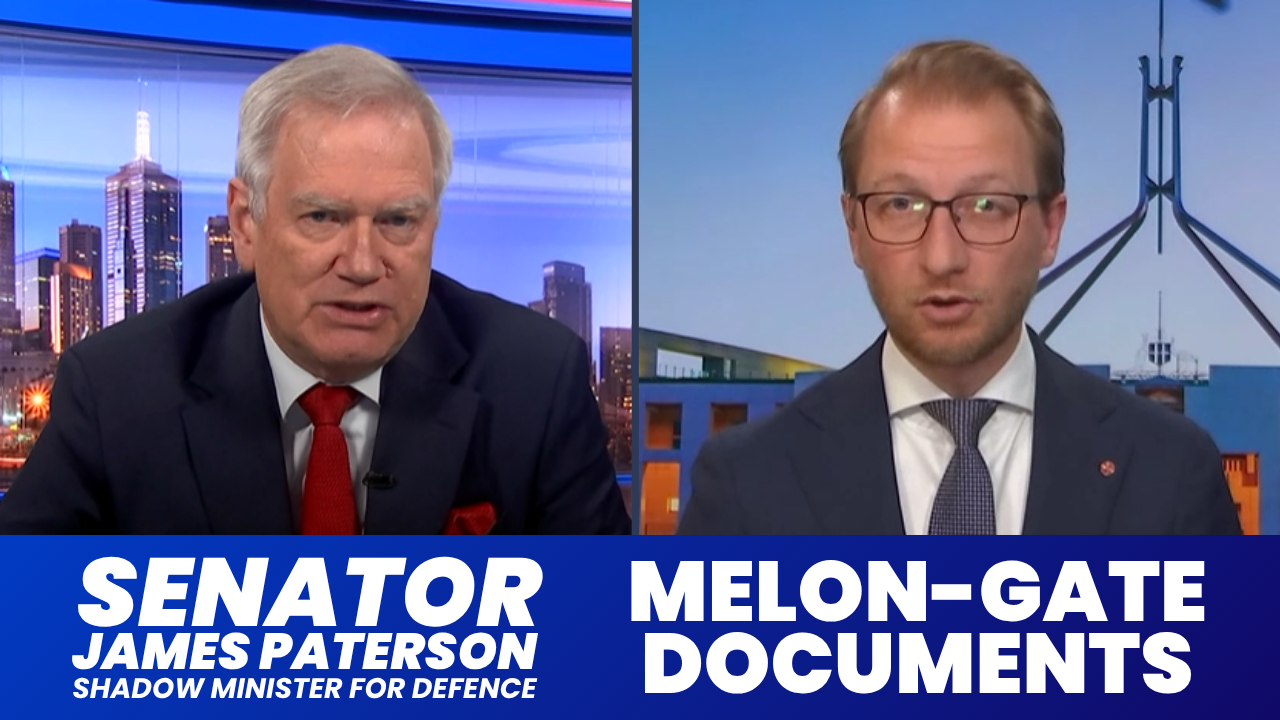
ANDREW BOLT: James Paterson, great to see you again. Look, every party in the Senate this afternoon, except Labor, have voted to force the government to hand over documents about the melons scandal by next Monday. What documents and why?
SENATOR JAMES PATERSON: This is really important, Andrew. It was bad enough that the Prime Minister has insulted the government of Japan, the people of Japan and the Prime Minister of Japan. But in seeking to extricate himself from the mess he's put himself in, it appears that his government has leaked confidential correspondence from Japan to try and downplay the seriousness of this incident. And that could be a criminal offence. So in the first instance, we've referred it to the AFP, but in the second instance, the Senate virtually united today, with the exception of the Labor Party, to vote to force the government to release this correspondence in full, and any correspondence the Prime Minister's office has had with anyone else about it, so we can understand what role they played in leaking confidential correspondence from a critically important ally.
BOLT: But doesn't the Prime Minister have a right to release correspondence if he sees fit? I mean, what's the issue there?
PATERSON: Well, firstly, he hasn't transparently released it. He hasn't just published it and said, I'm doing this. It's been leaked by someone presumably in his office. Secondly, this is confidential correspondence from a really close and important ally of Australia. They weren't consulted about the release of this information. In fact, they've been quoted by media outlets this week saying that they were surprised to see it in the public domain. If our allies can't have confidence in us that we'll protect their correspondence, how can they trust us to keep their secrets in a dangerous and uncertain world? So I think it's very important this be investigated and we get to the bottom of it.
BOLT: Yeah, I thought it was really interesting, the Prime Minister today in Parliament saying, oh, but listen, the Japanese ambassador has just said, you know, we had a very warm meeting with the Japanese Prime Minister. He didn't address the issue, which is we're not talking about the meeting, we're talking about the sexist jokes afterwards that seem to have offended Japan. It's all over the papers, by the way, in Japan now. And I hear some journalists and commentators say, oh, no, no, no, this is a trivial issue. So, you know, Japan isn't that fussed about it, it's a sexist joke at worst, but I strongly disagree because the cover-up has revealed so much. What do you say though to that argument?
PATERSON: I think it's to the great credit of the government of Japan that they've tried to downplay this issue, but unfortunately they can't unsay what the Prime Minister said, and they can't undo those crude gestures that he made. It's really important to remember that Sanae Takaichi is the first female Prime Minister in Japan. It's a very significant development for a conservative country to have a female Prime Minister. And so for her to be so cruelly, and classlessly, and crassly mocked by an allied friendly country like Australia and our Prime Minister really is very demeaning, particularly because he actually insulted the gift of the Imperial melons, which is a very important gesture from Japan to Australia, and he's gone on a bawdy podcast to make light of it. It's actually quite offensive and ill-informed. And in a classic case with Anthony Albanese, he's just incapable of admitting fault. He's incapable of acknowledging when he gets things wrong. Like when he lied about falling off the stage, he can't tell the truth about stuffing up here. And he's now pressing into service all his female cabinet ministers, who've been so vocal about attacks on women, to try and downplay this. I think the hypocrisy just reeks.
BOLT: Oh, absolutely. And it's trashed his reputation. I think we've got to be careful. The Japanese Prime Minister in a media release at the time talked about one crown melon. There might have been two, but her press release nominated one. I think it's Albanese, for the sake of a joke, who talked about two, like this, you know, obviously a joke. The joke wouldn't have worked with one melon. I know it's a trivial detail, but we've got to be clear about these things. But I initially wanted to ask you about something else before this blew up again more today. Something really concerning, I've already reported that drones from people unknown have buzzed the RAAF base at Williamtown, New South Wales, for a couple of days in July without being intercepted. The people at the base just told, oh pull your blinds down. Now we've learned that there have, in fact, been more than 140 incursions detected in defence air spaces in just one year by these drones and whatever. And the government today seems to have no answers, not even to whether China, for instance, might have been behind it. Have a look.
[CLIP START]
SENATOR THE HON TIM AYRES: People who are doing this activity should stop it. They will face the full force of the law. It's absolutely unacceptable.
[CLIP END]
BOLT: Oh, China, just stop it, great strategy, very cheap if we can just do that. What did you make of all this?
PATERSON: Well, whoever is doing this, Andrew, it's incredibly dangerous. Planes take off and land on these bases, and a drone could do serious damage and hurt someone. It could be compromising our national security and intelligence because these bases collect, and process, and analyse intelligence. And it's alarming that this vulnerability has been advertised to the world, because it doesn't appear in any of these instances that we've used counter-drone capabilities to safely take these things out of the sky. In fact, in the case of RAAF Williamtown, apparently they just went and reported it to the New South Wales Police for them to look into. Our bases need air defence, they need defence from missiles, and they need defence from drones. We've seen in Ukraine, and Iran, and Gaza, how critical these capabilities are. And Australia has this technology, we export it to the rest of the world, including to Ukraine, but just apparently we don't have them on our own bases. So much so that the final layer of our apparently "layered defence" on our bases is to close the shutters of our offices on our bases so that cameras on the drones can't see through. I mean, this is a joke.
BOLT: It was a pretty sick joke. And I would actually stress that even if China had nothing to do with any of these 147 incursions, they will have noted and learned a weakness in our defences. Just quickly, before you go, the Tomago bailout. $2.5 million to each worker there. $2,5 million to each permanent job, to save it. Totalling up to $2.5 billion in all. Even if you add the, you know, people indirectly employed, it works out to $500,000 per worker, this bailout deal. How can any jobs in the private sector deserve that kind of subsidy?
PATERSON: Well, it is an extraordinary expenditure of taxpayer money, and it is obviously unsustainable if every heavy industry in Australia needs to be bailed out by the federal government like this. It's not going to lead to a more efficient or productive economy. And the particularly galling thing about it, Andrew, is that it is only necessary because electricity has become so unaffordable because of an issue which you've pursued very consistently for a very long time, which is the ideology of net zero. And Labor cares more about their commitment to that ideology than they care about the workers or about our economic competitiveness or productivity. And so I think it's very important that my party has recognised that, that we are committed to abandoning net zero because we want these industries to be able to stand on their own two feet. We don't want them to have to be bailed out like this. We're not going be able to afford to bail everyone out like this. And so we need to make energy competitive and affordable again, and we will.
BOLT: Are you against that subsidy for Tomago?
PATERSON: Well, I don't want to see it close. This is an important industrial facility. I don't want to see the aluminium smelting industry in Australia depart. I wish it wasn't necessary. Unfortunately, Labor has to put a band-aid on their broken energy policy. What we've got to do, Andrew, is fix our energy policy so that this isn't necessary in the future.
BOLT: It's not a band-aid, it's the whole medicine cabinet on this thing and the hospital as well.
PATERSON: Indeed.
BOLT: It's just sensational to me, and they keep doing it, they keep doing it. This is what, the fourth or fifth deal? I mean, it's just, anyway, what a strange way to run an economy. James Paterson, thank you very much for your time.
PATERSON: Thanks for having me, Andrew.
ENDS