

Media
|
Transcripts
August 10, 2026
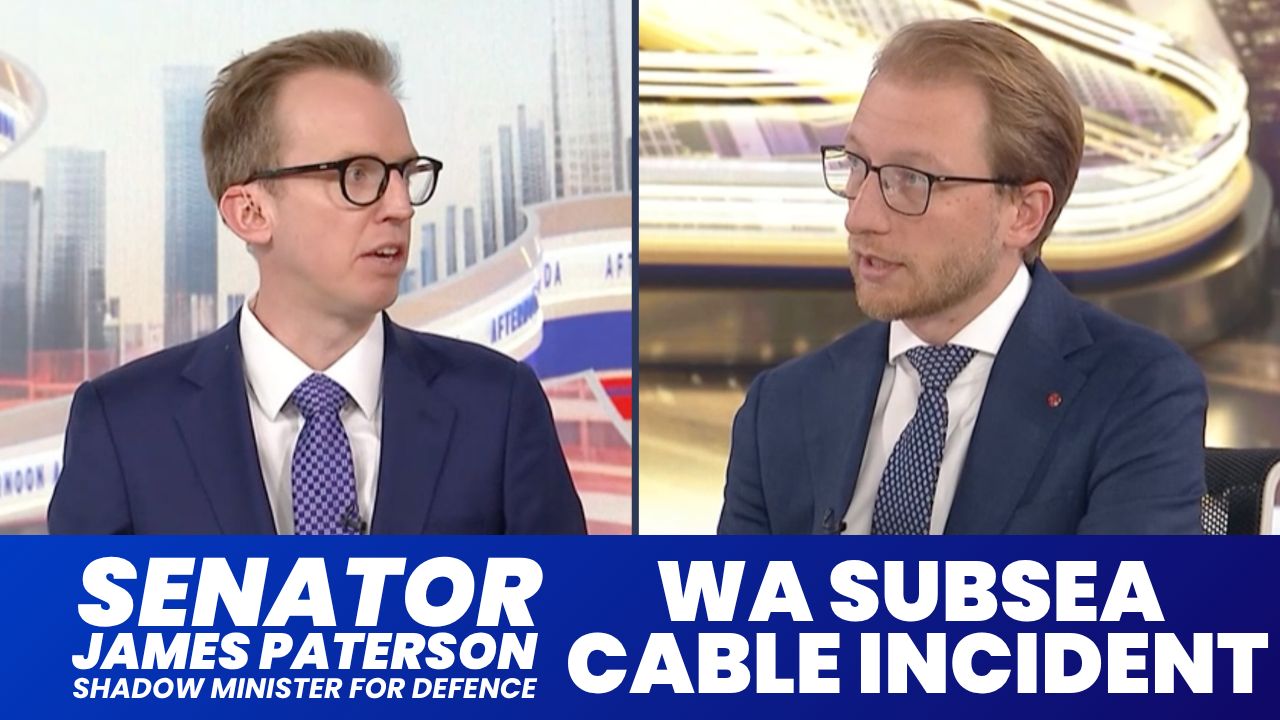
TOM CONNELL: Joining me live now Shadow Defence Minister, James Paterson. Thank you for your time, so have you sought a briefing on what's happened here?
SENATOR JAMES PATERSON: I will be, and so I'll be cautious about what I can say, not yet having been briefed on this. But based on what's in the media today, I am concerned, We should have robust counter drone capabilities at our most important defence bases, and RAAF Williamtown is a very important defence base, very important RAAF base, where we have sensitive capabilities, including our F-35s, and also intelligence activities that take place on that base. And telling men and women in uniform on base to close the blinds is not an adequate security mitigation for a drone which could have kinetic effect as we've seen spectacularly in Russia's attempted invasion of Ukraine, and could have intelligence gathering abilities.
CONNELL: Is there a precedent for this, that in this scenario, given there's no one in that, it's unmanned, that it would be shot down or taken out normally?
PATERSON: Well, there are really good counter-drone capabilities, including made by Australian companies, some of which have been exported around the world, including to Ukraine, which allows them to intercept a drone like that in a non-kinetic way. In other words, using jamming technology, for example, to intercept the communication between the drone and the drone operator to force it to land.
CONNELL: So it just drops from the sky?
PATERSON: Well, they can actually force it to land quite safely. It depends on the drone.
CONNELL: They can force it to go into a mode that lands safely rather than pose a risk.
PATERSON: Yeah, again, it depends on drone, and the drones themselves are getting more capable as the counter-drone capability gets more capable, but there are also kinetic means of taking these things out of the sky if they're deemed to be a risk.
CONNELL: We will wait to hear, perhaps, once there's more information available. Another story on subsea cables damaged off WA and concern around whether maybe our adversaries are testing our vulnerability here. There was $4.5 billion for uncrewed drones as part of the defence budget and the repositioning, if you like. Would that indicate that this is something we're cognisant of?
PATERSON: So our submarine cables are critical to our national security and our economic security. About 98% of internet traffic goes through these cables, and there are only a small number of them that touch the Australian continent, and they're publicly known. So if an adversary were to deliberately sabotage and damage them, they could have, particularly if they did so simultaneously to a number of them, they could really destabilise our country and our economy. So it really is critical that we get to the bottom of what happened in this particular incident. How was it damaged? Who was responsible for damaging it? Was it accidental? Was it deliberate? I mean, it really is important to understand how that occurred.
CONNELL: A lot of debate around immigration, we're waiting to see exactly what Labor does. But I suppose if you look at this broadly, it's always going to be hard to bring down numbers when many parts are a demand-driven system. Does that fact itself need to be looked at? In your view?
PATERSON: Well, there are policy levers available to government if they want to hit the targets that they set for themselves in the budget and in every single financial year of the Albanese government they've failed to hit their own targets. And it is only now, four years in, that they're contemplating some apparently significant policy changes in order to meet the targets they've missed in previous years.
CONNELL: Levers, though, often you go, let's do this lever and let's see how low that gets it. Is it just a point where we need a bit more certainty and caps of more different types of visas if you're going to have any certainty around achieving it, rather than demand-driven, and what does this lever do to that demand?
PATERSON: I'm not going to freelance in another colleague's portfolio, it's not my responsibility. But I would say that if government says we're going to hit this NOM target in the budget and they consistently fail to achieve it, then they have to look at the policy options to deliver it. And it is telling that Tony Burke is only now getting around to doing this. And even when he brought things forward, it appears he was rolled, either by Cabinet or by ERC, so much so that he had to cancel a National Press Club address, which is pretty humiliating.
CONNELL: When your opposition, though, discusses this, I'm sure elements come up of the difficulty of doing it. It's not easy, is it? You think of something like working holiday makers, a huge cohort, the biggest driver of the NOM, but you've got international agreements, free trade deals, regional workers, so you might go, hey, let's have 50,000 fewer of them. That has ramifications. It's not easy, is it?
PATERSON: It's a complex area of public policy. There are significant economic ramifications of the changes you make, and there are trade-offs. You're absolutely right, Tom. But that's not a valid excuse for a government that's been in power for four years now, that's brought in about one and a half million people in that time, where housing-
CONNELL: Was it a catch-up from COVID, and demand-driven has been something since the 90s?
PATERSON: Fine, but Tom, you allow one and a half million people to come in in four years, you build a tiny fraction of the homes to accommodate them, when we already had a housing affordability crisis. It should be no surprise that rents are going up and housing is becoming unaffordable. And governments don't just get to sit around and watch that and say oh well, that's interesting, and that's nice. They actually have to do something about it. They're elected to govern, to make decisions, they've promised to deal with this issue, they have failed to for four years.
CONNELL: The thing that seemed to upset Labor people the most was the prospect of family reunion visas only being able to be applied for when you're on shore. Should immigrants have the right to think that when they come here and settle they can get family members to join them?
PATERSON: Well, it is very hard to know whether that is actually a proposal that Tony Burke took.
CONNELL: What do you make of that proposal?
PATERSON: Well, I am not going to freelance commentate on another colleague's portfolio that we don't even know the government is going to bring forward. I don't even know if Tony Burke can get that through the cabinet, let alone present it to the parliament. So let's wait and see what the detail is.
CONNELL: Is there a lack of viability, though, to saying to someone, hey, you're skilled, come out here, do this job? Look, your wife and kids will come one day in a few years. Is that an unreasonable expectation for any country?
PATERSON: Yeah, look, I can understand why people who are skilled workers who want to come to our country for a period of time, why they want to bring their families with them. And we have in the past been quite generous in allowing that, but we have a very new problem here, which is migration that's kind of both been uncontrollable and unsustainable from an economic point of view, but also has lost its social license, frankly. Australians believe that migration is too high and it needs to be brought back under control. And so we do have to contemplate measures that we haven't previously contemplated in order to bring it back down to more sustainable levels. And we should look at the migration program holistically and how we can achieve that.
CONNELL: So the sorts of things we wouldn't contemplate before, and that you would have previously said, that's not reasonable, you think immigration is such a problem, they now need to be contemplated.
PATERSON: Well, self-evidently, the government is contemplating things that say if the previous Coalition government tried to do any of the things speculated in Tony Burke's package, they would have been screaming murder and saying this is outrageous. They're now contemplating it themselves. So that just shows how the debate has moved.
CONNELL: They did use one of the levers you alluded to in terms of prioritising onshore applications for skilled visas. Are you comfortable with that, if it brings the number down but we have fewer skilled workers in the country?
PATERSON: Well, I think the criticism I would have with Labor on skilled migration has been the way in which they've preferenced their mates in the union movement to the exclusion of Australia's construction workforce needs in particular. So they have as equivalent priorities…
CONNELL: It's not the number, it is who we are getting in.
PATERSON: Well I think the composition is incredibly important. I think, you know, when we have a housing crisis we should be bringing people who can help alleviate that housing crisis, not people that simply add to that housing crisis because they're an animal trainer or a yoga teacher or some other kind of profession this government has prioritised equally with construction workers.
CONNELL: It's always good to be able to get a yoga spot on a Saturday morning, I guess, that I probably should do it, I'm getting old. Gambling deal, brewing here? How much will you stand on principle versus wanting some sort of change to happen?
PATERSON: Well, I think it's clear, as our Shadow Minister, Sarah Henderson, has said, that the government's package has not met the mark in terms of community expectations, that gambling advertising has become too pervasive. And I think reasonable, sensible amendments can be made to strengthen it. But let me say, really important point. We also have to be cognisant of the risk of unintended consequences here and reaching too far and going too hard. We've seen how a quasi-prohibition policy has failed when it comes to tobacco. We now have an out-of-control black market. You could very easily say the same with gambling if you adopt a quasi-prohibition model to advertising where foreign offshore illegal organised crime run betting just takes over the market and where there are no consumer protections, there is no BetStop, there is no taxes raised, there are no Australians employed.
CONNELL: Okay, James Paterson, got to leave it there, appreciate your time today. Thank you.
PATERSON: Thank you.
ENDS