

Media
|
Transcripts
September 17, 2026
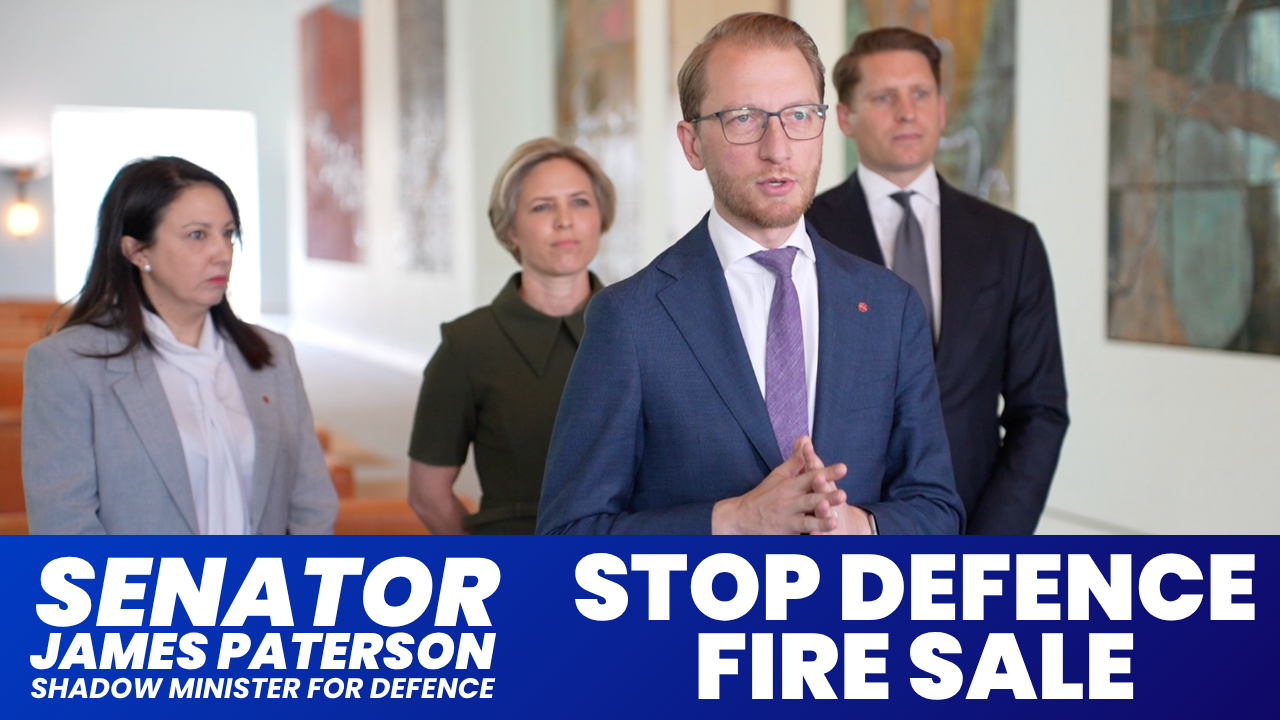
SENATOR JAMES PATERSON
SHADOW MINISTER FOR DEFENCE
SENATOR FOR VICTORIA
TRANSCRIPT
JOINT PRESS CONFERENCE
AUSTRALIAN PARLIAMENT HOUSE
Thursday, 17 September 2026
Topics: Senate says stop defence estate fire sale, Labor backs down on veterans allied health cap, Labor’s digital censorship bill, AI
E&OE…………………………………………………………………………………………
SENATOR JESS COLLINS: Hey everyone thanks for coming out today. On the 4th of February this year the Deputy Prime Minister Richard Marles handed down an independent audit of the defence estate which took the defence community completely by surprise. And so, in March we set up an inquiry into this defence estate, and we looked at the management of this process. We looked at why the government was forcing the sale of 67 fully operational highly strategic and nationally significant defence assets. Now the overwhelming evidence that we found through this inquiry was that the process was flawed, was that it was a predetermined outcome from the government that they wanted to sell important sites like Victoria Barracks Sydney, and Victoria Barracks in Melbourne, and Point Cook down in Victoria. The spiritual home of the Army, the spiritual home of the Air Force. And the process was flawed. They worked on false financial assumptions. And we have been trying through the inquiry to look under the hood of these financial assumptions, and they've been obstructive in this process. Now, the government simply has not done the consultations on this. So, we did the consultations that the government refused to do. And the overwhelming message that we have from the Australian people, and I have spoken to thousands of people around the country. I've been into town halls where 500 people have unanimously said, do not do this. And so, we are here on behalf of the Australian People to say, halt this divestment program. Now, there is a fundamental problem that we have with the management of the defence estate. The first is that the defence minister can't get the money that he needs to invest in the defence estate rather than divest. The second is that the defence bureaucracy is collapsing under its own weight and has become too expensive to maintain. So, we are here to call on the government to halt this defence estate program so that we can provide more scrutiny and we can do this through the proper process.
SENATOR LEAH BLYTH: We're very concerned that with the sell-off of these assets. While they might seem surplus for purpose now, for some of them. What happens if we have to change our posture drastically in Australia? Labor have admitted themselves that we live in the most dangerous strategic time since the end of World War II. Now does not seem to be the time to have a reckless sell-off of defence assets that we may need into the future. Communities will be impacted by this. It's important that communities can see our defence bases, that they can live amongst our defence personnel. We need to make sure that there is a place for our cadets to be able to go to. And for our reservists to be able to access easily without having to travel extra hours to be able to participate as reservists in Australia. So, we want to see this pause, and we want to see the consultation happen properly.
ANDREW HASTIE MP: I want to add my voice and call on the Labor government to halt immediately its fire sale of prime defence estate across our great country. It's an attack on the ADF's identity. It's an attack on the ADF's history. And it's an attack on ADF morale. One of the things that our capital cities have always done during times of war, whether it was World War I or World War II, have been to stand up for Australia and enlist in the ADF. We've always had a very close relationship between our capital cities and the ADF. Whether it's Perth, Adelaide, Sydney, Brisbane or Melbourne, our capital cities have stood up. And Labor selling off prime defence estate in our capital cities will just cut that connection between our capital cities, and the Australian Defence Force. It'll hurt our reservists. It'll hurt our cadets. And it's a reckless policy by Richard Marles and the Albanese Labor Government. That's why today I want to commend Senator Jess Collins, Senator Leah Blyth and Senator James Paterson, our Shadow Defence Minister, for the work they've done here. And the Coalition stands with them completely calling on Labor to halt the sell-off. Second thing I want to say is a great day for veterans across Australia with the Albanese Labor Government ceasing its attack on veterans and rolling back the cap on allied healthcare. I want to commend our Shadow Veterans Minister Michael McCormack, the Member for Riverina. The outstanding advocacy he has done on behalf of Australia's veterans over the last month fighting this cap they put on allied health. And I want to congratulate and thank the veterans who came all the way to Canberra, who gave up their time and energy to advocate for their peers across this country to make sure that they get the care that they need.
SENATOR JAMES PATERSON: Today the Senate is telling the Albanese Government to stop their reckless fire sale of defence estate assets around Australia. 82,000 Australians have joined my petition so far on my website, senatorpaterson.com.au, to add their voice to Senator Collins and Senator Blyth and the Senate in saying that in a dangerous world the last thing we should be doing is flogging off our critical defence bases, disregarding our military history and further distressing our veterans. As Andrew said, our veterans have had a really important victory today. But they shouldn't have had to fight their own government after fighting for their own country to get them to scrap the allied health cap. They shouldn't have to keep fighting their own government to stop them from selling off these critical defence bases. Whether it's Lancer Barracks in Parramatta, where the ashes of fallen soldiers have been scattered on the parade ground, where the Albanese government plans for apartment towers to be built on top. Whether it is HMAS Cerberus in Victoria, a critical ongoing naval training facility where the government plans to flog off so much land around the base it could affect the firing range or the storing of explosives. Whether it's Irwin Barracks in Western Australia, a critical base for our Reservists. more than 1,000 of whom train there that will be asked to drive up to 50 minutes in traffic to another base to continue serving the ADF at a dangerous time. Richard Marles, please listen to the Senate. Please listen to the Australian people and please listen to veterans. Stop this reckless sale of our military heritage and our critical defence base capability. Go back to the drawing board, consult the communities and reconsider these reckless plans. Happy to take questions.
JOURNALIST: Senator Paterson, do you think the sell-off of Sydney's Victoria Barracks is a sign of Labor's attitude towards Australia's colonial history? Do you think that's where the issues arisen?
PATERSON: I think Labor has shown two things with this reckless defence estate fire sale, particularly for heritage assets like Victoria Barracks Sydney, a spiritual home of the Australian Army, A base which has operated for over 100 years, and which has ongoing use and has been used to stage counter-terrorism capability. They've shown they have no regard and no respect for our history, colonial or otherwise. And they have no regard and no respect for the ongoing need for these facilities today. They might think they're surplus to requirements right now. But if we find ourselves in conflict in the future, we will need bases like this to mobilise through to defend our country. And Labor's inability to fund defence properly is what is driving them to have that disregard for our capability and our heritage.
JOURNALIST: Can I ask, on a different topic, we've got a poll in Capital Brief this morning that has just come out that shows 65% of Australians support the move to allow people to opt out of algorithms, and 66% support their digital duty of care. Does this show that the Coalition is out of step with the majority of Australians by opposing this?
PATERSON: Well, if the only thing the government was doing in this bill was giving Australians choice over algorithms, that would be one thing. But we all know they're doing far more than that. They're allowing the Minister for Communications to decide what constitutes “harm” and then restrict access online to that “harmful” content. I don't trust any politician to decide what is harmful and what Australians can hear and what Australians can say. But I particularly do not trust Anika Wells to make that decision on behalf of the country. It's very clear from her interview with the Saturday Paper that she thinks that social media is to blame for the fact that Australians no longer believe this government. It's actually much clearer. The reason why the Australian people no longer believe this government is because they keep lying to them. You tell Australians 50 times before an election, you'll make no changes to negative gearing and CGT, and then you do. It's not the algorithm's fault that people don't believe it. It is your own fault.
JOURNALIST: So, have the Coalition put forward any actual suggested changes to the bill yet?
PATERSON: Well, we've made it very clear that the bill is unsupportable in its current form. If the government wants to abandon its current approach for internet censorship for a different approach and revise their bill, they're welcome to put that forward and we can consider it then. But at the moment, we think it's irredeemable.
JOURNALIST: But negotiations over legislation [inaudible] you say you don't support it in its current form. Is there a form in which you could support it? Is there a proposal for that form?
PATERSON: The ball's in the government's court. The bill in its current form is unsupportable. We're not interested in having negotiations with the government about how much free speech of Australians should be restricted online. If they continue with this approach, then the bill will never attract our support.
JOURNALIST: Isn't the ball currently in the Green's court, not the government's court, because now they have balance of power and can pass the legislation with minor adjustments and you guys won't get what you want out of it?
PATERSON: If the government wants to negotiate with the Greens about how to censor Australians, then they're free to do so. But I would advise them that I think the Australian people would not look kindly on their digital rights and freedoms being taken away in a cosy deal with their Greens political allies.
JOURNALIST: If the government couches its decision on the $5,000 allied health cap as being a responsive, a response to the concerns of veterans. Do you at least give the government some credit for ultimately listening and getting this right?
PATERSON: Well, they shouldn't have had to be dragged kicking and screaming by desperate veterans coming here to Canberra at their own expense and in their own time just to get their own government to listen to them. They should have consulted veterans in the first place before they did this. They should've listened to those representative organisations who told them this was a bad idea and would backfire. Veterans fought for Australia. They should not have to fight their own government to give them the care that we promised them. Many of them were harmed during their service. The least we can do is provide them the care that they need after they come home.
JOURNALIST: Does the Opposition have concerns for the resourcing of safety in the AI space and the coordination of that while we're trying to sort out the copyright impasse?
PATERSON: I think we should listen very carefully to the voices raising concerns about safety and alignment of AI models. I think that's a genuine concern. But if Australia wants to have a seat at the table and an opportunity to influence these global behemoths, then the only way to do so is to attract them to invest here in Australia. To bring their training models here to Australia. To build their data centres here in Australia. Bring their chips to Australia. That will give us an outsized influence relative to our population and scale in the world than we would otherwise have. The first step is to get them here; the second step is we will have a say and seat at the table.
JOURNALIST: Well, we have a safety institute at the moment, are you happy, is the Opposition happy with the resourcing of that and the coordination in the bureaucracy to address AI safety?
PATERSON: AI safety risks are real and should be taken seriously. But the reality is right now, Australia is not an influential jurisdiction globally in the regulation of AI, or the case of AI development. It's occurring elsewhere in the world, and while ever it occurs elsewhere in the world and not in Australia, no matter how many safety institutes we have, no matter how well they are funded, we will not have a seat at the table influencing their development. If we become the second centre for AI training in the western world after the United States, we will get a very powerful seat at the table to have our concerns heard about safety.
JOURNALIST: Mr Hastie, on the allied cap, as a veteran, do you think that veterans around Australia will see today as a win or will it be soured by the fight they had to put up over the last couple of weeks?
HASTIE: Yeah, no worries. Look, I think it's a huge win for veterans across the country. They were very upset with the government's change by putting a cap on allied health. Many men and women across this country who have served in uniform carry the scars of that service. And they do need help and putting a cap on allied healthcare was ridiculous, given the largesse of the Albanese government spending in other areas. Whether it's the net zero energy targets they're chasing. Or the bailouts of a lot of our sovereign capability. All caused by Labor in the end. And then to neglect our veterans in the way that they did, with just a small amount of support compared to what they're spending elsewhere. I think it's a huge win for veterans. They should be proud of their advocacy, particularly the ones who came to Canberra and gave voice to thousands of other veterans around the country who didn't have a voice, and again I want to acknowledge the Shadow Veterans Minister, Michael McCormack, for his work in this space.
JOURNALIST: Mr Hastie, this is the third time Labor's had to back down on policy regarding veterans. The first time [inaudible] funding. Where do you think this disconnect has come from?
HASTIE: I think there is a pattern here, whether it's the back down on medallic recognition, the back-down on Cameron Baird, VC, MGs, families, travel support, and now the allied health cap. There is a disconnect in Labor. And that's why we've called on Matt Keogh, the Veterans Minister, to resign, or the Prime Minister Anthony Albanese to move him on.
ENDS