

Media
|
Transcripts
June 4, 2026
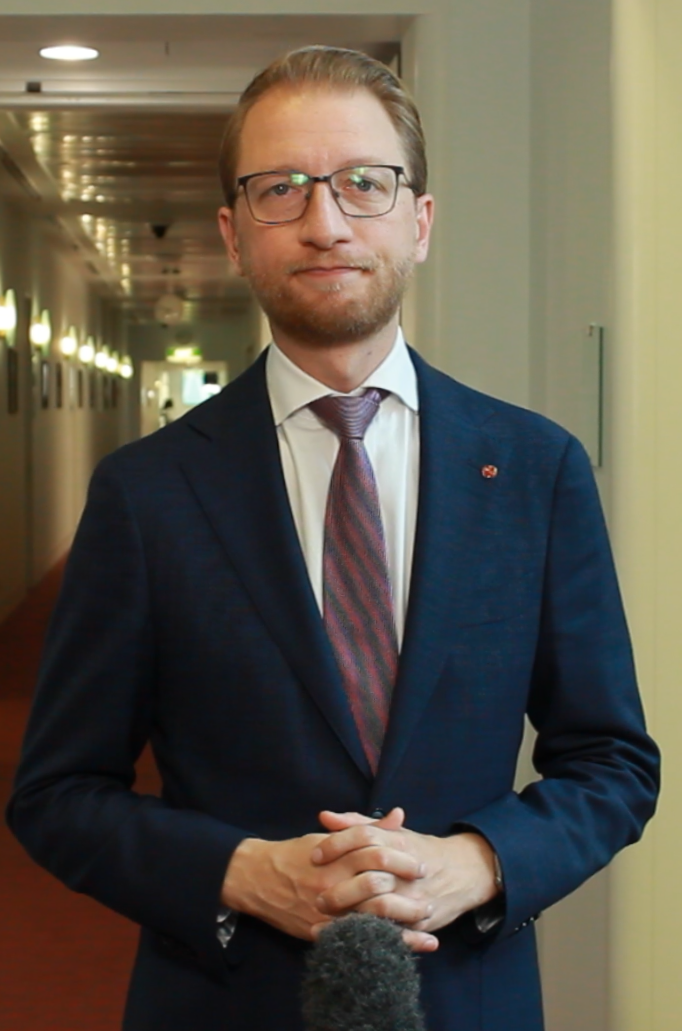
SENATOR JAMES PATERSON: Well, Jim Chalmers' disastrous budget is collapsing before our eyes with even the Labor Party's political allies, the Greens, objecting to extraordinary powers that Jim Chalmers wants to grant himself. Jim Chalmers is seeking the power to change the law after it passes at the stroke of a pen is an admission of guilt on his part that he has completely stuffed this up. And he wants to mark his own homework. These are god-like powers that no minister should be granted, but particularly not one like Jim Chalmers, who's been dishonest to the Australian people about his tax changes. Who knows what he would do with it. Now to give the Greens credit, although they are in support of higher taxes on capital gains and negative gearing, and trusts, they have a principled position that the Parliament should write the laws of this country, not individual ministers. And I urge them to hold firm on their position to not allow these laws to pass with these extraordinary powers, to force the government back to the table to fix their mistakes before the bill passes.
JOURNALIST: Jim Chalmers is arguing if the Coalition votes against the bills today, you're against lower income taxes. Is that a fair argument?
PATERSON: These bills raise taxes. The government has said $77 billion of higher taxes as a result of these bills passing. It's higher taxes on capital gains, it's higher tax on trusts, it is higher taxes on property investors. It's ultimately high taxes on small businesses, on farmers, on young people saving for a deposit to buy their first home. And the Coalition is against high taxes, that's why we will be voting against this bill. But we also have our own tax plan, a better tax plan a tax back guarantee that will index tax brackets to inflation so Australians do not face a secret tax rise every single year under Labor's inflationary economy.
JOURNALIST: How will the Coalition pay for that?
PATERSON: We've set out some of those savings already to Labor's climate bureaucracy, to Labor's corporate welfare, to changes to eligibility for welfare for migrants. We'll provide more examples of that in the normal time and the normal way, in our costings.
JOURNALIST: What do you make of the latest tariffs from Donald Trump?
PATERSON: It's incredibly disappointing. The United States is a great friend of Australia, but this is not a friendly act from the Trump administration. And it is very difficult to justify under our free trade agreement. And it's particularly difficult to understand why the Trump Administration believes that Australia is somehow a source of slave-labour produced goods. This is something that we hope the US administration reconsiders.
JOURNALIST: Is it disappointing also after we saw the second hand subs deal and now we are getting tariffs, are we're being treated fairly by our key ally?
PATERSON: I think we should separate those two issues, particularly because the Albanese government is now telling us that it's Australia that asked for those three in-service Virginia-class submarines. There is actually a defensible logic as to why you would want Virginia-class submarines all from the same block or generation, that is easier to manage. The problem for the Albanese government is those arguments have always been a case and for the last three years they've told us that the optimal pathway was to acquire two in-service and one new Virginia-class submarine. And they've pulled the rug out from everyone with this change including even their own caucus. I'm really worried that their failure to be transparent is undermining political support for a AUKUS, they need to be much more upfront with the Australian public.
JOURNALIST: Have you got to the bottom of why they made the change?
PATERSON: The government's argument is that three in-service Virginia-class submarines from the same block of submarines is going to be much easier for a country like Australia to manage. I do understand the logic of that, but I don't understand why for the last three years they haven't shared that with us. Why they haven't taken the Opposition or the public into their confidence and said, look, this is what we're aiming to do. Apparently for 18 months they've been engaged in intense conversations with the US administration to secure this change. Why didn't they disclose any of this to the Parliament or the people of Australia?
JOURNALIST: The Labor Party's national conference is coming up in July. We're now seeing people from the left and the right, Ed Husic, Peter Garrett has coming out of the woodwork. Are you worried that Labor is going to vote against AUKUS at their national conference and leave the federal government in a hard place?
PATERSON: I think it's unlikely that a command and control political party like the Labor Party would allow something like that to happen. I'm sure it would be stage managed in a way to ensure that the Prime Minister and the Deputy Prime Minister are not embarrassed in their own conference. But I am worried that there are signs of dissent within Labor on this that haven't been dealt with. Ed Husic feels emboldened to go publicly attacking our signature defence policy when this government said they'll speak with one voice on foreign policy, and there is still today a minister in the Albanese government, Josh Wilson, who is opposed to AUKUS. He has previously expressed his opposition to AUKUS, he has never clarified those remarks, he has never said he supports AUKUS and the Prime Minister is letting him get away with that. So what are the standards of the ministry of this government they don't even require their ministers to support their government policy?
JOURNALIST: What do you make of reports, One Nation's failed to put in three years of auditing reports in Queensland. Is this a sign maybe they're not ready to be a party of opposition or government?
PATERSON: Well, nothing would surprise me when it comes to One Nation, this would certainly be their consistent with their approach in the past to legitimate compliance issues. They often have difficulty here and it is a symptom of a party that is not well run, not well organised and ultimately, I think, not in a place to govern Australia. Pauline Hanson is now saying that she wants to be Prime Minister, if they can't even get their electoral returns right, how can you run a government?
JOURNALIST: There's also analysis showing female voters and even voters in the city are beginning to flirt with One Nation, look at One Nation. Does that concern you?
PATERSON: I am not surprised that in an environment of incredible distrust in the political system and in the major parties, when a government of the day decides to break fundamental promises that the beneficiary of that is an insurgent populist party that's saying they'll change the system. I mean, they were always going to be the beneficiaries of Anthony Albanese and Jim Chamlers’ decision to break promises. I think it was very ill-advised to breach public trust in the way this government has done. But at the next election Australians will be required to choose who they want to govern Australia, who they think can provide a Prime Minister, a Treasurer, a Finance Minister, a Defence Minister, and a Foreign Affairs Minister. I have no idea who One Nation would choose for those positions. I don't think they know and I certainly don't think the public will know either.
Thanks everyone.
ENDS