

Media
|
Transcripts
June 2, 2026
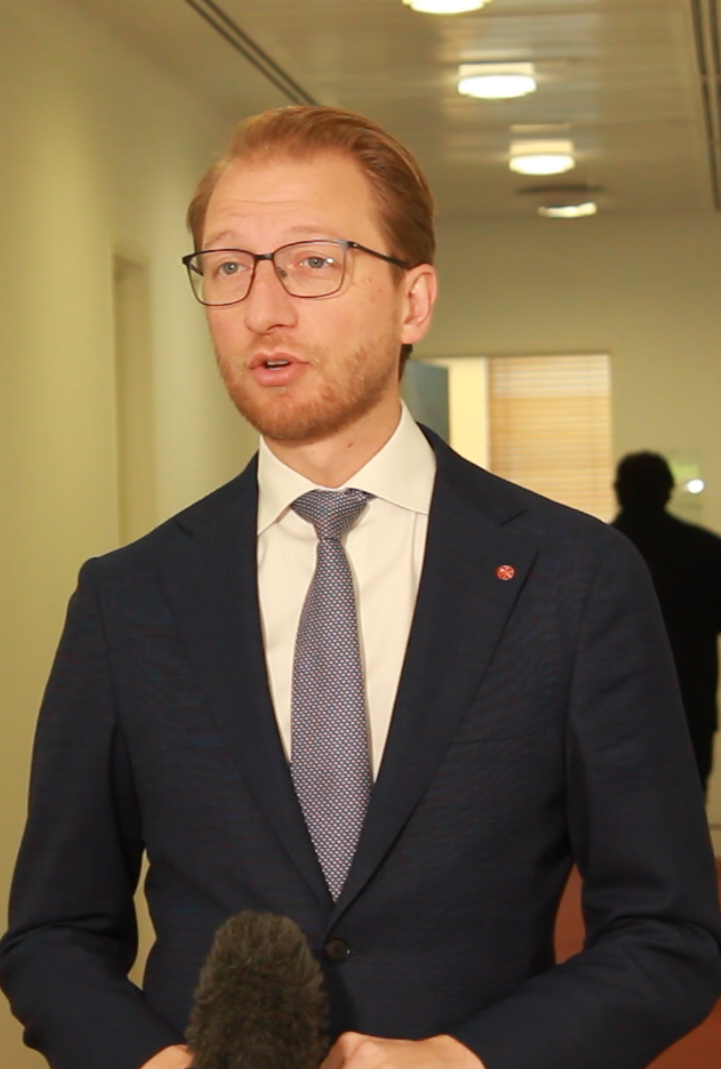
SENATOR JAMES PATERSON: Richard Marles' spin on defence spending has been badly exposed on the front page of The Australian today in a story by Ben Packham, which demonstrates Labor is trying to mislead Australians by claiming to spend far more on defence than they actually are. While spending on things like pensions, superannuation, and welfare for veterans is critically important, it does not add any new military capability, it does not support any current missions, and it does not sustain any current platforms. Nor does, by the way, funding things like our intelligence community and the Inspector-General of Security. Unless Richard Marles plans to deploy the IGIS to the frontline in a future war, then this is just pulling wool over the Australian people's eyes. The truth is, laid bare in the budget papers, Labor is actually cutting defence spending by about $800 million between this financial year and next year. Richard Marles talks a lot about how dire our strategic environment is. If that's right, and I agree with him, he needs to match that rhetoric with real funding for the ADF, not just spin and accounting tricks, which do not make our country safer.
JOURNALIST: Senator, the US is a critical strategic partner for Australia, and we consider them a friend. Does a friend swap out a new sub for an old one?
PATERSON: Well, this is a really good question for Richard Marles to answer because if you'd listened to his comments at the Shangri-La Dialogue in Singapore, you would assume that it was Australia's choice to initiate this change in the “optimal pathway” the Albanese government outlined three years ago when they said we would get two used Virginia-class submarines and one new Virginia-class submarine. Richard now says that it is going to be cheaper and easier for us to get three used Virginia-class submarines. Well, if that was the case, why wasn't this the optimal pathway three years ago? What has changed? Was it Australia that initiated this change, or was it the United States that did so?
JOURNALIST: It's quite clear that the US is very, very worried about its capacity to produce 2.33 a year, which would allow us to have a new one. Are you worried?
PATERSON: I am not as hung up as some others are about these figures of US submarine production. Of course, we want the United States to be able to produce more submarines, not fewer, and we are investing in their submarine industrial base with billions of dollars of Australian taxpayers' money to help them do so. But that 2.3 target compared to the 1.3 actuals is not written into the act of Congress requiring the President to certify. What he’s required to certify is that it would not diminish US national security to transfer the submarines to Australia. If you take into consideration HMAS Stirling and Henderson, and if we deliver them, that will mean more US submarines in the water more often than would otherwise be the case. It's a very compelling offering to Australia, from Australia to the United States.
JOURNALIST: But given this enormous amount of public money going into the office program, and in fact the Americans seem to be going, changing, as we speak, isn't it right that there should be an independent inquiry then?
PATERSON: I think we do need to have a public conversation about contingency plans prudently made for any capability gaps that might arise. A capability gap could arise if there is any complications with the Collins-class Life-of-Type Extension, and the Auditor General's report from the other week suggests that's a very high risk. And a capability gap may arise now that we're going to have only used Virginia-class submarines, which have a shorter lifespan in the water and will need to be replaced sooner by the SSN-AUKUS submarines that we are going to jointly build with the UK. And that means we do need to plan for a possible contingency gap that could open up, that could leave Australia exposed, and I think we need to look at supplementary capabilities that could help fill that gap.
JOURNALIST: Do you welcome the Peter Garrett inquiry?
PATERSON: Look, Peter Garrett has predetermined views when it comes to nuclear propelled submarines. I doubt he is going to give it a clean bill of health or a big green tick. I'd be sceptical of anything produced by Peter Garrett, no disrespect to him personally, but he is sceptical about this deal and about the US alliance.
JOURNALIST: Richard Marles indicated that the acquisition of a third, second-hand submarine would be a cheaper option. Has the government given you any sight of the figures and what kind of saving that would be? And do you think that the £368 billion overall cost is a realistic figure now?
PATERSON: No, Richard Marles has not given the Opposition or the public any transparency about this. All he has said is that there will be a significant saving. So I'll be asking questions to the Defence Department in Senate estimates this afternoon and tomorrow, and I expect them to be able to provide those answers. If the Defence Minister is able to say that there are significant savings then the Defence Department should be able to put specific dollars on those savings.
JOURNALIST: And also over the weekend in Singapore, the US Secretary of War Pete Hegseth gave a keynote speech, notably, he didn't mention Taiwan, but he did talk about progress in the relationship with China. Does that concern you that he has omitted Taiwan from his speech, and what could be the implications for the region in terms of US commitment to Taiwan?
PATERSON: I'm not concerned about that. I think US policy on Taiwan is very clear. They support, like Australia does, the maintenance of the peaceful status quo when it comes to Taiwan. It's actually enshrined in an act of Congress, the Taiwan Relations Act, passed in the 1970s, when Richard Nixon recognised the PRC as the sole government of China. And that really dictates US policy on it, which I think is very clear and consistent.
JOURNALIST: We also have the new Prime Minister of the Solomon Islands, Mathew Wale, here. Will you be meeting with him? Do you expect to have sight of the China Security Pact?
PATERSON: I'm not personally meeting with the Solomon Islands delegation while they're here in Australia, but I welcome the fact that they are here so quickly after a change of Prime Minister in the Solomon Islands. They're a critical part of our Pacific family, a critical partner for Australia, and I wish the government well as it comes to deepening our security relationship with the Solomon Islands. That is in Australia's national interest, and we will always barrack for Australia's national interest from Opposition.
Thank you.
ENDS