

Media
|
Transcripts
November 29, 2026
Sunday, 29 November 2026
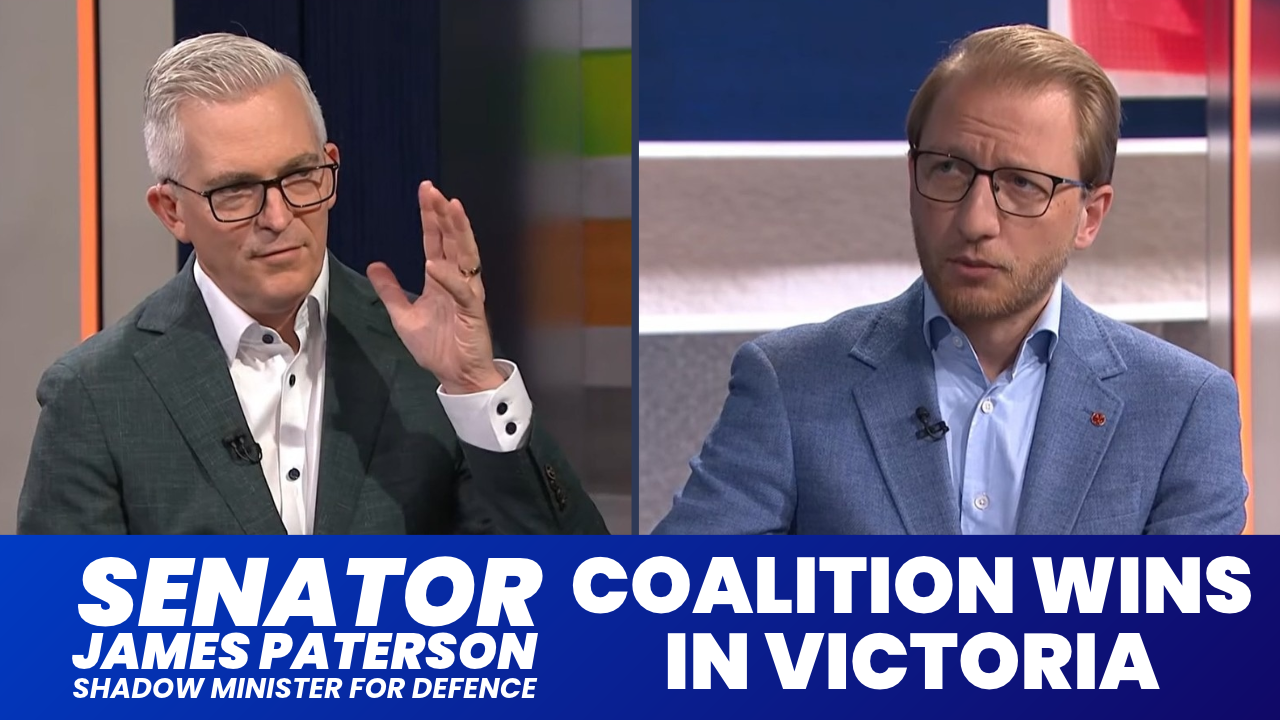
Topics: Jess Wilson wins the Victorian state election, Defence base security, Pacific treaties, Leah Blyth
E&OE…………………………………………………………………………………………
DAVID SPEERS: James Paterson, good morning to you and Liberals haven't had much to celebrate in Victoria for a long time, so I'm sure you're enjoying the moment. Can you explain why this has happened?
SENATOR JAMES PATERSON: It's down to a range of different factors. Obviously, the Victorian Labor Government has performed atrociously on so many things that are important to Victorians. It's not just that there was corruption in this government, but there is corruption that had consequences for the lives of Victorians. It's not just that $15 billion walked off building sites via the CFMEU into the pockets of organised crime, it has meant that the potholes were rife across this state.
SPEERS: So these were Labor failures, basically, that drove this result?
PATERSON: Not only. I mean, it's not enough to win an election just to have a bad government. You also have to have a united, determined, disciplined, focused opposition that meets the test, meets the threshold for the voters that you are ready to govern and that you'll take the state in a better direction. And Jess Wilson and her Liberal and Nationals team did that. She led from the front, but her team backed her in, and they had that unity and discipline and focus that is critical.
SPEERS: The Coalition's primary vote is only slightly better than it was four years ago here in Victoria. Do you accept that this is really Labor's vote collapsing, splintering and the One Nation preferences helping the Coalition form government?
PATERSON: There's still a fair bit of vote to count, David, particularly pre-polls and postals, and I think you'll see our primary vote rise a little bit more. But obviously this is a rejection of Labor in Victoria, a stunning and catastrophic rejection of them. And there are many Victorians who didn't want to vote for a major party who were looking for any alternative. We met them on the polling booths. I think one of the most important things that Jess said last night is that many people voted Liberal for the first time, but many people also preferenced the Liberal Party for the first time. And as Raff was saying, she understands that is a borrowed vote. That's a rented vote. We don't own that, and it requires real humility and real delivery to earn that vote again in four years' time.
SPEERS: So just on that, how critical is a preference deal between the Liberals and One Nation?
PATERSON: We actually didn't do a preference deal. I know there was a lot of hullabaloo about that from the Labor Party, but we were trying to get rid of a corrupt Labor government. We were never going to preference Labor ahead of One Nation. Imagine if we had. And One Nation was never going to preference a corrupt Labor government ahead of the Liberal Party, so there was no preference deal done between One Nation and the Liberal Party.
SPEERS: But how are you thinking about it federally now? That issue of a preference deal?
PATERSON: Sure, but just to conclude this point, because it has implications there - One Nation voters didn't want a Labor government. Whatever the How To Vote card that One Nation printed said, One Nation voters weren't going to be preferencing the Labor Party high, they wanted to get rid of this government too, and so the power is in the hands of the voters. I'm not going to pre-empt our decision federally.
SPEERS: Does this change your thinking, though, on that?
PATERSON: No, it doesn't. I think the key lesson federally that comes out of this is that if you want to get rid of a bad Labor government, the only way to do that is to vote Liberal and National. No other party can get rid of a bad Labor government except the Liberal and the National Party.
SPEERS: One Nation will have a strong presence in the upper house. They'll be needed by the new Coalition government to pass legislation. What sort of challenge will that present for Jess Wilson?
PATERSON: Look, it's possible there'll be multiple pathways for legislation in the upper house. It may be that the Liberals can, Nationals can, work with One Nation or Labor or even the Greens to pass legislation in the upper house,. Let's see, there's a long way to go in that.
SPEERS: Do you think they'd be keen to do that?
PATERSON: Well, I think they will be happy to have options. I think that they will be happy because on different issues different parties can agree, and they'll deal with the Parliament that the Victorian people give them. I think the other real question, though, David, is whether the One Nation can hold together over a term of four years, all of its MPs. It doesn't have a good track record here. Of every One Nation MP elected in the history of our state and federal parliaments, 70 per cent have left the party or the parliament before the end of their first term.
SPEERS: So you think One Nation could fall apart here?
PATERSON: Well, let's see if they can remain a cohesive entity with such an inexperienced team politically.
SPEERS: Did federal issues play a role here?
PATERSON: Look, it was predominantly a state election fought on state issues, but there was some federal overlay or overhang. I think the first is that the Prime Minister is deeply unpopular, especially here in Victoria. You don't have to trust my word for it. Even Ben Carroll, at his level of public support, didn't want to be seen with the Prime Minister in the campaign.
SPEERS: It might have been the other way around, possibly.
PATERSON: Maybe it was mutual. But the other thing is the Labor brand in Victoria was very damaged, I think particularly by the federal Budget in May. It was obviously an economically reckless thing to do to increase those taxes and to smash the housing market. But it was a politically reckless thing to do as well. In a time of disillusionment in politics, the Prime Minister broke a promise that he himself said he made 50 times. And no wonder people don't trust the Labor Party.
SPEERS: Look, the Liberals did wait until the final two days of the campaign, when half the state had already voted, maybe even more, to unveil those policy costings, including this surprise privatisation plan of the sewerage works and other things. Did you see that as a clever move, and did you advise Jess Wilson to do this?
PATERSON: David, I think Jess deserves enormous credit for how upfront she was about the state of the budget and the difficult decisions that will be required to fix it. Six months out from the election, she stood up, and she said she was going to have a back office hiring freeze on the public service to save $22 billion over a decade.
SPEERS: But she didn't mention these privatisation issues. In fact, she said that she wouldn't do this.
PATERSON: I'll come to that, just quickly on this. When she made that announcement after the state budget, there were journalists who said this was a very, very bold gamble and it might not pay off, it might cost the Liberals the election. During the election campaign, they announced more savings early in the campaign, including selling off land and saving a billion dollars by scrapping the Treaty and other things. And every time she was asked, because I was with her, Jess said there'll be more savings to come, we'll announce that in our costings. So for anyone for whom that was important, they could wait until the costings before they cast their vote. Obviously, a lot of Victorians decided they knew they had enough information to vote already without that. And then, in the costings, she was open and transparent. And I think the telling thing here David, is we expected a big difference between our pre-poll and postal vote and the vote on the day. That's generally what happens, we generally trend down, but even voters who had that information about the sewage lease - not privatisation - for 90 years still decided to vote Liberal and National.
SPEERS: Why not release it earlier then? Why not tell people up front before they vote?
PATERSON: Because they were genuinely going through the costings process with the Independent Parliamentary Budget Office. It's a small team.
SPEERS: You are seriously saying this had not been decided until two days before the election?
PATERSON: It was not. The decisions were made as the costings came in; final decisions were made in the days before it was announced.
SPEERS: Okay, so you think this is a strategy that federal Liberals should emulate, wait until two days before to unveil privatisation plans?
PATERSON: No, David, I'm not saying that. It's a cheeky way of asking the question, but that's not what I'm saying. I'm just saying Jess was up front with voters about how dire the state of the books were and the tough decisions that will be required.
SPEERS: But you clearly think the strategy worked. I mean, federally, you guys have a lot of promises that we don't know how you'll pay for. I could go through the list, but you know it's a big list. Will you wait until two days before the election to announce a whole bunch of privatisations?
PATERSON: We have announced $31 billion of savings that we would make already.
SPEERS: Yes, but you've also promised everything from repealing the negative gearing, capital gains tax, trust changes, your own tax cuts, more defence spending, I mean, I could go on. Your $31 billion doesn't scratch the surface.
PATERSON: When before have you heard a Federal Opposition announce $31 billion of savings, potentially 18 months before an election? We are being upfront, we are saying...
SPEERS: The question is, will you announce privatisations two days before the election?
PATERSON: I would have no insight into that. I'm the Shadow Minister for Defence. I'm sure we will be upfront and honest with Australians before the elections about what our plans are.
SPEERS: Well let me ask you directly, would you privatise Snowy Hydro?
PATERSON: David, I'm the Shadow Minister for Defence. It's the last thing I'm thinking about right now.
SPEERS: The NBN?
PATERSON: That is not my portfolio. That's a matter for colleagues.
SPEERS: The ABC?
SPEERS: No decisions have been made on any of those things. I mean, these are getting kind of ridiculous, those suggestions.
SPEERS: So those sort of privatisations are ridiculous?
PATERSON: David, obviously we're not going to privatise the ABC. I think, you know, you can be pretty safe on that one.
SPEERS: I'm glad to hear that. Australia Post? NBN? Snowy Hydro?
PATERSON: I've not had any conversations with any of my colleagues about those.
SPEERS: That's not a no.
PATERSON: Well, David, we will be upfront and honest with the Australian people.
SPEERS: Before the election campaign?
PATERSON: As Jess and her state team were with the Victorian people before they vote. It's up to them to decide when they vote, but we'll be upfront and honest.
SPEERS: A bill, let's turn to some other issues, a bill passed to Parliament during the week that will give the Defence Minister new powers to create defence security zones anywhere in Australia. The aim is to improve security at defence bases, ban photos being taken, things like that. But these zones could also cover data centres and would allow the Defence Minister to exempt contractors and even foreign personnel from state and federal laws. Are you comfortable with this?
PATERSON: We supported the legislation, but only after I asked the government to refer it to the Parliamentary Joint Committee on Defence so that it could do an inquiry. And our team on that committee, led by Dave Sharma as Deputy Chair, made recommendations to increase parliamentary oversight of these powers. I think one of the things that's been lost in this debate is why this is necessary. There have been hundreds of drone incursions over our most sensitive military bases, including RAAF Williamtown, where the majority of our F-35 fleet is. And up until this legislation passed, it was not legally clear that our defence personnel had the power and authority to shoot a drone down above a base. Now some of those are probably just kids doing silly things, but some of them could be more nefarious. It's incredibly dangerous. And what we have been telling our defence personnel to do was close the blinds. Close the blinds is not an adequate protection for sensitive defence facilities.
SPEERS: And is this the right approach, or is this overreach?
PATERSON: Look, it's up to the government to defend their own bill and the detail of it, but our judgement was that it is in the national interest for our Defence Force personnel to be able to protect our bases.
SPEERS: The government signed a string of treaties and security agreements now across the Pacific, the latest was with the Solomon Islands. Do you give the Albanese government credit for what it's done here and importantly, would you keep these treaties and agreements in place?
PATERSON: We do absolutely give them credit. It is in Australia's national interest to strengthen our relationship with the Pacific, and it doesn't need to be needlessly politicised. I'm particularly pleased about the sovereign decision of the government of the Solomon Islands and the new Prime Minister to change his security relationship with the People's Republic of China and to strengthen his security relationship with Australia. Anyone who understands the history of World War II and the war in the Pacific could understand how strategically important the South West Pacific is to Australia, and we are part of the Pacific. It is our family, and I think the security of the Pacific is best provided by nations of the Pacific, including Australia.
SPEERS: I wanted to ask you about the Nakamal agreement, one of these agreements, with Vanuatu. It has a clause, Article 4, which commits both Australia and Vanuatu to targeting net zero emissions by 2050. So would you keep that agreement with Vanuatu?
PATERSON: We're very supportive of these agreements, but we do have some reservations about things that stray beyond the narrow security relationship between the Pacific Islands and Australia. We don't think it's appropriate to bind a future parliament of Australia on domestic public policy settings like climate and energy policy, and we think the Australian people deserve the right to elect a government that would make different choices in climate and energy policy as one example.
SPEERS: Ok, but if Vanuatu sees climate change as an existential threat, a security issue, you're saying, no, it's not. Are you prepared to scrap that agreement?
PATERSON: I understand why climate change is important to the Pacific, and I think we need to respect that and listen to that carefully, and we would need to look at these agreements carefully and decide whether or not…
SPEERS: So you're not committed to keeping that agreement in place?
PATERSON: Well, I didn't say that, David, what I'm saying is these are really important agreements in Australia's national interest. There are some elements of the agreement…
SPEERS: But would you keep this agreement or not?
PATERSON: We haven't made any decisions about that yet, David.
SPEERS: So you are not committed to it?
SPEERS: David, there are some elements about the agreement that we are uncomfortable with. We have not made a decision to scrap any of these agreements. We will look at it very carefully to make sure that it continues to be in Australia's national interest.
SPEERS: That does leave a question mark over these agreements in the Pacific.
PATERSON: We've been upfront and honest about this. In the Joint Standing Committee on Treaties, we put in a dissenting report that said we're uncomfortable with these elements of the agreements, but we support the agreement.
SPEERS: And look, finally, let's turn to the surprise defection of Liberal Senator Leah Blythe during the week to One Nation. How is it that no one in the party seems to have known this was happening? Do you guys talk to each other? Does it surprise you at all?
PATERSON: It certainly was surprising. It was disappointing. I thought I had a good relationship with Leah. We worked together in the defence portfolio, and never did she let on to me that she was so unhappy with the direction of the Liberal Party that she might defect to One Nation. In fact, the only conversations we had about the direction of the Liberal Party was that she was happier with the direction of the Liberal Party under Angus Taylor. I understand she had a very tough pre-selection coming up in South Australia. But frankly, Leah was critical of other Liberals who might defect to One Nation, highly critical of other Liberals who might do it, and she's now done it herself. So I find it very difficult to understand.
SPEERS: So what does it say about the dysfunction of the South Australian Liberal Party Division?
PATERSON: I don't comment on other divisions of the Liberal Party. You know, the Victorian division has had a good night. I hope our other divisions around the country have a good night like we've just had, and I'm not going to give them public advice.
SPEERS: By the sounds of it, I mean, here is Senator Leah Blythe, who is clearly unclear whether she was going to be given that winnable position on the preselection, Senate preselected ticket. But there's also doubt about whether your other existing senators, Kerrynne Liddle will be given a spot, Andrew McLachlan. I mean would that concern you if sitting senators are bumped off the ticket?
PATERSON: The Liberal Party is a democratic party. All of us have to appeal to our members to justify our role in public life. I accept that in a future election I'll have to put myself before my members too if I choose to run again. I have to ask them for their support again, and I hope that I get it if I choose to run again. But there is no guaranteed jobs in politics and nor should there be. We have to demonstrate our performance, frankly it's not about us.
SPEERS: You know these concerns about the South Australian Division, and Alex Antic is the President. Would you support federal intervention?
PATERSON: I haven't seen anything that would justify a federal intervention into the South Australian Division. A very high bar needs to be met before you can justify an intervention of very serious malpractice or malfeasance in a division, and I haven't t seen that.
SPEERS: Shadow Defence Minister James Paterson, thanks for joining us this morning.
PATERSON: Thanks, David.
ENDS