

Media
|
Transcripts
July 30, 2026
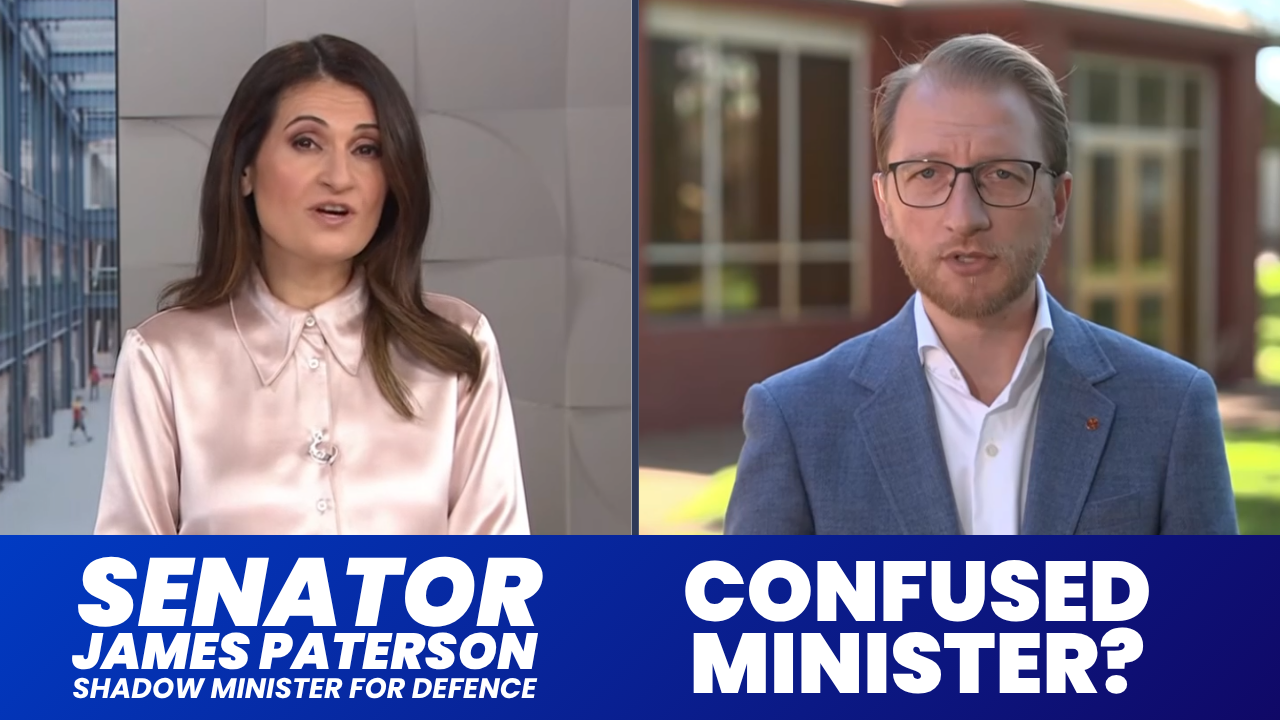
PATRICIA KARVELAS: Also today, a day after Defence Industry Minister Pat Conroy told the ABC 7.30 that America's submarine rotational force would come to an end once Australia's own Virginia-class submarines began arriving under the AUKUS Submarine Pact. He has walked back those comments, saying the agreement could be renewed. For some reaction on this and some other stories, there's quite a lot to talk about actually, I want to bring in the Shadow Defence Minister, James Paterson, welcome to the program.
SENATOR JAMES PATERSON: Good afternoon.
KARVELAS: Pat Conroy yesterday said the US presence known as Submarine Rotational Force West, SRF-West, would come to an end once Australia's own Virginia-class submarines began arriving from the US. That's all under AUKUS, and that's by 2032, right? He has clarified that. He says the agreement could easily be renewed or expanded. He's technically correct, isn't he? It does come up, and then it's up to the government of the day to make a decision about what happens next.
PATERSON: Well, Patricia, let's be clear. This is a very embarrassing stuff up from the Defence Industry Minister. He's doing his best to clean it up today, but I think it would just be better to admit that he got it wrong and that in answering Sarah Ferguson's question, he said something that he didn't intend to and doesn't reflect the government's intentions. By pure coincidence, I'm in Western Australia, and this morning I visited HMAS Stirling where Submarine Rotational Force West will be. I saw the good progress that's being made on the base to upgrade the facilities to host our American and British friends on base and I can tell you that the kind of investments that are going in there are not investments that are going come to an end, the base is not going to be closed and it's not also purely just for Australian submarines even when we receive those Virginia-class submarines. It was always envisaged, and it is a critical part of the AUKUS deal for our American friends, that they're able to have a rotational presence of Virginia-class submarines for the ongoing future, and it's extraordinary that on national television while in the United States, Pat Conroy has effectively issued a public eviction notice to the US Navy before they've even arrived here at Stirling.
KARVELAS: But let's be technical here. It does actually end in 2032. Is the agreement itself a public eviction notice?
PATERSON: Well, I think it's really important to remember why he was being asked this question and what his answer was in response to. Sarah Ferguson was asking about the fact that Virginia-class submarines will in the future be equipped with tactical nuclear weapons, and would that be a problem for our treaty obligations because we're a signatory to the Treaty of Rarotonga, we don't permit nuclear weapons on Australian soil. And in answering that question, he said, well, it won't be a problem because the Submarine Rotational Force West is leaving in 2032 before the Virginia-class submarines get equipped with tactical nuclear weapons. So what he was saying is, don't worry, there won't be any American submarines at Stirling post-2032. But of course, he's now said today that's not true, that there will be an ongoing presence of US submarines beyond Submarine Rotational Force West, beyond 2032. So why was it relevant to him to talk about the end of SRF-West to Sarah Ferguson, in answering a question about nuclear weapons, if there is going to be an ongoing US submarine presence here in WA?
KARVELAS: Okay, so you're pointing out that he's made a mistake as you frame it, but do you have a concern with the government's policy? Because you're saying that the government policy is that it would be ongoing, right?
PATERSON: I have a concern that we have a Defence Industry Minister who's either not across the details or is shooting from the hip. And a story just posted online in The Nightly by Andrew Greene says that this has sparked concern in the Pentagon, and that our US partners have sought urgent clarification from Australia about whether or not they will be welcome here beyond 2032. This is our most important security relationship. The ongoing presence of US submarines in the Indian Ocean via HMAS Stirling is critical to our shared security interests because we're engaged in a shared collective effort to deter conflict in the Indo-Pacific, and if we're putting a date around their departure publicly out there, that's an advertisement for potential adversaries that they can take advantage of vulnerabilities beyond then. So it was an irresponsible and reckless thing to do. And when you make a mistake, as we all do in public life, no-one is perfect, you should just own up to it. I think Pat Conroy should own up to it. If he can't, then I think his senior minister, Richard Marles, needs to come out and clarify this urgently.
KARVELAS: Okay. I want to move on to a couple of other issues if I can. Angus Taylor has been mentioned at ICAC. The inquiry then discussed an in-person meeting during which, according to messages between key reformers in this group, Taylor allegedly agreed to initial payment of $15,000 followed by a monthly injection of $3,000. Now, he has said he has not written a check, but shouldn't he clarify whether this meeting took place and what was asked of him?
PATERSON: Well, as you said, Patricia, this is a matter before the NSW ICAC, the less publicly said about it speculatively by people like me who have no connection to it or NSW, the better. Angus Taylor was asked a direct question and has provided direct answers, which is this payment was never made, and I really think we should let ICAC get along with its work.
KARVELAS: So you don't think it's important that he corrects the record on what he was asked, his involvement more broadly?
PATERSON: I think he's answered all reasonable questions about it. It's really a matter for ICAC to pursue to the extent they think it's necessary to do so.
KARVELAS: Okay. I mean, a lot of people still say he's got questions to answer because he's only clarified that one part of this, which is that he didn't write the cheque. Aren't you concerned by some of these allegations that are emerging at ICAC and this factional group that formed and the fact that they even were asking this potentially of him, allegedly?
PATERSON: It's a good thing we have ICACs in New South Wales and other states, where they can investigate matters like this. It's a good thing that they've got the powers that they have that they can get into this. Of course, in my home state of Victoria, we've had a Victorian Labor Government which has staunchly resisted requests from our own independent broad-based anti-corruption commission for the powers they need to investigate the corruption that's occurred on Labor's watch in Victoria. They've even, until this week, refusing to call a Royal Commission and have shamelessly backflipped on that under political pressure. So I think these bodies are important, I think they should have the powers that they need, and I think that they should be allowed to do their work.
KARVELAS: Luke Gosling is the Federal Labor MP who has been charged with assaulting the Northern Territory Administrator. The Prime Minister says this is a legal process now and he's right, I mean, you just used that defence about ICAC, that it's a legal process. If it's a legal process, should he be commenting?
PATERSON: Well, there's a difference here, which is that one of his MPs, who is also a special envoy for Defence and Veterans Affairs, has been charged with two counts of assault, was arrested by police, and has been released on bail. That is a serious matter. No one should be serving in a ministerial or quasi-ministerial role while facing serious charges like those. I make no judgement about Luke Gosling's guilt or innocence. He's entitled to the presumption of innocence. We should allow the legal process to follow, but in the meantime, he should stand down from that role. I mean, the precedent is very clear here in the previous Parliament under previous governments. People facing allegations that were historic in nature that did not even amount to charges, let alone convictions, were required to resign from their positions. Anthony Albanese, when he was opposition leader, was frequent in demanding people's resignations for allegations. The least he can do is be consistent and enforce that on his own ministry.
KARVELAS: Just finally, the One Nation leader has appealed to work with your side of politics on her plans to block people found to have worked with or assisting terror groups. It's been rebuffed by the government. The government says it wouldn't stand up in the High Court. Do you think you should work with her?
PATERSON: Well, we're willing to work with anyone who wants to stop these ISIS fighters coming back to Australia. And Tony Burke's answer that you played earlier, frankly, gives me no comfort and should give the Australian people no comfort that this government is doing everything they can to protect us from someone who left our country to go and join one of the most reprehensible terrorist organisations the planet has ever seen. We don't want these people back in our country. We introduced a bill into the Senate in March through my colleague Jonno Duniam, the Shadow Home Affairs Minister, which would have taken a number of steps which would make it harder for these people to return, including criminalising assistance to people who are in terrorist hotspots or members of terrorist organisations from coming home to Australia. We're willing to work with anyone who wants to protect Australians.
KARVELAS: So you are happy to work with Pauline Hanson on her laws?
PATERSON: Well, what I think the most helpful thing to do here with this proposed legislation is for it to be introduced and referred to a Senate Committee so that it can be examined. These issues around constitutionality can be explored, and the parliament can make an informed judgement about it.
KARVELAS: So you don't agree with Tony Burke that this wouldn't, you know, last a short period of time in the High Court, it would fall over straight away?
PATERSON: Well, I'm just not willing to take Tony Burke's assurances at face value. I think this should be properly tested by the Parliament. Any senator or member has a right to introduce a private member's bill, to have it examined by a Senate committee, to have experts come in and give evidence, and for us to weigh up that evidence and make a decision accordingly. I mean, this is a government that's given us constitutional assurances in the past that turned out to be completely false, including in the NZYQ matter. So I think it should be tested.
KARVELAS: Thank you so much for joining us.
PATERSON: Thank you.
ENDS