

Media
|
Transcripts
May 29, 2026
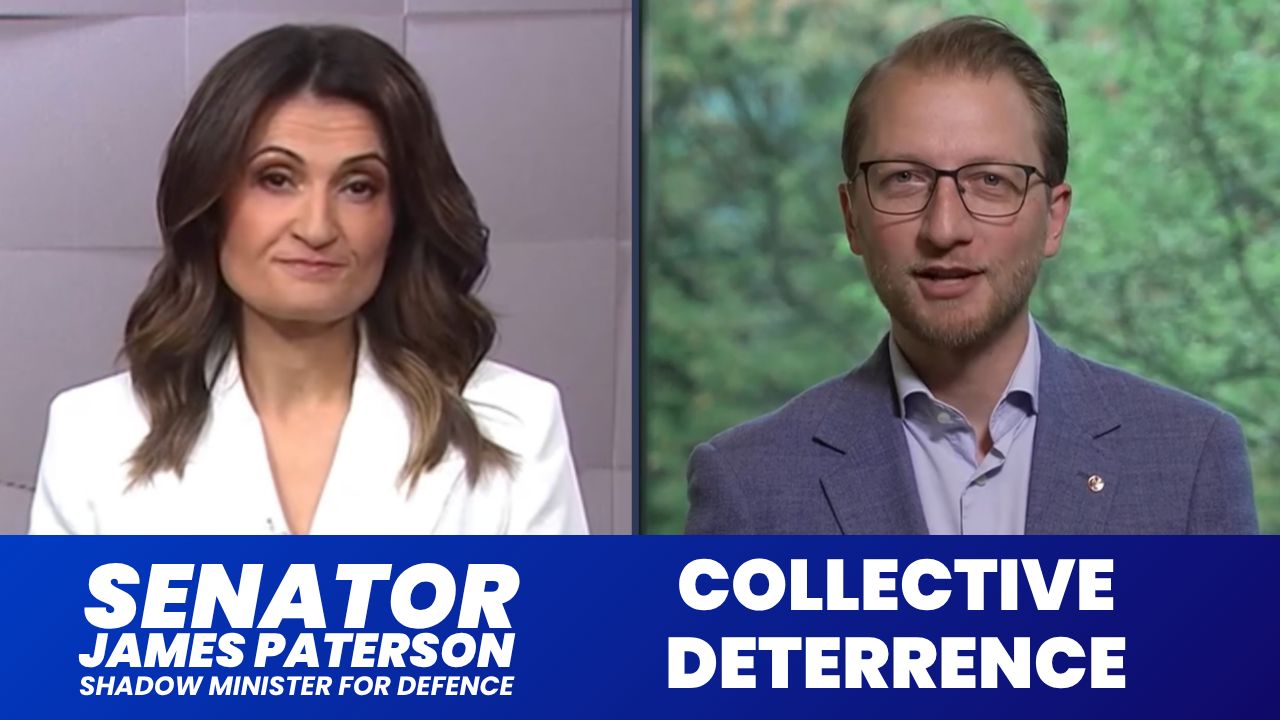
PATRICIA KARVELAS: James Paterson, welcome to the program.
SENATOR JAMES PATERSON: Thank you for having me, Patricia.
KARVELAS: Why is Tony Abbott the right person to take your party forward?
PATERSON: I'm really pleased that Tony has stepped up and offered to serve as president of the Liberal Party. He is someone who has a deep commitment to our cause, and he is the best campaigner that the Liberal party has fielded in modern times, the most devastatingly effective opposition leader in that period, particularly between 2009 and 2013. And his task is to get the organisational wing and the federal secretariat fighting fit for the next federal election to support the parliamentary party in our work.
KARVELAS: Isn't he a symptom of what's also gone wrong in the party?
PATERSON: What do you mean by that?
KARVELAS: Well, I mean, he was rolled as Prime Minister, of course, and began the revolving door of prime ministers, handed down a pretty controversial budget, which was difficult for the Liberal Party. I could continue. I'm just trying to put to you that he's also part of an era of the past, a legacy that had some difficult chapters.
PATERSON: Well, it is often the case that Federal Presidents of the Liberal Party and indeed Federal Presidents of the Labor Party are former senior serving politicians, and I think Tony is someone who's got a passion and commitment to our country and our party and wants to serve. It's an organisational role though, it's not a parliamentary role, it is not a policy role. His task is to get the campaign machine firing so that we can take the fight up to Labor. It's up to the parliamentary party to chart our course, particularly in terms of policy, and it's up to the organisational wing to provide us with the manpower, with the technology, with the resources to have that contest at the next election.
KARVELAS: So we won't have any policy influence, does that mean?
PATERSON: No, I mean, Federal Presidents of the Liberal Party have never had a role in the policy of the party, we are unlike the Labor Party in that there's a very clear separation between the organisational wing and the parliamentary wing, the organisational wing is responsible for running campaigns and choosing candidates, and the parliamentary wing is responsible for setting policy. It's been that way since Robert Menzies founded the party more than 80 years ago. Unlike Labor, which has a culture of the organisational wing being able to bind the parliamentary party on policy, we do not have that tradition.
KARVELAS: Okay, this is the Federal Council that's about to begin, that's where he will be formally, of course, elected leader. What else do you plan to do at this meeting?
PATERSON: Well, there are always speeches, including one from the Opposition Leader in Victoria here, Jess Wilson, welcoming us. There'll be speeches from Angus Taylor, and Jane Hume, and other senior colleagues. And there will be policy debate where members get to have an opportunity to have their say, to bring their ideas forward for us to consider.
KARVELAS: Okay, and on those policy debates, what are the most contentious and important policies that you have to debate?
PATERSON: That's a good question, Patricia. I'm not across all the motions that members have submitted, but traditionally they span the full spectrum of policy issues from, for example, taxation, and foreign policy, and defence, to social policy like childcare and education. So that is a thing that members can bring forward on behalf of their divisions and make the case for, and we listen to their contributions and consider them as part of our process.
KARVELAS: You were the first person to say earlier this year that the party needed to change or die. Do you think you are successfully changing rather than dying?
PATERSON: It's an ongoing process, Patricia, there's no doubt about that. I said at my press conference where I announced my resignation from the front bench, that this wouldn't be solved quickly, nor would it be solved by one person. It's a collective responsibility that all the parliamentary party needs to accept and needs to work towards. And when you lose trust with your voters, as the Liberal Party has done in recent years, it takes time to win it back. When someone walks away from a political party that they have traditionally supported, simply a leadership change is not going to be enough to earn it back. We're going to have to demonstrate performance, unity, focus, discipline, and ideas on a consistent basis over a long period of time to re-earn that support. I'm confident we've got the settings in place to do that, but I and all my colleagues understand that this will be an ongoing process.
KARVELAS: Okay, when you say it takes time, of course, you know, the word time can mean many things. What sort of time frame are you talking about?
PATERSON: I'm not going to be specific about it. This is politics, it's more art than science. There's not a hard and fast deadline that you can put on it, except that we understand that there are people who are disappointed in our party, who want us to do better, and particularly in light of the most recent Federal Budget, want to see us fight for them and fight for Australia, and we will do that. We'll fight Labor's toxic taxes, their broken promises, whether it's on CGT, negative gearing, or trusts. And who knows what else will be coming down the pike if Anthony Albanese can change his mind on those things, as he did on stage 3 tax cuts and superannuation taxation, who knows what he'll change his mind on next?
KARVELAS: Okay, I mean, we've seen just in the last week, of course, Labor's got their tax policies pertaining to housing on the table. One Nation, who are your peers on the right, at least, main competition, have also announced negative gearing changes to limit the number of homes people can negatively gear, not the same as Labor's policy, but very much a restriction though on negative gearing. Theirs is about two properties, which would be the limit. You're the only party that hasn't moved on this yet. It has popular support. Doesn't that show that you're out of touch with voters?
PATERSON: I don't think that's true. I mean, we announced on budget night, sorry, budget reply night, as part of Angus Taylor's speech, a $5 billion infrastructure fund to unlock the supply of more housing. That's a critical policy for making housing more affordable. And we announced one of the most substantive income tax policies ever by a federal political party, our tax back guarantee, which is indexation of personal income tax thresholds so that voters in the future, Australians in the future, will never have to pay higher taxes just because inflation pushes them into a higher tax bracket. Effectively, compared to what Labor's offering, they'll be getting a tax cut every year under a Taylor led government.
KARVELAS: I want to change the topic, if we can, to that very much in your portfolio. Donald Trump's former defence secretary, Mark Esper, told The Nightly today, it is expected Australia would fight China over Taiwan alongside the United States, saying the likelihood has been discussed between the two allies for years. Was this discussed while you were in government, and do you think that's what we would do?
PATERSON: I wasn't party to any discussions like that, so I can't authoritatively comment on that. What I can comment on is more broadly his observations. I agree with him to an extent, I agree with him that it is a critical and core national security priority for the United States, for Japan, for the Philippines, and for Australia to prevent conflict over Taiwan, and the best way we can do that is with credible collective deterrence. Where I disagree with him is that a current government should pre-commit on behalf of a future government on how we would handle any contingency or any conflict that might arise. It's not possible, nor is it desirable in my view, for us to pre-commit to future conflict. That is a sovereign choice that must be made by the Australian Government at that time based on those circumstances.
KARVELAS: And does this demonstrate that this administration expects a pre-commitment from us?
PATERSON: Not necessarily because I note that the administration hasn't made that pre-commitment themselves. The US administration continues to hold a policy of strategic ambiguity, where they are not clear about what they would do in the event of a conflict over Taiwan, and so Mr Esper is asking Australia to do something that the United States itself has not done, nor have our other allies.
KARVELAS: And that's an unreasonable request, right? I mean, that is a request that we should make quite clear that we don't intend to respond to?
PATERSON: Well, I've said very clearly that it must be a sovereign choice of an Australian Government at the time whether or not we would commit ourselves to conflict and how we would do so and it would depend on the circumstances of the time. It's impossible to bind a future government as a current politician without knowing all of those circumstances and all those facts. So I think we should maintain our strongly bipartisan policy in relation to Taiwan, which is, we are opposed to unilateral changes of the status quo, and we do want to discourage and deter any conflict or any unilateral change.
KARVELAS: Do you get the sense that this is an issue that is accelerating? Obviously, there are lots of different analyses, and reading the tea leaves about where this is all going. Do you really feel like this is a live issue now?
PATERSON: Well, we have to take the Chinese Communist Party at its word, and they've said that, in their words, reunification with Taiwan is a core national objective, and Xi Jinping has asked that the People's Liberation Army be ready to conduct combat operations over Taiwan as early as 2027. But the Chinese government has also said that it has not made a decision about whether or not it would use force, and, of course, they would prefer to reunify with Taiwan without the use of force. So there are lots of different factors that would go into that consideration. One that I would point to that's available in open source is that Xi Jinping has sacked his Foreign Minister, his Defence Minister, his equivalent of the Chairman of the Joint Chiefs of Staff, the head of the military, and the General of the Rocket Force and the CEOs of the State-Owned Enterprise that supply rockets to the Rocket Force. So very clearly Xi Jinping has concerns about the state of readiness and ability of the People's Liberation Army, and I think that is a factor that he would have to very carefully weigh up in relation to this conflict.
KARVELAS: Just returning to domestic politics before I say goodbye to you and let you get on with your events for the afternoon, and of course, going into the weekend. That Redbridge poll that was published recently showing that One Nation is set in the worst case scenario, for you at least, not for them, to win a swathe of seats and unseat Liberals. How much is that going to be front and centre of this Liberal Council meeting?
PATERSON: Well, all of the polls, whether it's that or others, show that we've got a big task ahead, and everyone knows that. We understand how serious this moment is for our party and for our country, although I believe that most of the data in that particular poll was taken prior to the budget, and I really do think the budget has changed the political dynamic dramatically here in Australia. When the Prime Minister himself admits that on 50 occasions he ruled out changing things like capital gains tax and negative gearing, and he goes back on that promise, it does raise questions in the mind of voters; if this government was re-elected, what would they do? Would they tax the family home? Would they introduce a death tax? And if they deny that they're going to do those things before the election, why should we treat those denials any differently from the denials that they made about CGT, negative gearing, trusts, stage three tax cuts or superannuation? I mean, this is a Prime Minister who has broken fundamentally the faith with the Australian people, and I think that puts the Liberal Party in a good position to fight for our people, to fight for country, and take it up to the government.
KARVELAS: But of course, it's some time away before we go to an election. So, is it possible? And do you worry that, from your perspective, people might get used to these changes? It's a long time till the next election.
PATERSON: Well, some of these changes don't come into immediate effect. I think the first changes start on 1 July 2027, others start on 1 July 2028. And I think there'll be a really big debate between now and then about the impact of these challenges. We've seen how vocal the small business community has been about this, not just the tech sector, which is obviously very significantly affected, but florists, and plumbers, and gym owners, and hairdressers, and other small businesses that feel that their whole world changed overnight on budget night. They feel like the government has broken faith with them, and we will fight for them all the way up to the next election.
KARVELAS: Do you think it was appropriate for Angus Taylor to use the kind of language he did about the Prime Minister in question time yesterday?
PATERSON: Patricia, you are a very experienced political journalist. You would know that that is far from the harshest thing that's been said over the dispatch botch over the years. Not always are they caught by a live mic. Sometimes they are, but honestly, frankly, I think a lot of Australians would agree with that assessment about the Prime Minister. I think he has shown arrogance, particularly in relation to tax policy. And I think many Australians are feeling that towards the government right now.
KARVELAS: Don't we have to elevate the debate though, and not use nasty language about each other?
PATERSON: Well, I encourage you to ask the Prime Minister about the things that he's said across this dispatch box that haven't been captured by a microphone in recent years since he became Prime Minister.
KARVELAS: Oh, can you tell me?
PATERSON: No, it's not my place to break that story tonight, but next time you have him on your program, I suggest you ask him.
KARVELAS: Alright, well yeah, we, particularly where I sit in the press gallery, and I go and watch Parliament, there is only so much we can hear, so you're right, it is about whether it gets caught on the live mic. Okay, have yourself a very good time at this Liberal Council. Thank you so much for joining us.
PATERSON: Thank you so much, I'm sure I will. Thank you.
ENDS