

Media
|
Transcripts
June 25, 2026
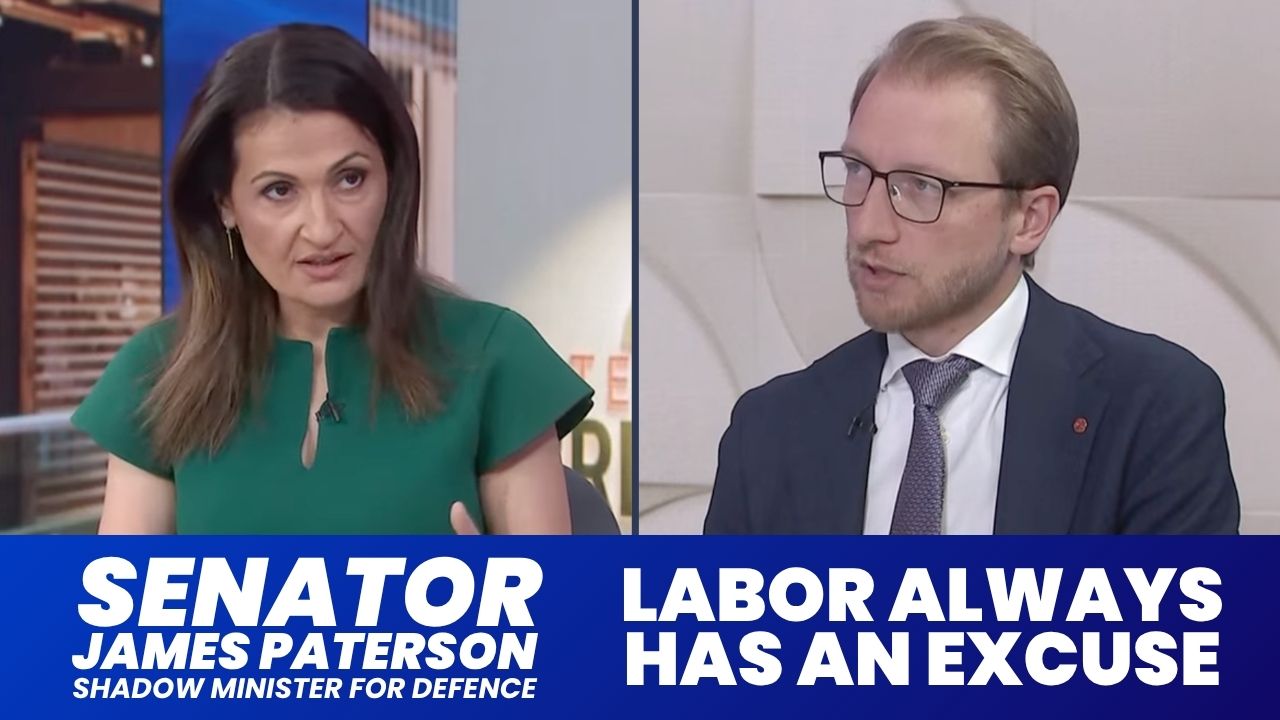
PATRICIA KARVELAS: For a view from the Opposition, I spoke to the Shadow Defence Minister, James Paterson, a little earlier. James Paterson, welcome to the program. Thank you for having me. The government says they received the final advice yesterday that they can no longer have an exclusion order any longer for this woman. That's the application of the law. ASIO tells us they're all over this. Isn't that the guarantee we need?
SENATOR JAMES PATERSON: Well, the problem, Patricia, is this government has always had an excuse, they've always had an excuse about why they can't protect Australians from this cohort of high-risk people who are allegedly affiliated with ISIS and some of whom on their return to Australia have been charged with extremely serious offences, crimes against humanity, human trafficking, I mean, these are not good people who we want to have in our country. And I would be more convinced when the government has excuses like this, if from the start of this crisis they'd shown they're willing to do whatever it takes within the law to prevent these people from returning. And I just don't think their heart has been in it. We know that Tony Burke was having secret meetings with the charity that was seeking to bring them home, there were officials in the room, he asked the officials to leave. There are incriminating notes of that meeting that say things like, where he's alleged to have said things like we could find another way to achieve our objectives, we're thankful for keeping you keeping this out of the media. I mean I think the government has been up to this in their eyeballs and now they're running away from it because of the politics.
KARVELAS: I don't think it's just the politics, it's the constitution, isn't it? They are actually coming up against the constitution and that's unavoidable whether you're in government or them.
PATERSON: Absolutely, there are constitutional constraints, and I would never advocate a government act outside the law, but also the Opposition would of course offer the government bipartisan support for any legislative change necessary to secure the security of our country and I think there are things the government has done along this journey which they didn't have to do. They did facilitate the granting of passports to these people. There are grounds under the Passports Act to refuse or cancel passports.
KARVELAS: Yeah, but on this particular temporary exclusion order, this is the way the law works. Clearly there is a problem around the way it's constructed, but did you expect them to test it in the High Court?
PATERSON: Well, if the government thinks there's deficiencies in the law they should talk to us about that. Because we've shown consistently over the last four years when the government has run into trouble with these issues, including before the courts, that we've been willing to act in the national interest, to put Australia's national security interest first. To work in a bipartisan way to fix holes in the laws and to remedy court findings when they occur. So that same offer remains on the table. If they want to keep this person out of Australia, if a legal change would facilitate that, of course we will work with them to achieve that.
KARVELAS: ASIO boss Mike Burgess says he's overhauling the terror threat level system, he wants to do that, probable isn't enough, do you think it should change?
PATERSON: Yeah, I thought this was a timely intervention from the Director-General of ASIO because I do think there are limitations with quite a binary system of terror threat warnings. The gap between probable and expected in an ASIO assessment might be quite large and in the public's mind might not be. So I think we do gradations of what an expected terror attack might be, putting more information to the public domain to give Australians confidence that our agencies are on top of this problem, which I am sure they are sincerely doing. I think it's a good idea.
KARVELAS: I want to move to another issue if I can and that's in relation to mono versus multicultural Australia. Just clarity from you, do you think we should be a multicultural nation?
PATERSON: Yeah, I believe in liberal multiculturalism as distinct from Labor's version of multiculturalism. And liberal multiculturalism is about being consistent with liberal values, recognising people first and foremost as individuals and judging them by their character, by their values. Not by irrelevant characteristics over which they have no control like their skin colour or their ethnicity or their nationality and expecting them to sign up to Australian values. But signing up to Australian values doesn't mean you can't celebrate your traditions and your heritage and your culture and I think that's perfectly consistent with the Australian tradition.
KARVELAS: Pauline Hanson, of course, was behind the monoculture word. She also said, we are one nation, we are, and it should be one language. She's really troubled by, you know, she mentioned, for instance, Mandarin being spoken in homes. Is that a problem?
PATERSON: Well, Australia's official national language is English, and it is important that everyone speak English so that we can converse with each other as fellow citizens, as colleagues, as fellow students, whatever...
KARVELAS: Sure, but in households?
PATERSON: I have absolutely no problem at all with people speaking a second language at home. For decades, if not centuries, Australians have spoken other languages at home, whether it's Greek, or Italian, or Mandarin, or whatever. That's perfectly consistent with the Australian tradition. And I think this push to impose a government-down, mandated monoculture is deeply weird, illiberal and not consistent with Australia's approach to these issues, a successful approach to these issues for a long time.
KARVELAS: You answered that quite well, deeply weird. Why didn't your leader just say that?
PATERSON: I think Angus has been very clear about this as well.
KARVELAS: He wasn't clear the other day, come on.
PATERSON: Well that's your interpretation, I know Angus' views on this, I've talked to him about this, I know where he stands and he is right to put Australian values at the heart of this. And anyone can sincerely subscribe to Australian values, it is not determined by your ethnicity or your skin colour or any other characteristic and we should never discriminate against people on those characteristics. But we should be demanding and discerning and have high expectations when it comes to values, and we should be unapologetic about that.
KARVELAS: Do you accept that it hurt Angus Taylor's leadership? I've spoken to Liberal MPs who are concerned about the way he handled this issue.
PATERSON: No, that's not my assessment from talking to my colleagues this week, Patricia. I might not have spoken to the same people you've spoken to, but my assessment is Angus is secure as leader of the Liberal Party. But we all accept these are unusual, difficult political times and as a party we've got a lot of work to do. That's a collective responsibility though, it doesn't just fall on the leader, we all have to pitch in to that.
KARVELAS: Okay, but mistakes like this, I mean, it was a bungle, wasn't it, Not being able to answer it?
PATERSON: No, I don't accept that.
KARVELAS: Really? He had to mop it up the day after?
PATERSON: I don't think that is a fair characterisation. That was a press conference in which a wide range of topics were canvassed. He's been asked other related questions. He's given more detail, been more expansive. I think it is completely normal.
KARVELAS: I want to move to some other issues. You're a leading Victorian Senator, a Liberal, and you are, I think, personal friends also with Jess Wilson, who is trying to run for Premier in Victoria. She's right now presiding over the most unusual circumstances. Moira Deeming has accused Matthew Guy, alleged an assault. What do you make of the way this is unfolding? It's quite extraordinary.
PATERSON: Well, that's a matter which is with police, and it would not be appropriate for me to publicly comment on that.
KARVELAS: You've seen the footage?
PATERSON: I have. But speaking more broadly, under Jess Wilson's leadership of the Victorian Liberal Party, I have never seen the State parliamentary party in my 21 years of Liberal Party membership as united and focused.
KARVELAS: This is not united, it's on the front page of all the Victorian papers.
PATERSON: I accept that, but I'm telling you, speaking to my colleagues in the state parliamentary party, they have a real unity of purpose and focus, and this is certainly an issue that needs to be dealt with by the police, and that's appropriate, and I will not traverse that in any inappropriate way.
KARVELAS: Did you watch the CCTV?
PATERSON: Yes, I've seen the footage that has been posted.
KARVELAS: Does it look like an assault to you?
PATERSON: Look Patricia, I would love to be able to give you a very candid answer about that.
KARVELAS: Because you have a view right based on the footage?
PATERSON: Police are examining this, and it's not appropriate for politicians to provide running commentary on what is an active police matter. I'm happy to comment on it if and when they've dealt with it, but I do not want to prejudge that.
KARVELAS: Does it worry you though that these sorts of stories are coming out when Jess Wilson is gunning to be Premier? This looks like, this looks like a rabble.
PATERSON: Certainly, any state leader leading into an election would want clear air for that because there are really serious issues in Victoria, and Jess is offering the Victorian people a fresh start in November, and that's something I think Victorians are crying out for. They have had it with this government, and it's 12 years of corruption and incompetence, and they are looking for change, and the Liberal Party can offer them that change, and I think it will be helpful when we move on from that.
KARVELAS: I have to ask you as Shadow Defence. The Ben Roberts-Smith war crimes allegations are causing issues in your party. Defence personnel spokesman Philip Thompson basically paraded a prominent critic of your colleague, Andrew Hastie, around Parliament House. This is Scott Jones he brought into the Parliament. He also, this man, had a pretty crude gesture that he made and shared on his social media. Was that appropriate?
PATERSON: So, Andrew Hastie and Phil Thompson are two very close colleagues of mine, they're two veterans who served our country in uniform, I've got nothing but respect and high regard for them. What I would say more generally is obviously in relation to the Ben Roberts-Smith matter, he's entitled to the presumption of innocence, all of us should want to see a fair trial, none of us should do anything which would prejudice that. I have also observed that the veteran community is divided on this issue. Ben Roberts-Smith has supporters and critics within the veteran community, and it's been a very active debate online between those people. My advice to everybody is, whatever view you have, however sincerely you hold it, the best thing is to let the system do its job.
KARVELAS: And should Phil Thompson not have facilitated this man around Parliament House?
PATERSON: I don't think Phil was in any way casting any judgment about the Ben Roberts-Smith matter, and I've discussed that with him, and I know he wants to see a fair trial as well.
KARVELAS: You have raised it with him?
PATERSON: I've discussed the Ben Roberts-Smith matter with him over a number of weeks, we are colleagues in the defence portfolio, you would expect we would talk about that.
KARVELAS: Thank you so much for coming in.
PATERSON: Thank you.
ENDS