

Media
|
News
August 12, 2026
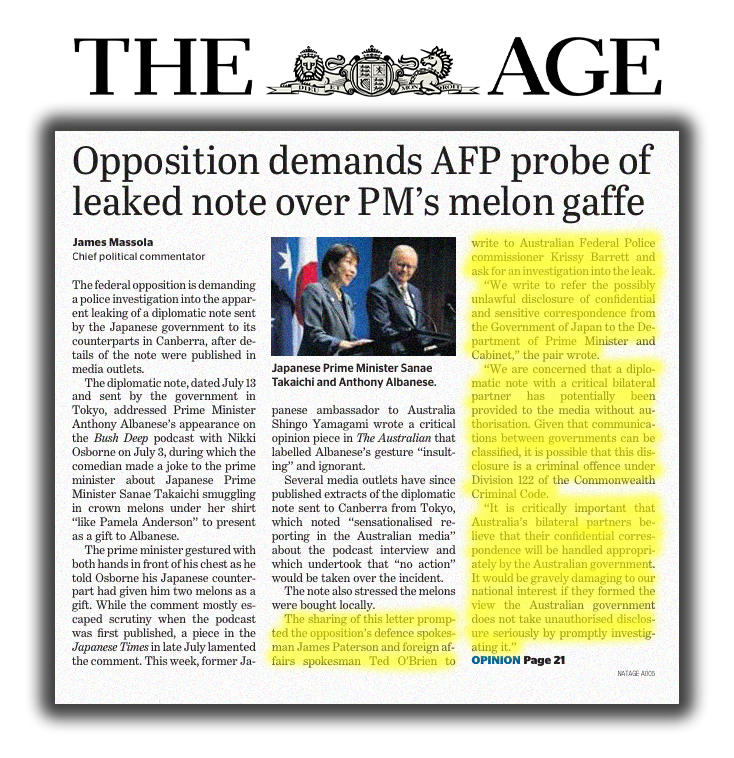
The federal opposition is demanding a police investigation into the apparent leaking of a diplomatic note sent by the Japanese government to its counterparts in Canberra, after details of the note were published in media outlets.
The diplomatic note, dated July 13 and sent by the government in Tokyo, addressed Prime Minister Anthony Albanese's appearance on the Bush Deep podcast with Nikki Osborne on July 3, during which the comedian made a joke to the prime minister about Japanese Prime Minister Sanae Takaichi smuggling in crown melons under her shirt ''like Pamela Anderson'' to present as a gift to Albanese.
The prime minister gestured with both hands in front of his chest as he told Osborne his Japanese counterpart had given him two melons as a gift. While the comment mostly escaped scrutiny when the podcast was first published, a piece in the Japanese Times in late July lamented the comment. This week, former Japanese ambassador to Australia Shingo Yamagami wrote a critical opinion piece in The Australian that labelled Albanese's gesture ''insulting'' and ignorant.
Several media outlets have since published extracts of the diplomatic note sent to Canberra from Tokyo, which noted ''sensationalised reporting in the Australian media'' about the podcast interview and which undertook that ''no action'' would be taken over the incident.
The note also stressed the melons were bought locally.
The sharing of this letter prompted the opposition's defence spokesman James Paterson and foreign affairs spokesman Ted O'Brien to write to Australian Federal Police commissioner Krissy Barrett and ask for an investigation into the leak.
''We write to refer the possibly unlawful disclosure of confidential and sensitive correspondence from the Government of Japan to the Department of Prime Minister and Cabinet,'' the pair wrote.
''We are concerned that a diplomatic note with a critical bilateral partner has potentially been provided to the media without authorisation. Given that communications between governments can be classified, it is possible that this disclosure is a criminal offence under Division 122 of the Commonwealth Criminal Code.
''It is critically important that Australia's bilateral partners believe that their confidential correspondence will be handled appropriately by the Australian government. It would be gravely damaging to our national interest if they formed the view the Australian government does not take unauthorised disclosure seriously by promptly investigating it.''