

Media
|
Transcripts
September 10, 2026
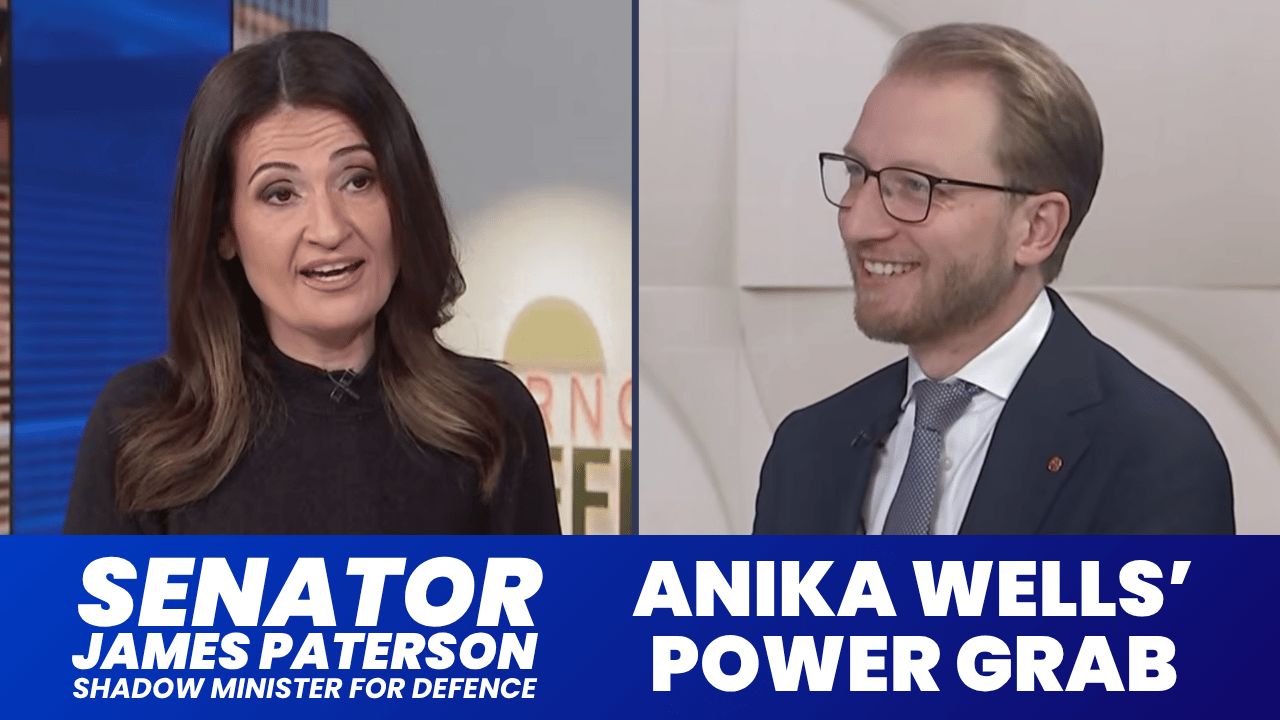
PATRICIA KARVELAS: For a view from the opposition, I want to bring in the Shadow Defence Minister James Paterson. Welcome to the program.
SENATOR JAMES PATERSON: Thank you for having me.
KARVELAS: There is division in the Senate, but you have got leave, so you can spend time with me.
PATERSON: How lucky am I?
KARVELAS: You're my favourite person right now for getting leave. You are opposing the digital duty of care laws. This is despite the fact that key people on your side of politics, Peter Dutton, and then of course people like Zoe McKenzie in her maiden speech have talked about the harms and the need for these changes. Why didn't you come up with something constructive today rather than a blanket No?
PATERSON: Well, I was listening to the interview you did before with Peter Malinauskas, who is a political leader from the other side of politics whom I respect, I think he's thoughtful. But he has a touching level of faith and confidence in Anika Wells and federal ministers here that I do not share. There's a pretty profound problem with this bill, and that is it allows a minister, a politician, to decide what constitutes harm and then restrict access to that information. In a liberal democracy, it is not a good idea to vest that power in a minister. And even if you think this government and that minister are wonderful, bear in mind that we're in a democratic country, government will change in the future, and then there'll be a different politician in that portfolio one day who you may not agree with, who will get to make those decisions. Many of your viewers probably don't like the idea of a future One Nation government. If you wouldn't trust this power in the hands of Malcolm Roberts or Pauline Hanson or Barnaby Joyce, don't put this power in the hand of Anika Wells either.
KARVELAS: Okay, so it appears to me, though, that you haven't come and said, get rid of the ministerial discretion and we'll support the bill though Is that what you're saying? Because I didn't hear that today.
PATERSON: Angus Taylor was very clear. He said we oppose the bill in its current form, and we are loud and proud about that. We are not interested in a bill that restricts the rights and freedoms of Australians, particularly at the whim of a minister. And frankly, we don't trust the motivations of this government. Anika Wells has said one of the motivations for this legislation is that when she's out in her community and she goes door knocking, people don't believe her anymore. She said that in an interview with the Saturday Paper. Well, the reason people don't believe Anika Wells anymore, or any of the ministers in this government, is not because of social media, it's because they lied. They lied about capital gains tax…
KARVELAS: Ok, so.
PATERSON: This is an important point, Patricia, please let me finish. They lied about capital gains tax, they lied about negative gearing, they lied about stage 3 tax cuts, they lie about superannuation. If you lie to people, they won't believe you, and no regulation of social media is going to fix that.
KARVELAS: No, and so that issue, in terms of ministerial power to create these categories, if the government were to remove that, would you vote for the bill?
PATERSON: Well, it would depend on what else they did to the bill. We are very clear in its current form, we could not support it, we will not support it.
KARVELAS: Well, beyond that, what are the problems with it?
PATERSON: Well, let's talk about the features of the bill that are less objectionable, that are less concerning. So the government says it wants to give Australians control over whether or not they have an algorithm or whether they have a chronological feed, which some social media apps still allow you to have that control to toggle between those two, others don't. That's not an inherently objectionable idea if Australians want to have control over that. But that idea has been packaged with a whole lot of really dangerous stuff that could impact our rights and freedoms and democracy. And we are not going to vote for a bill that includes all of that, and so we've been very clear in this form we don't support it.
KARVELAS: So if it was algorithm only, then you'd vote for it.
PATERSON: Well, that is not what we have before us. The draft bill…
KARVELAS: But, but that's not the... I asked you the question. If it's algorithm only, would you vote for it?
PATERSON: I'm not going to get ahead of my colleagues and make a judgement about a bill that doesn't exist yet and whether or not we'd support it or not. If there's a new bill, if the government changes its approach, we'll take it through our processes and we will look at it.
KARVELAS: Okay, in terms of harms for children though, the designated areas that are clear, eating disorder information, misogynistic content, do you have a problem with that list?
PATERSON: That's exactly why we were supposed to ban under 16s from social media. They're children, social media is dangerous for them, they shouldn't be on it. But the social media ban, which we supported, in fact we led the debate on, is not working, and this government has utterly failed to get children off social media.
KARVELAS: So if so many, and you're right, a lot of young people are still able to get on social media, they report that, we know that right. So, given the getting onto social media, and let's be clear here, Big Tech hasn't been particularly helpful either in making that, they've got the ability to see that, you know, our 15 year olds are on, for instance. Wouldn't you want to prohibit that material that my daughter, as a teenage girl, could see, telling her to have an eating disorder? Don't you want to stop that?
PATERSON: I don't think you can make social media safe for children because there is other content which is already unlawful, for example, violent abhorrent material of people being beheaded by terrorists or child sexual exploitation material, which is already unlawful, which you can see on social media. So social media is inherently unsafe for children, children shouldn't be on it. We should focus on making the law that's been passed by this parliament actually work, and the government needs to get down onto that implementation of that policy.
KARVELAS: Okay, so you don't think you can make social media safe?
PATERSON: No, I think you are very naive if you think we can ever make social media safe enough for a 10 year old, or an 11 year old, or a 12 year old, or a 13 year old to use, let alone younger.
KARVELAS: Shouldn't you be trying as a Parliament?
PATERSON: No, we should be trying to get kids off social media because it is not safe for them. Even if you could remove the safety issues, it's not good for their mental health. It's not good for their intellectual development. It's no good for their schooling. It's not good for their concentration. They should not be on it.
KARVELAS: Okay, so reforming it or trying to change it for those young people that are on it, you don't think is a worthy project at all?
PATERSON: I just think it's a fruitless one, even if it was worthy, it's not going to succeed. So let's focus on what we can do, which is what the under 16 social media ban was supposed to do, which is set a strong social norm to support parents in getting children off the platforms. It's not working, we need to redouble our efforts to make that work.
KARVELAS: Well, the government just tried to do that, right? With bigger penalties, and that's exactly what they're trying to do.
PATERSON: Again, they include in it a whole lot of other things which empower the e-Safety Commissioner, who has made some poor judgements in my view about the boundary between harm and free speech that made it impossible for us to support.
KARVELAS: Ok, I want to move to a few other topics. Kevin Rudd, former Prime Minister, former Ambassador to Washington. He's had lots of jobs, let's be honest. He spoke today. He warned there is a one in three chance Chinese President Xi Jinping will try to militarily seize Taiwan by 2028. Do you agree with that assessment?
PATERSON: Kevin is one of our foremost experts on Xi Jinping and the People's Republic of China, and if he is saying that we should take it very seriously, it is consistent with the warnings of other respected scholars and analysts. It is unfortunately far more likely than we would like it to be, and we should be preparing accordingly. Firstly, to deter it, to prevent it from happening, but secondly, if it does occur, to make sure we've got the ability to secure our interests and our values in that scenario.
KARVELAS: Okay, and in that scenario, another question that was asked of Kevin Rudd, it's a reasonable one, is we're now so embedded with the US military establishment through AUKUS and, you know, obviously the alliance for a longer period of time. If the US were to get involved, it would, it would be inevitable, wouldn't it? That we would be involved.
PATERSON: I don't think it is inevitable actually, I think it would be a sovereign choice for the Australian government, and they would have to make a decision based on the circumstances of the time. It would depend on a whole range of factors that we can't possibly predict now, including when and how the conflict was initiated and the circumstances of that conflict.
KARVELAS: He also said something really interesting about now that we've got this kind of incredible numbers of EVs, it is just remarkable that we should look at car manufacturing again and these sorts of things. What do you make of that?
PATERSON: I mean, if it was commercially and economically viable, I certainly have no problem with that. I think in this industry, as in other similar industries, though, scale is an enormous advantage, and there are other countries who are a long way further down that road and investing in that scale, it would be hard probably to compete.
KARVELAS: I have to ask you about this stoush between One Nation and Andrew Hastie, this cartoon where the way that he's talked about is pretty offensive, obviously, as he's described as a traitor in this. Pauline Hanson says she didn't say it though, she hasn't removed the video last time I checked, and I've checked a few times today thinking perhaps that'll happen. How's this settled?
PATERSON: Well, Pauline Hanson needs to take responsibility for her actions and the actions of One Nation. And right now, today, at the top of her X feed is a pinned post of a cartoon which is paid for by One Nation, which is animated by a One Nation state election candidate in Victoria, which is authorised by Pauline Hanson, for which she provides the voice over. And in that video, on multiple occasions, it calls Andrew Hastie a traitor. Andrew Hastie is not a traitor, he's a patriot. He has served with distinction in the global war on terror, in the ADF, in Afghanistan. Something that Pauline Hanson and James Ashby and many One Nation members have never done. And there is no graver insult that you can make, no worse smear, than to call a veteran a traitor. And they should apologise and take responsibility for their party.
KARVELAS: And if they don't, we know that they've put Ben Robert Smith in Farrer, I believe, they campaigned around this issue, what do you do?
PATERSON: Well, if they don't apologise or take it down, then it will show that One Nation's words about supporting the Australian Defence Force and supporting veterans are hollow and insincere because you cannot go around smearing veterans in the way they've smeared Andrew Hastie and pretend you support veterans. It's not just an attack on Andrew Hastie, it's an attack on every veteran and every serving member of the ADF, and it reflects incredibly poorly on One Nation.
KARVELAS: Thank you so much for coming in.
PATERSON: Thank you.
ENDS