

Media
|
Transcripts
October 8, 2026
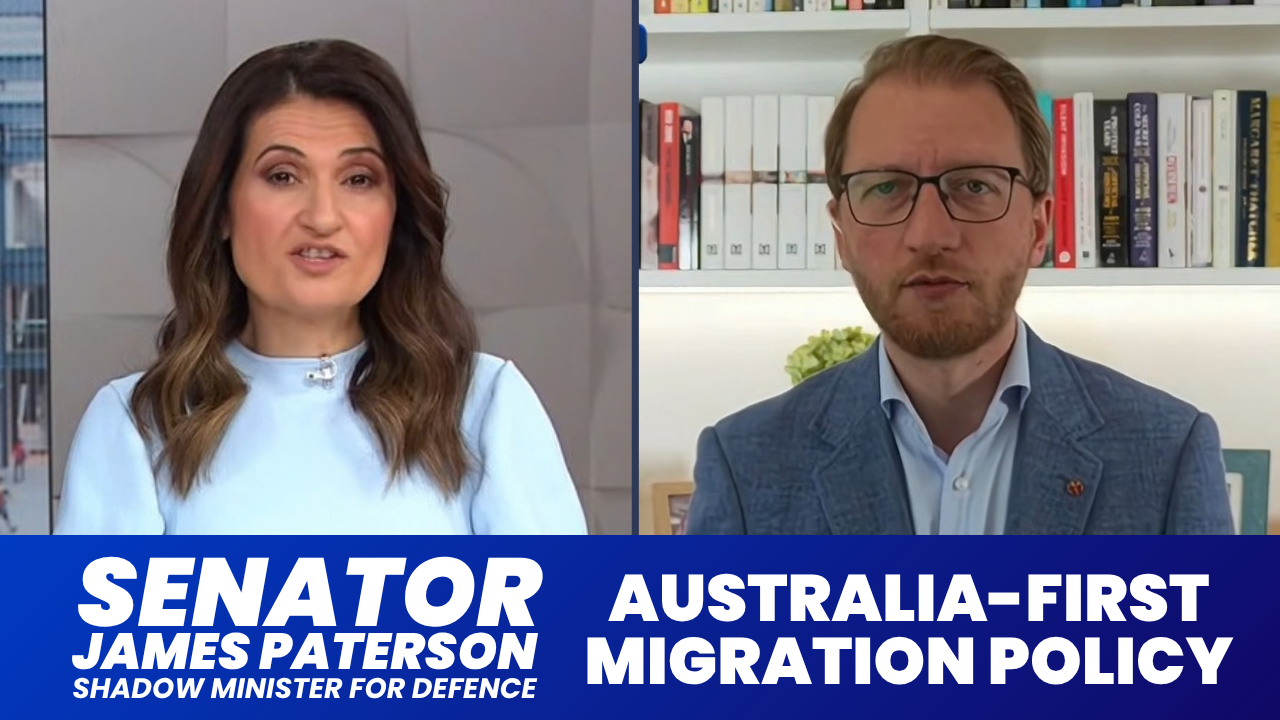
PATRICIA KARVELAS: For a view from the opposition, I want to bring in the Shadow Defence Minister, James Paterson. Welcome to the program.
SENATOR JAMES PATERSON: Thank you for having me.
KARVELAS: Just on this issue in relation to the High Court judgement, the New South Wales Premier has dismissed the High Court decision on that mind, saying people shouldn't overreact to the decision. It's actually a very narrow technical decision. And the Federal Government has the same view, saying it has nothing to do with federal laws. Isn't that the case? It is actually quite a specific and narrow decision.
PATERSON: Let's take one step backwards and look at this from a principle point of view and ask ourselves, is it sensible or reasonable for a company in Australia that mines coal, or gas for that matter, and exports that overseas to be held accountable and effectively liable for the emissions of that product when it is overseas and emitted by someone else? We don't think so. We think that the country that is responsible for using that resource should be held accountable for those emissions, not Australia. And penalising Australia, Australian workers, Australian companies, is a bad idea. And effectively, that's what the High Court decision has required New South Wales to do. I heard your interview with the Minister in New South Wales, and she says she's quite happy about that because that's what New South Wales wants to do, but I don't think that's good for Australia.
KARVELAS: Yeah, well, that is their law.
PATERSON: Well, it may well be, Patricia, but I don't think that's good for Australia, because why on earth should we be responsible for the emissions of other countries who happen to use our products?
KARVELAS: Okay.
PATERSON: Fair enough, on one level, if you want to hold us accountable for the emissions that we are responsible for, for the energy that we use in our country, but we shouldn't be responsible for other countries. And I guarantee you this will cause concern and alarm among our trading partners, particularly in countries like Japan and Korea. They don't want anything which could disrupt potential future energy supplies to their countries. They are highly dependent on Australia for energy, and they want certainty, and decisions like these and policies like these undermine that.
KARVELAS: Well, you mentioned Japan, and as you heard there, the Minister in New South Wales for Resources also mentioned Japan and the fact that they signed up to net zero by 2050, which means that that's the answer, she said, in relation to emissions, because they are actually committed to lowering emissions. They're actually bound by that agreement.
PATERSON: I'm not sure when the Minister was last in Japan and spoke to her Japanese counterparts, but I was in Japan a few months ago and repeatedly and specifically across the Japanese Parliament, the Japanese government and Japanese industry, they raised concerns with me about Australia's policy changes to energy, including emissions and the way in which that threatens Japan's energy security. Japan is not a resource superpower like Australia. It doesn't have a lot of natural resources.
KARVELAS: But they're committed to net zero.
PATERSON: It's invested billions of dollars in Australia and wants to continue to, in resources like gas and coal, but it is worried that Australia is becoming a less reliable partner for the supply of those energies, including because of our climate policies, but also gas reservation, tax policies, a whole range of issues. So they are very alarmed by developments like this. I've heard it from them directly when I was in Tokyo just a few months ago.
KARVELAS: Okay, but do you accept that Japan is signed up to net zero and that actually requires them to lower emissions, so if they are to take Australian coal, this Scope 3 emissions issue that you raise being an issue about whether we can continue being a supplier is basically dealt with by that.
PATERSON: No, it's not dealt with by that, and Japan is investing in new technologies like carbon capture and storage to deal with their own responsibilities for emissions. But if we're effectively double counting, if we are taking responsibility for their emissions and they're taking responsibility for their emissions, then the risk is you'll see fewer resources taken advantage of in Australia. We think it's time that Australia used our natural resources to the fullest possible extent for us and for our trading partners like Japan and Korea.
KARVELAS: Well, let me, just one final question. I find this issue absolutely fascinating. On these Scope 3 emissions, do you think that the federal government should be overriding the New South Wales laws through the EPBC? Is that what you're suggesting?
PATERSON: Anything that jeopardises investment in Australia's natural resources and taking full advantage of them should absolutely be addressed by the Federal Government. We shouldn't put net-zero ideology ahead of-
KARVELAS: They should override the New South Wales laws?
PATERSON: Yes, the federal government is responsible for our climate and emissions policy. Chris Bowen has made that very clear. He takes a leadership role and responsibility for that. And therefore, the federal government should take responsibility in the national interest to make sure we take full advantage of our natural resources. We haven't been doing that adequately because we put far too many obstacles in the road of using it, including environmental regulation and red tape. We're very clear about this. We think we should take advantage of those resources for ourselves and our partners.
KARVELAS: I want to go to your migration policy. The rideshare company DiDi told the nine papers that your migration policy will have an impact on rideshare prices and wait times. That means that prices will increase. We're obviously in an inflation crisis. You are basically going to, according to the people who, you know, have to hire these drivers, make Australians pay more. Do you want to be doing that?
PATERSON: Patricia, if I was going to take public policy advice on Australia's migration policies, probably one of the last companies in the world that I would ask is a rideshare company headquartered in the People's Republic of China like DiDi. Australia's migration policy is set for Australia and for the benefit of Australians. We're not going to be dictated to by foreign tech companies from authoritarian countries as to what our immigration settings should be. And Australians never voted for a permanent guestworker economy, but over the last four and a half years, there's been about a million increase in the number of temporary visa holders in Australia. We've gone from about two million to three million. That's an extraordinary increase and if it was ever put to the Australian people, I am seriously sceptical they would ever approve of, certainly not for sectors that have lower wages and lower skills. If we're going to be bringing people to this country because we need them to do jobs, it should be in the high skilled area where they're adding a lot of economic value.
KARVELAS: Ok, Are you hoping to wean Australians off these services, the gig economy services?
PATERSON: We're hoping to bring Australia's migration rate down to a sustainable level in an economic and responsible fashion.
KARVELAS: But do we have to wean ourselves off these services as a result?
PATERSON: Patricia, four years ago, we had these services in this country. You were able to get an Uber, you were able to deliver food, and at that time, we had one million fewer temporary visa holders in Australia. So I just don't accept this argument. We're only proposing, in our case, to reduce the temporary visa stock in our country by 650,000 people. That's where we were only a couple of years ago, is somehow going to lead to economic ruin? Particularly when we're replacing those workers with much higher skilled, higher economic contribution workers who, we have assessed, are in areas we actually need. The problem with temporary graduate visas, and particularly with bridging visas, is they're not being assessed against any kind of skills shortage in our economy. They're just allowed to stay here because they've previously been here studying or doing something else, and they've decided they want to stay. Well, it's up to the Australian Government to decide who we should have in our country and the contribution that they can make.
KARVELAS: These temporary graduate visas that you want to abolish, the government says that by abolishing them, some of the most talented people that businesses, who are highly skilled, want to employ after, of course, they've obtained degrees, won't be able to get them. They are actually really skilled people.
PATERSON: Well, if they're really skilled people, then they can apply for and be granted a skilled visa. The problem with a temporary graduate visa is that they are not required to prove that they are skilled. They could be just driving Ubers or DiDis and delivering food, taking up a place in Australia that could otherwise go to someone who is genuinely high-skilled and filling a real need and a real skill shortage. To give you one example, we propose creating 3,500 new AUKUS visas so that the most advanced and intelligent engineers, scientists, and technologists from our Five Eyes partners can come to Australia and help us complete our national security mission. That's the kind of people we're going to be bringing to Australia who add enormous economic and also strategic value to our country.
KARVELAS: I want to go to AI before I let you go. In a speech today, Andrew Charlton said it was clear that voluntary regulation would not be enough to deal with a clear market failure on AI safety. He's talking about a middle ground being needed, warning the pace of change could lead to AI laws being outdated. Is your side of politics wanting to work with the government on this type of approach?
PATERSON: The AI opportunity before Australia is a once in a generation opportunity, but it does come with very real risks. And I think it's important that parties of government act in the national interest and with goodwill to try and get this right on behalf of our country. We could potentially attract hundreds of billions of dollars of investment and get access to the most advanced frontier models in the world. But we want to make sure that we do that in a way that is safe and in a way that Australians support. And so I think we should be very pragmatic and sensible about how we go about this, and the general direction that Andrew Charlton outlined in his speech today I think, is heading in the right direction, but the specifics and the details will matter and we look forward to understanding what the government is proposing exactly here.
KARVELAS: Okay, but you want to be the pathway that the government has as a traditional party of government. Clearly politics is being disrupted, but let's accept the tradition so that there's bipartisanship on this, as you say, once in a generation change.
PATERSON: We're not going to give the government a blank cheque. We're not going to sign up to any policies without having the opportunity to consider them carefully. But if they land in a sensible place, if they're acting in the national interest, then we're certainly open to supporting them in doing so. And one of the key reasons why we need to do that is right now, Australia is not a relevant jurisdiction for global AI regulation. Frankly, we could pass whatever regulations we like, and it would make no difference. But if we work with the government and secure this investment in Australia from the most advanced frontier labs in the United States, we will become one of the most important jurisdictions globally for regulation. That means we get to have a say, we get a seat at the table, we get influence global safety regulation over AI for and on behalf of Australians.
KARVELAS: Thank you so much for joining us.
PATERSON: Thank you.
ENDS