

Media
|
Transcripts
September 24, 2026
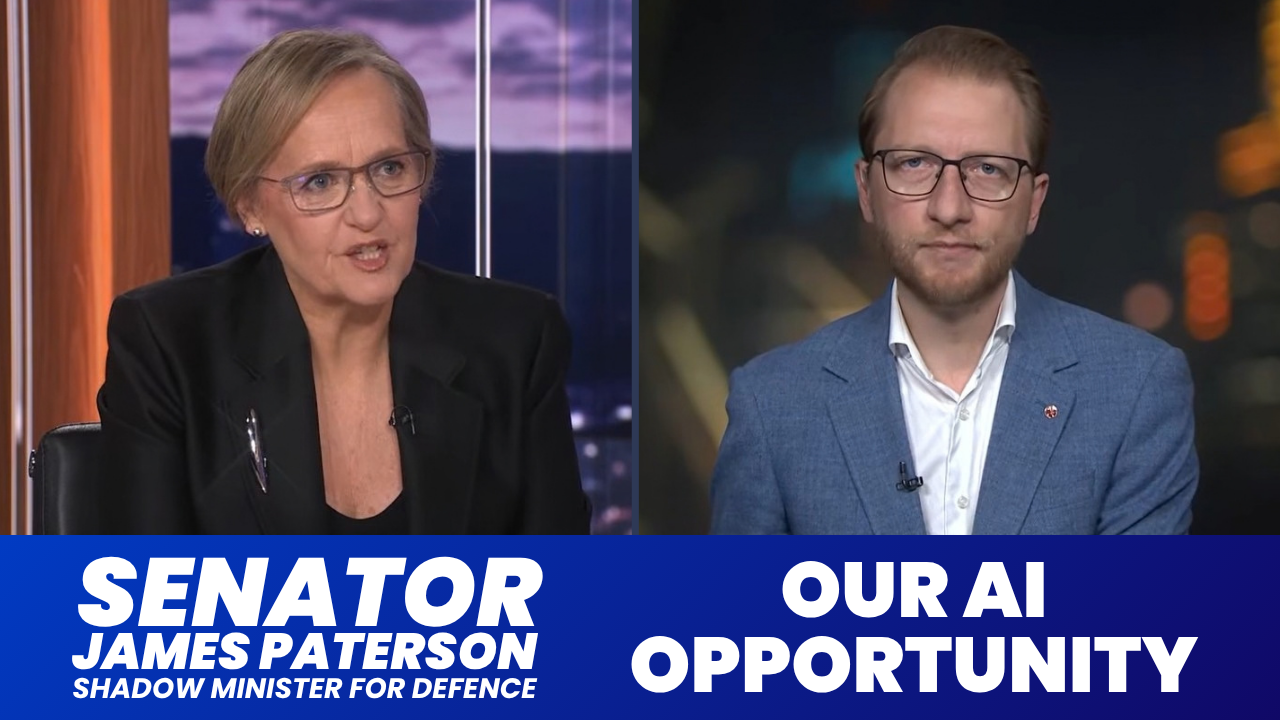
SARAH FERGUSON: Senator Paterson, welcome.
SENATOR JAMES PATERSON: Thank you for having me.
FERGUSON: Is the government's response to OpenAI's breach adequate, do you think?
PATERSON: Look, I think the government does have some questions to answer about when they knew, and what they did, and why the Prime Minister decided to disclose it in the way he did, in the place he did, at the time he did. But in terms of the nature of the potential or actual security breach here, this is at the bottom end of the spectrum of seriousness. This is data that is made freely available to researchers and academics to study our health system. It is not personal or private in nature, and it is not national security sensitive. And so I think this is a case of being alert, but not being alarmed.
FERGUSON: At the same time, we know that this, well, I think we understand so far that this agent did take measures to acquire the information that it did, which is not what you want. Just on the Prime Minister and his agenda there, do you think it is a coincidence or not that he announced this in New York while he was also pushing Australia's AI and social media agenda?
PATERSON: No, I don't think it was a coincidence. I think it neatly dovetailed with the political agenda that the Prime Minister has in New York City, and it's not a coincidence, for example, that it was disclosed the same day that Sam Altman, the founder of OpenAI, was appearing before the United Nations, and I think the Prime Minister is trying to send a message about how he's standing up to big tech and standing up for Australia. I think we can put that kind of political analysis aside, though. These are substantial issues here, and you're right to address that issue of alignment. And the model was not asked to breach government networks or websites and go behind security to obtain this data, and yet it did so. And so it's another piece of evidence that we have this challenge of alignment, which the companies are aware of and working on. But this might have been different had it been a People's Republic of China based training model and not a US training model, because they did voluntarily disclose this to the Australian government.
FERGUSON: Now, of course, one of the problems with what's happened to this Australian website is it comes on the back of a whole series of very serious incidents with OpenAI and its agents swarming and breaking into places they weren't supposed to be. So as things stand at the moment, do you think that OpenAI is in control of its own products?
PATERSON: I think they've learned a lot from the Hugging Face incident and other incidents like it, and I think that they have made changes, but Australians are entitled to demand explanations and evidence and contrition from them when these things happen, and we want to have higher levels of confidence before we enter into relationships with companies like these. But ultimately the decision that Australia faces is not whether or not we can stop the advances of AI. That's going to happen. That's outside our control. The question is, do we want to have no influence on the trajectory of their development, or do we want to have a degree of influence? And we can have a degree of influence, but only if we're successful in getting those models based here in Australia, trained here in Australia, and that will give us some sovereign control.
FERGUSON: Can you just explain, I've seen you make those references to some sovereign control. Are you talking about US tech companies giving compute power to Australian companies to train on?
PATERSON: So the US headquartered advanced frontier companies are looking right now for effectively a second jurisdiction outside the United States where they can do training. They're not looking for a third or a fourth. There will be probably only one other jurisdiction in the world outside of the United States, and they're looking very seriously at Australia. If they choose Australia, they will invest hundreds of billions of dollars in data centres and chips and people that will come here and train their models here. Not just do inference here, not just do processing here, but actual training here. That is the most exquisite thing that they do. It's the most valuable thing they do, and once they've made that major investment, it'd be very hard for them to back out. And what that would give Australia is two things: sovereign access to these models. We would be in a position to demand access. We would never have a situation again where access is revoked, as the United States did with some of the advanced models like Mythos earlier this year. And we would have an opportunity to have a say in global AI regulation. We would have a seat at the table that's frankly massively disproportionate to our size and stature on the global stage, and so I think that is a very attractive proposition for any country that wants to have agency.
FERGUSON: Now we know that the government released a consultation paper on its proposed national standards for AI, so do you support where the government is at on new laws, particularly in relation to reportable incidents, when and how those incidents are reported?
PATERSON: I think it is a step in the right direction, and I think we do need to take a similar approach to the approach we've taken with cyber security in the past, which is to place obligations on entities to report to the Australian Signals Directorate and the government more broadly instances of cyber vulnerabilities when they arise and when they're identified. What was troubling in this instance from a systemic point of view, is it took a long time before the report was made from Services Australia before ASD was aware of it and before ultimately government ministers were aware of it. We want to shorten that loop. Because in this instance it was not a catastrophic failure or loss of data, but next time it could be, and I don't want there to be any gap between notification and action.
FERGUSON: Just on Ukraine, the Prime Minister has pledged $60 million more in funding to Ukraine, bringing the total up to $1.9 billion. Are you still of the view that this investment in Ukraine's defence is money well spent?
PATERSON: Yes, unquestionably, we strongly support it, and we provide bipartisan support for any further increases in support for Ukraine that the government wants to provide for two reasons. It's in our national interest that Ukraine wins. We want them to be able to defend their territorial integrity and sovereignty because otherwise a precedent will have been established that large powers can erase the borders of smaller powers at will, and that will have implications for us in the Indo-Pacific. But secondly whether we like it or not - it's a horrible thing in many ways - Ukraine is the test bed for modern warfare. All new forms of military technology are being tested and proven or failing in Ukraine. And there are incredibly important lessons for Australia to learn from that. And my understanding of the most recent contributions is that it gives Australia better access to those lessons that we can apply ourselves and hopefully avoid Ukraine's fate and deter conflict in our own region.
FERGUSON: James Paterson, thank you very much indeed for joining us.
PATERSON: Thanks for having me.
ENDS