

Media
|
Transcripts
June 1, 2026
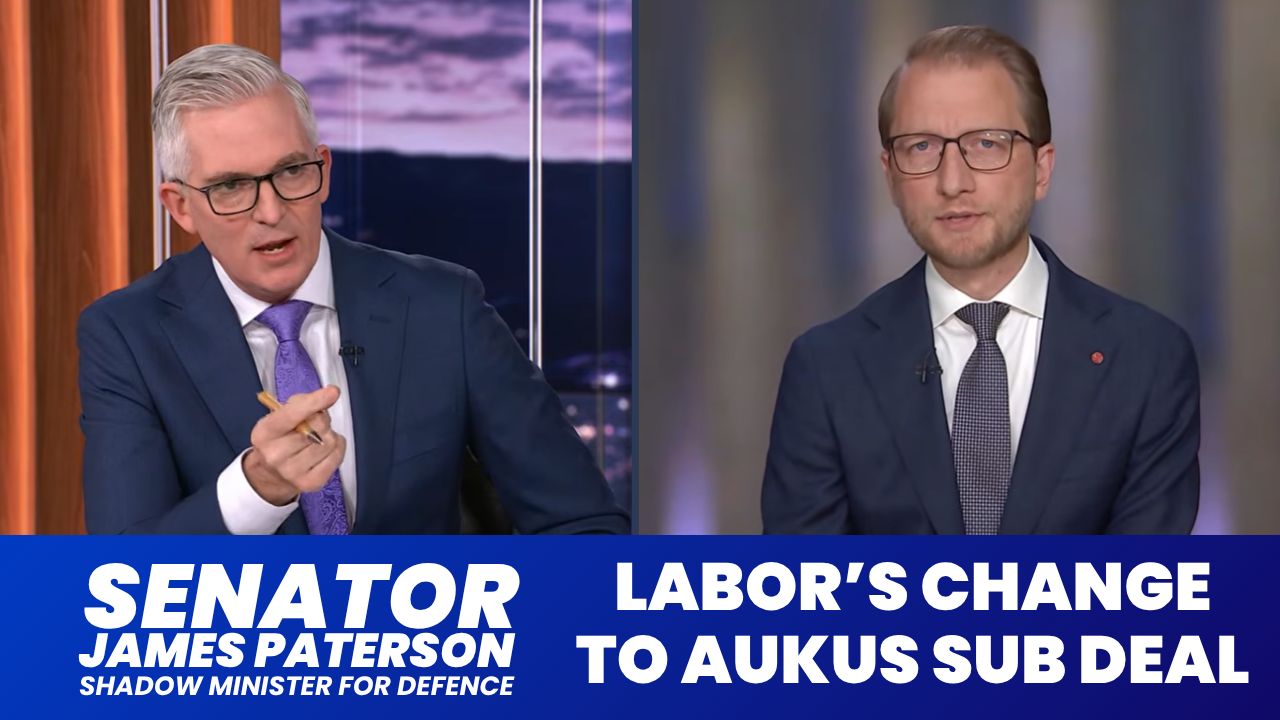
DAVID SPEERS: In an effort to change its fortunes, the Liberal Party has now turned to Tony Abbott, installing the former Prime Minister as party president. Liberal Senator and Shadow Defence Minister James Paterson joins me now. Thank you for your time this evening, Senator.
SENATOR JAMES PATERSON: Good to be with you, David.
SPEERS: So when you withdrew support for Sussan Ley back in February, you said you didn't think she could turn the ship around. Why hasn't Angus Taylor been able to turn the ship around either?
PATERSON: David, if I remember correctly, I think you were at the press conference where I resigned from the front bench before the Liberal Party made the decision to change leadership. And I said at the time that when we lose trust from many of our traditional supporters who have walked away from us, that it is not going to be quick or easy to earn that trust back, nor is it going to be fixed by just one person and just one change of leadership. I said then that it was a collective responsibility, and it remains the case today. Now, I think there has been some improvement in our polling since that time. I think The Australian had us at 17% in the polls then. Even the most pessimistic poll out in recent days has us much further ahead than that. But I don't want to sugarcoat it for you or your viewers, we've got serious work to do. We understand how serious this moment is for the party, and we very clearly need to demonstrate conviction, unity, discipline, focus and competence over a sustained period of time to earn back that trust that we've lost.
SPEERS: My reading of Newspoll and RedBridge, though, is that since the budget three weeks ago, you've actually lost a bit of ground that you had gained. And this has been three weeks where Angus Taylor's been throwing everything at the government over the budget. If he can't get traction on what the polls are saying is an unpopular budget, doesn't that worry you?
PATERSON: Well, there's another poll out today in the News Corp tabloids that shows us increasing our support, which shows Angus Taylor is the preferred Prime Minister, and so did the Resolve poll a couple of weeks ago. And in fact, the Fox and Hedgehog poll also showed today a 51% two-party preferred vote for the Coalition, which would be a 6% swing against the government, since the election, which would be potentially enough to turf them from office. So I don't think these polls are unalloyed goods for the Prime Minister either. But I'm not downplaying the seriousness of the challenge that the Liberal Party has, I accept that.
SPEERS: Well, you've said this isn't going to be a quick turnaround. How long could it take? How long do you give Angus Taylor here? And would you be willing to make another change to say Andrew Hastie before the next election if that doesn't happen?
PATERSON: Politics is more art than science, David, it is not possible to put a specific timeline on it, but we know we've got two years or thereabouts to the next election, and we know we need to demonstrate progress towards our political objectives well before then, and that's what I and my colleagues are working towards.
SPEERS: Does that mean you're still open to another change if the Angus Taylor project doesn't work?
PATERSON: No, I don't think any of my colleagues want to go through another leadership change this term of parliament. They are not easy things to do, and I don't think that would increase trust in the Liberal Party.
SPEERS: I'm interested in what you think the party should be doing about One Nation because there appears to be two different schools of thought. You've got Tony Abbott, your new Liberal Party President, saying he doesn't want to disparage Pauline Hanson at all. He says his job is not to fight on the right. You then got Andrew Hastie with a very different view. He's more than happy to criticise Pauline Hanson. Your outgoing party director, Andrew Hirst, also says ignoring One Nation is not an option. Where do you stand? Should the Liberal Party take on One Nation?
PATERSON: One Nation are not our enemy, but they are a political opponent, they are trying to take votes and seats off the Liberal Party, and with their increased prominence in the polls brings increased legitimate scrutiny on their performance, on their policies, on their candidates, on their conduct.
SPEERS: So does that worry you that your party president is saying he does not want to fight them?
PATERSON: Well, it's up to the Parliamentary Party to chart our own course, and I'm very clear about our role in this. There was a story in The Australian this morning that showed that Pauline Hanson has missed 88% of Senate estimates committee hearings over the last decade as a Senator. For a opposition or crossbench Senator, Senate estimates is core business, and not showing up to 88% of those hearings frankly is shirking your responsibilities when we are paid very well by taxpayers to do it.
SPEERS: So you're willing to criticise Pauline Hanson, so is Andrew Hastie. Should Tony Abbott, as party president, also be willing to criticise One Nation and take the fight up to them?
PATERSON: It's not really his role as party president. It's an organisational role. His role is to rally the troops, to raise money, to get the campaign organisation fighting fit. And I'm very pleased he's put his hand up for that role. I think he'll be outstanding in it.
SPEERS: Let's turn to the defence portfolio and this updated AUKUS plan. The US will now sell Australia three used Virginia-class submarines instead of two used and one new submarine. Does this concern you at all?
PATERSON: I am concerned, and I'm surprised because it was only three years ago that the Albanese government announced what they called the "optimal pathway" to acquiring nuclear propelled submarines that included two used and one new Virginia-class submarine. If it was optimal three years ago what has changed in the last three years? Richard Marles has said the reason is that it's simpler to acquire these used submarines, and it is cheaper. Well, nothing about that has changed in the last few years. If it was simpler now, it was simpler three years ago, and if it is cheaper now, it was cheaper three years ago. So something else has changed, and the government is not being transparent about that, and I plan to pursue them on it in Senate Estimates this week.
SPEERS: What do you suspect has changed? Is the reality here that the US has not got its own production rate up to a level where it can provide us with a new submarine?
PATERSON: I don't know what the reason is, David, although I am not as concerned by those production numbers as some other commentators are. Everyone's heard those statistics about 1.3 boats a year being produced now, needing to be 2.3 a year in the future - as if that's kind of written into the act of Congress that established AUKUS. That's not the case. And if we successfully establish HMAS Stirling and the Henderson shipyards, that frankly will allow the United States to keep more boats in the water more often and is a very tangible contribution to the alliance. So I'm not as obsessed with those figures as others, although of course, we want to see them producing more, not fewer.
SPEERS: You've expressed some concern, though, about the fact that there are now going to be three used Virginia-class submarines. Are you saying this is now a bad deal for Australia, that we've been duded here at all?
PATERSON: Look, I wouldn't go that far, but what I would say is that three used submarines, self-evidently, are going to be in service for the Australian Navy for a shorter period of time than two used and one new submarine. And that puts massively increased pressure on the SSN AUKUS program, which is the joint Australian-UK program to build our own nuclear submarines from the 2040s onwards. If that can't be delivered, then a very serious capability gap could emerge in both under sea warfare and long-range stealth strike, and I think we do need to be having a public conversation now about contingency plans for that capability gap, and also a capability gap that could arise given the Collins-class Life-of-Type-Extension has drifted as well.
SPEERS: Well, that's interesting. So you're saying you're worried about a capability gap now. Is this a break in bipartisanship on AUKUS? How should we interpret what you're saying?
PATERSON: No it's not. I am a true believer in AUKUS, and I think we should double down on delivering AUKUS and any support the government needs to do that they will have from the opposition. I'm not an advocate of a Plan B alternative to AUKUS. What I am an advocate for is prudent contingency planning, recognising the risks with the Collins-class Life-of-Type-Extension, recognising we are now getting only used Virginia-class submarines, recognising the massive challenge we have with SSN AUKUS with the UK. I think we need supplementary capabilities that will help serve alongside AUKUS submarines, but will also help fill a capability gap should it arise in that very risky program. And I've advocated B-21 Raider bombers as one possible example to get the conversation started. I'm not certain that that is the answer, but we need to be having a conversation about it, and we need to be doing it now.
SPEERS: Final question. We saw there in Jacob's piece, Pete Hegseth, the US Defence Secretary, Secretary of War, praising Australia for stepping up on defence spending, particularly at HMAS Stirling and the Henderson Shipyard. You've argued the government's actually cutting defence spending. What do you know that Pete Hegseth doesn't?
PATERSON: Well, I would just encourage anyone who wants to commentate on this to look at the budget papers.
SPEERS: You don't think Pete Hegseth has done that?
PATERSON: Well, there's an $800 million cut between this year and next year, financial year, in the defence budget, and the government is playing lots of games with accounting measures and trying to count things like pensions, which we never used to previously, to claim higher spending. It's appropriate that the Defence Secretary be positive about our alliance, particularly publicly, and we are the best ally the United States has in the world, but that doesn't mean we're doing everything we can in our own national interest or that we're listening to our own best informed experts. People like Sir Angus Houston, people like Professor Peter Dean, who say we need to be spending three per cent of GDP on defence.
SPEERS: James Paterson, thanks for joining us tonight.
PATERSON: Thanks, David.
ENDS