

Media
|
News
August 14, 2026
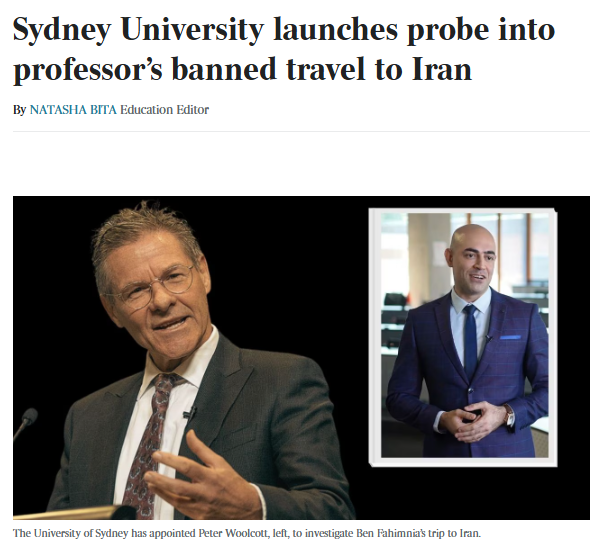
A “deeply concerned’’ University of Sydney has buckled to political pressure over a professor’s banned travel to Iran by appointing former diplomat and public service leader Peter Woolcott to investigate the trip.
“We are deeply concerned by this matter,’’ a university spokeswoman said on Thursday after The Australian revealed the widening scandal over professor Ben Fahimnia’s trip, which forced his emergency evacuation from the Middle East war zone last year. “We are concerned at apparent inconsistencies in the reasons provided to the university for that travel to a country with government ‘do not travel’ advice in place.”
The university has appointed Mr Woolcott, a retired diplomat, Australian Public Service Commissioner and chief of staff to former Liberal prime minister Malcolm Turnbull, to investigate.
“The independent external review will consider the purpose and outcome of the academic’s travel to Iran alongside the approvals process for the travel, any further remediation steps the university should take, and any additional recommendations for the university in the context of heightened geopolitical risks and tensions,’’ the spokeswoman said.
The university – which holds sensitive research and teaching contracts with the Department of Defence – announced the probe after the federal opposition demanded it explain its “appalling failure’’ in sending the senior professor to Iran last year in breach of government sanctions.
A Department of Foreign Affairs and Trade spokesman said that “since 2023, the Australian government has made clear its expectations that universities should not enter into, continue, or facilitate research collaboration with Iranian entities’’.
Professor Fahimnia has told The Australian that he travelled to Iran to visit his parents and did no work while here.
Opposition defence spokesman James Paterson said the Islamic Republic of Iran had been a state sponsor of terror for half a century, and had persecuted and murdered its own citizens. “This is an appalling failure by Sydney University for which there are no good excuses, given the sensitive defence research taxpayers fund them to do,’’ he said.
The Australian revealed on Wednesday that Professor Fahimnia, who is the university’s chair of supply chain management, had to be rescued from Iran after the university approved his visit. The Sydney University spokeswoman said on Thursday that initial investigations showed a “combination of system and human errors meant that the travel request was erroneously processed by the university’s travel booking systems’’.
“Significant work has been undertaken since 2025 to address control weaknesses in processes, systems and training,’’ she said.
“However, discrepancies in accounts and processes remain and we welcome Mr Woolcott’s insights to ensure ongoing compliance and to provide assurance that this matter has been fully and impartially reviewed and that all appropriate actions have been taken.’’
The university’s latest annual report lists the travel to Iran for “university-related administrative or strategic engagements’’.
But Professor Fahimnia told The Australian that he went to Iran to visit his parents on the way to a conference in Turkey, and there were “absolutely no work-related matters in Tehran’’.
He also denied working with Iranian academics, despite co-authoring journal papers on supply chain disruption in 2025 and 2020 with engineering academics now employed by the University of Tehran and the Iran University of Science and Technology.
Foreign Minister Penny Wong wrote to all universities in 2023 directing them to cease all collaboration with institutions in Iran, Russia and North Korea.
On Thursday, Professor Fahimnia said his collaboration with Iranian researchers concluded years before Senator Wong’s directive.
“To clarify, my previous comments referred specifically to my trip last year, not my broader publication history or research career,’’ he told The Australian.
“I haven’t undertaken any research collaborations with colleagues in Iran for over five years, and any co-authored papers or research conducted with Iranian students or academics took place before the laws changed.’’
Professor Fahimnia worked with two Iranian academics – Fatemah Sabouhi from the University of Tehran’s School of Industrial Engineering and Mohammad Saeed Jabalameli from the Iran University of Science and Technology in Tehran – to write a research paper published in the Annals of Operations Research in July 2025. He said the paper – which explored ways to design “a supply chain resilient to major disruptions and operational disruptions” – had been completed in 2019 and “co-authored with a student in Iran at the time’’.
In 2012, when Professor Fahimnia worked at the University of South Australia, he co-authored a journal paper with Reza Molaei from the Iran Broadcasting Services, with the title “complex real-life supply chain planning problems’’.
An Iranian state television presenter with the same name made threats against Iranian dissidents living abroad in March, declaring: “When the dust of sedition settles, we will grab you by the collar.”
When The Australian asked Professor Fahimnia why he had worked on supply chain research with an Iranian state media representative, he replied that he “co-authored that paper with a classmate’’. “Although the co-author has the same name as the person you have identified, I don’t believe they’re the same person,’’ he said.
“In any case, I haven’t had any involvement with, or done work with, any Iranian organisation and I haven’t had contact with the co-author since the paper was published.’’
The federal Education Department wrote to Sydney University vice-chancellor Mark Scott in June telling him that travel to sanctioned countries, as well as research, was banned.
Opposition education spokesman Julian Leeser called on Sydney University to “set the record straight’’. “There is a clear and concerning gap in our oversight if we have university professors engaging with our strategic adversaries at a researcher to researcher level,’’ he said.
“I am very concerned that universities either do not know about or are happy to approve very questionable collaborations at the researcher to research level, and that the existing arrangements do not go far enough to address this.
“What is more concerning is that higher education providers appear happy to ignore directives from the Foreign Minister and our security agencies when it suits them.’’
A spokesman for federal Education Minister Jason Clare said the Education Department asked the University of Sydney on Thursday to “keep the government updated on the independent investigation”.