

Media
|
News
August 18, 2026
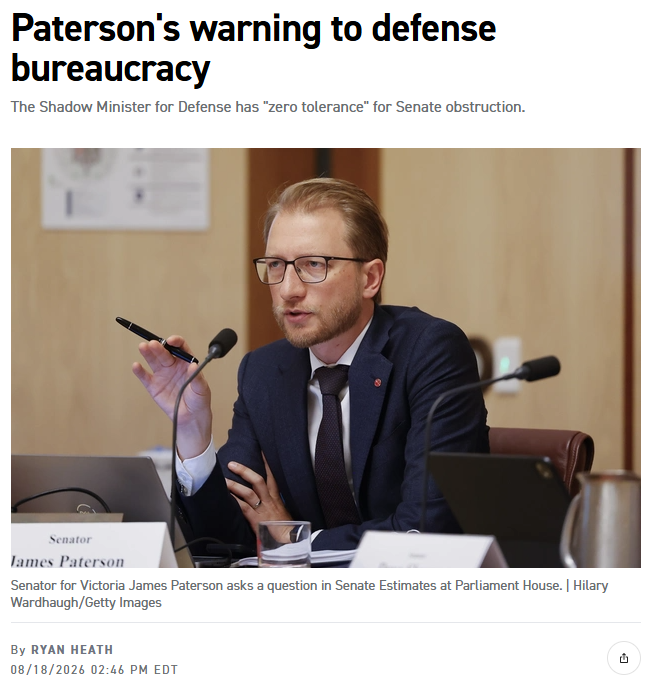
As as member of Australia’s shadow Cabinet and shadow minister for defense, Sen. James Paterson is at the heart of debates about AUKUS accountability, Australia’s role in supporting Ukraine against Russian invasion, and how Australia positions itself vis-a-vis China.
Paterson interned on Capitol Hill as a teenager, and entered the Australian Senate at age 29.
His packed travel schedule sees him visiting Australian and foreign bases, and companies up and down defense supply chains.
He represents the state of Victoria and lives in Melbourne.
This interview has been lightly edited for clarity.
I have a message for the defense bureaucracy on this: I have high expectations of their candor and honesty instead of estimates, and they did not meet that in the first round of estimates that I had with them while I was in the portfolio, and I expect them to do better.
So many officials either came ill prepared to answer questions, which I find very hard to believe, or would deliberately try not to answer questions because they’re worried it was politically inconvenient for government. I have zero tolerance for that.
I want it to be a respectful and productive and professional environment, but if they continually obstruct the Senate’s scrutiny function, then it will become a very unpleasant, uncomfortable environment for everyone involved.
I really hope that approach the next estimates with more candor than the last one because, for example, questions I asked the VCDF [Vice Chair of the Defense Force] about cuts in the integrated investment program was not able to be answered. It was not credible for him to say he didn’t know the answer to those questions.
They were taken on notice, but I have not received anything back on notice. It’s been quite a while. They are due back. If we get around to estimates in October and those questions haven’t been adequately answered, it will be a big focus.
His words were “that’s for the government to decide” — that’s not how Senate Estimates works.
We should be optimistic and positive, but realistic, and we shouldn’t pull the wool over our own eyes or anyone else’s.
What I don’t want to see is fatalism, that we should abandon AUKUS. These are solvable problems with the right level of investment and support.
I haven’t visited Barrow, but I hope to soon. Clearly there are constraints in the industrial base and the supply chains of the AUKUS nations collectively, which is why we’re doing this whole thing, right?
To help solve those problems in the U.S., courtesy of some investment from Australian taxpayers, they are investing and expanding the supply chain for the shipyards and in increasing the retention of the workforce, which have been the two major constraints on the Virginia class production.
We have more time in the U.K., but from the Commons inquiry and other expert commentary, I think it appears the challenges are larger.
This is partly why we’re doing Henderson [Defense Precinct alongside HMAS Stirling] in Western Australia for maintenance and sustainment of submarines in both the U.S. and U.K., and Osborne in South Australia to build them ourselves.
Now, we are gonna have to learn to crawl before we walk, before we run.
We are nowhere near ready to build our own submarines, and we have to do a partnership with the U.K. We could not do it completely on our own.
But we have time to make those investments now and manage that risk now and recognize the constraints that they have.
The only luxury we have in this is that there is a bit of time when it comes to SSN AUKUS. There is not a lot of luxury of time when it comes to Virginias or certainly not HMS Stirling, which has got to be online by the end of next year.
We’ve got time to get this right: as long as we are honest and realistic about it now.
Yes. There are two windows of capability gaps that I’m concerned about.
One is between the Collins class submarines and the Virginia class submarines in the early 2030s, where if Collins becomes unavailable because of the “life of type’ extension, or if there were for any reason delay and delivery of Virginias, that could be a capability gap.
And a capability gap could open up between Virginias and SSN AUKUS.
So I think we should be having now a conversation about supplementary capabilities that could address those two capability gaps.
Obviously, the early one is the most concerning because that also overlaps with some of the risk assessments about conflict in our region, including over Taiwan. So we need to focus in laser-like way on that.
We have the option to obtain at least three and up to five Virginia submarines for dealing with that second capability gap toward the 2040s; that’s an option depending on where the United States is willing and able to sell them to us.
For the first capability gap, it’s not an option and we really need to investigate alternatives.
I put the B-21 stealth bomber on the agenda for examination. It doesn’t have to be that capability, but you need some long range strike capability to deter our potential adversaries.
That’s right. It’s rapidly evolving, even in the course of weeks and months.
At the start of the war, Ukraine was really producing, in large volumes, short range drones that are doing devastating damage on the battlefield of Russian soldiers. But at this back end of the war — hopefully — we’re now talking about long-range drone strikes to Moscow.
That’s a massive development, which does have implications for strikes. It’s not exactly the same geography as ours, but it offers lessons.
They have a very powerful incentive to get this right because it’s their own national security.
This is not just an economic opportunity for the U.K., although it is. It’s not just an export opportunity. It is a critical technical advantage for their own national security that they don’t want to miss. So there’s a lot of political incentive to address this.
It’s very interesting the Prime Minister has appointed John Healey — the former defense secretary — as the chancellor. That shows to me that they’re putting defense and national security at the heart of their economic agenda as well as their defense agenda.
The new statutory defense committee which has been established, I think the core business of that community should be review of delivery of AUKUS. Not reviewing whether we should proceed with AUKUS, but whether or not it is tracking against the timelines and the deadlines we set for ourselves. There’s really nothing more important for that community to do.
Certainly one of the first questions I would have if I was going to be sworn into the defense ministry is: how are we tracking against the timelines. What are the risks and what are your plans if there’s any slippage?
At its heart, really, Pillar 2 is a military technology free trade agreement. It is supposed to get rid of, if not all, then at least most of the barriers to intellectual property, capital, and humans moving between the three AUKUS nations.
So Australia gets access to the most advanced defense industrial base in the world, both for importing capabilities, but also to sell to them. [But] I hear stories all the time about regulatory barriers that they’re running into.
The embassy in D.C. is very focused on this. They’re on the Hill all the time, asking Congress to pass more legislation to facilitate greater movement, but I don’t think we’ve nailed it yet. And I think we’re at risk of not achieving the full potential of Pillar 2 unless we get that done.
Yeah, exactly. I think that is fair. And, you know, free trade is not in vogue in the Western world and particularly not in the United States at the moment.
So, I understand the kind of language sensibilities around that. But if Australia and the United States and the U.K. can’t work together in a single spot on this, then no other group of countries in the world can.
You’ll never find three countries better aligned in terms of culture, values, political systems, interests.
I’m very supportive of the bilateral arrangements the government entered into in the Pacific over the last couple of years. PNG in particular is an indispensable partner to Australia and our mutual security interests are completely intertwined.
Something that harms Australia’s national interest and security would harm PNG’s, and vice versa.
We have a long history of training with the Pacific. It’s very common for senior military leaders from the Pacific to have been to [studied at] ADFA or Duntroon and have a positive experience from that.
I’m open-minded to extending, you know, extending more service to Pacific Islanders to be in the ADF [Australia Defense Forces]. I think that is mutually beneficial.
We have recruitment constraints that everyone’s aware of, that we need to address.
[Solomon Islands] Prime Minister Wale, in his [push for a] Pacific-wide multilateral agreement on security and policing, I think if that window of opportunity opens, we must seize it.
That’s because it will be even more durable than a bilateral agreement, because it will be the Pacific mutually committed to each other’s interest. It would be very hard to unpick.
If they’re all committed it binds us better. The Foreign Minister has publicly said that we’re in a permanent contest in the Pacific with China, which is welcome candor.
And if that is true, we need also to remember that for Australia’s national interest, we have to succeed in blocking the PRC [People’s Republic of China] from establishing military or policing arrangements every time they try.
And if that is true, we need to remember that for Australia’s national interest to succeed we have to succeed in blocking the PRC from establishing military or policing arrangements every time they try. For the PRC’s national interest to succeed, they only have to succeed once. So, they have to get one deep sea water port for the PRC’s Army and Navy in the Pacific, and it would totally change our security and defense posture.
We would have to spend a lot more on our defense, and we would have to reorient it to our northeast rather than our northwest. It would be a very, very different world if that happened.
So, yeah, the government has our unqualified bipartisan support on that. We may differ from time to time on the details, but it’s an important national mission.