

Media
|
Transcripts
August 11, 2026
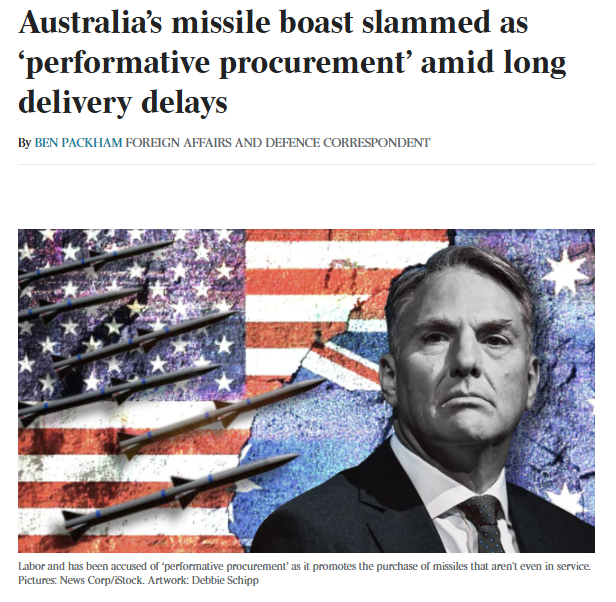
The Albanese government is claiming credit for buying air-to-air missiles that are yet to enter service and aren’t due to be delivered to Australia for years, sparking criticism it is engaged in “performative procurement” to shore up its defence credentials.
Defence Minister Richard Marles last week announced a $736m acquisition of AIM-260 Joint Advanced Tactical Missiles, declaring they would “soon” be carried by Australian fighter jets.
But the AIM-260 is yet to achieve “initial operating capability”, and military news sites say Australia won’t get them until 2033.
Mr Marles also said the air force would get “up to 450” of the Lockheed Martin missiles – the number the US has approved Australia to buy – when the disclosed $736m outlay is likely to buy fewer than 100.
His spokeswoman refused to say when the missiles would arrive but maintained “Australia expects to begin receiving deliveries well before the 2030s”.
A defence industry source with knowledge of the missile supply chain cast doubt over the claim, saying the AIM-260 was yet to enter full-rate production and when it did, the “US Air Force would typically field their own requirements first”.
“If those missiles arrive before 2030 I’ll walk buck naked up Northbourne Ave,” the source said, referring to Canberra’s main thoroughfare.
Opposition defence spokesman James Paterson said Australia needed missiles to deter conflict now, “not in the never-never”, given Xi Jinping had ordered the People’s Liberation Army to be ready for a potential Taiwan conflict by 2027.
“Performative procurement doesn’t make Australia safer,” Senator Paterson said.
“If you listened to Richard Marles and Pat Conroy, you’d be forgiven for thinking these missiles were just around the corner – not reportedly almost seven years away. The moment of maximum danger in the Indo-Pacific is long before 2033.”
The stoush comes amid fierce competition for already in-service US munitions amid “dangerously low” stockpiles due to Donald Trump’s Iran war. Charles Edel, the Australia Chair at the Centre for Strategic and International Studies, said the US missile shortages had serious implications for Australia.
“Because heavy military operations are draining US munition stockpiles, missile deliveries to allies like Australia face a growing risk of delay, creating operational vulnerabilities for their defence,” Dr Edel said.
The beyond-visual-range AIM-260 missile has been in testing since 2020. It is due to replace or supplement the AIM-120 AMRAAM, which is already in use with the RAAF.
The US congress approved the missile sale in March, putting the price of 450 AIM-260s plus test vehicles at more than $US2.6bn ($3.7bn) – about $8.25m a missile.
Announcing the purchase at Exercise Pitch Black in Darwin on Thursday, Mr Marles said: “These are the latest generation of air-to-air missiles, which will greatly enhance our air force’s capability.
“These missiles will be installed on all of our fighter planes. That is, our Super Hornets, our Growlers and our F-35s, and they will be operating on those platforms soon.”
The minister’s press release said Australia would be the first country to operate the AIM-260 outside the US. But according to multiple US military news sites, that won’t happen this decade.
“Australia will receive its first batch of JATM missiles in the third quarter of 2033, which tracks with current production timelines for JATM,” Naval News reported in November. “The delivery timeline is also based on the traditional balancing of US inventory requirements with foreign exports of defence materials.”
Another publication, Defence Security Asia, reported last Friday: “Australian deliveries are projected around the early 2030s, with earlier reporting indicating approximately 2033, meaning the strategic value of Canberra’s decision must be separated from immediate operational availability while American production capacity and domestic requirements continue developing.”
The Pentagon has issued a plea to US arms manufacturers to urgently increase production of guided weapons after burning through huge numbers of precision munitions in the ongoing war with Iran.
Deputy Defence Secretary Steve Feinberg wrote to industry leaders on Wednesday, the Washington Post reported, saying they had 21 days to submit plans to “drive significantly faster, more aggressive delivery schedules and/or increased production for critical capabilities”.
According to reporting by Reuters in recent days, the US Army has used “virtually all” of its long-range ATACMS and PrsM missiles – both of which Australia has on order.
A Centre for Strategic and International Studies report in April said about a third of the US’s Tomahawk cruise missiles, its SM-2 and SM-6 naval air defence missiles, and JASSM air-launched cruise missiles had also been expended. All are in use with the Australian Defence Force.
Supplies of ground-launched Patriot and THAAD missile interceptors have been halved, the CSIS said, although Australia is yet to order either system. The think tank said replenishing the stocks would take at least three years, depending on the model.
“Many allies and partners use these systems as well, creating competition for output,” it said.
A Defence spokeswoman told The Australian: “Defence is working closely with our international partners and continues to accept deliveries of guided weapons. For operational security reasons, Defence does not disclose the quantities or delivery times for guided weapons orders.
“Australia is making a record investment in sovereign missile manufacturing and rapidly building the capability to produce some of the most advanced guided weapons in the world under the 2026 National Defence Strategy and Integrated Investment Program.”
Dr Edel said the US missile shortages underscored the strategic logic behind Australia’s nascent Guided Weapons and Explosive Ordnance enterprise.
But he said what was planned as a gradual, decade-long ramp-up “must now move at wartime speed to cover gaps in munitions stockpiles and build allied capacity”. “Accelerating Australian assembly lines for weapons doesn’t just supply the Australian Defence Force with what it needs – it directly feeds back into the broader allied inventory, effectively expanding the total size of the joint allied magazine, enhancing the readiness of those forces, and tilting the deterrence equation in a positive direction.”
He said Australia should also diversify its weapons supply chain to ensure it wasn’t overly reliant on the US. “While the US alliance remains the bedrock of Australian defence, relying on a single defence supply chain in an era of global competition is a risk. “Looking to partners like Japan, South Korea and European allies isn’t a turn away from Washington; it’s a pragmatic recognition that the US industrial base needs help carrying the load.”