

Media
|
Transcripts
April 25, 2026
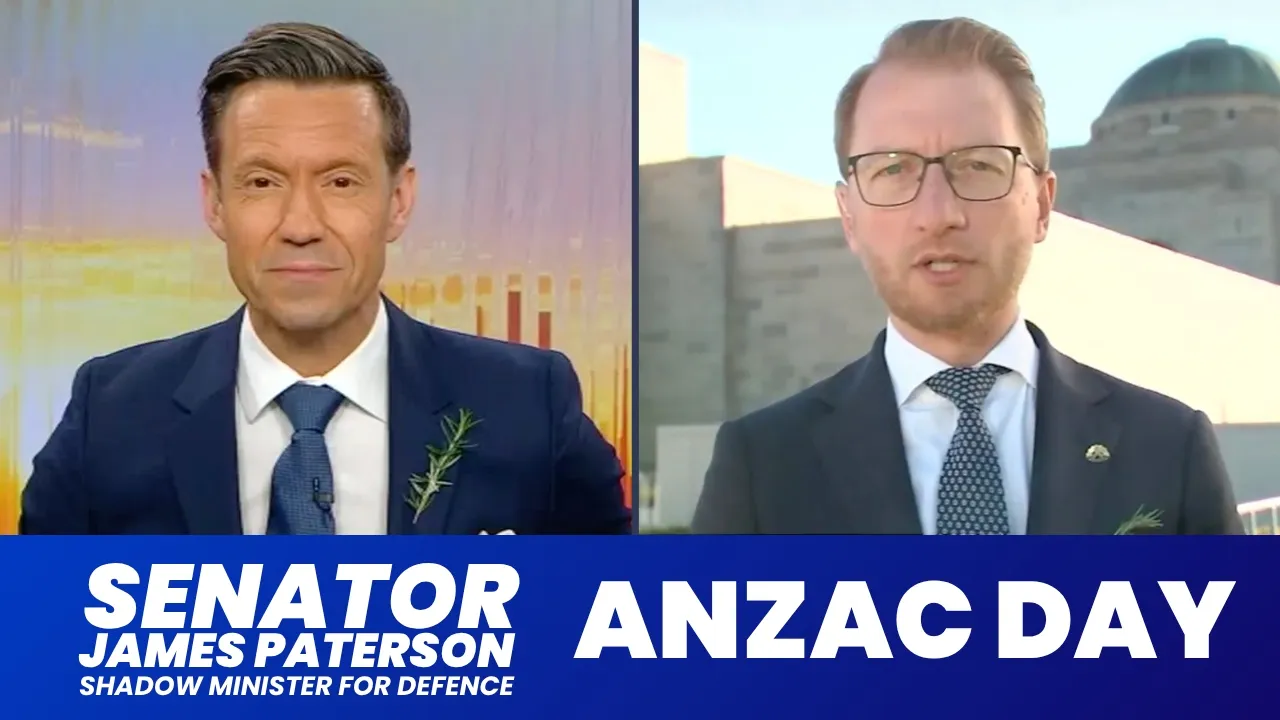
ALEX THOMAS: Let's speak now to Shadow Defence Minister James Paterson, who joins us live from Canberra. Mr. Paterson, thanks for your time today. Tens of thousands showing up at dawn services across the country. Is ANZAC Day the most unifying occasion on our calendar?
SENATOR JAMES PATERSON: Good morning. Look, I'd be surprised if it's not hundreds of thousands, if not millions. It is Australia's most sacred day, and I think it's the institution which is most widely supported among the Australian public. It's incredibly heartening to turn up to dawn services, as I did this morning here in Canberra at the War Memorial, and see young and old people who have lived in this country for generations, people who are new visitors to our country, migrants to our country, coming to pay their respects to people who've served our country and built this prosperous, free, tolerant, liberal democracy.
THOMAS: It's very personal to some people as to why they go, what they do when they're there; how do you reflect during those very poignant moments of silence?
PATERSON: I think it's very powerful, particularly to see young people wearing the medals of their parents or grandparents, carrying on a family tradition of remembering the sacrifice that their parents or grandparents have made so that they have the freedom that they enjoy today. It really is incredibly moving. It's also wonderful to see school students often come and lay wreaths on behalf of their schools, reflecting that this is a multi-generational, solemn moment that we all come together and recognise just how lucky we are to live in a country like Australia and just how essential our men and women in uniform have been to achieving that.
THOMAS: Yeah, because broadly modern generations have enjoyed this unprecedented period of peace. We know that ANZAC Day started in relation to the Gallipoli campaign in the Great War, the First World War, but obviously there are Australian servicemen and women right now in active operations and it's a good occasion to remember that.
PATERSON: I think that's exactly right. ANZAC Day, of course, is about celebrating our history, going back to Gallipoli and World War I and World War II, but it's also about remembering the service of our modern veterans who are still with us today, who served in more recent conflicts like Afghanistan and Iraq, and the men and women who continue to serve in uniform today, who get up every morning to protect our way of life, who believe that our country is worth fighting for, and who stand ready at a moment's notice to fight again if they ever have to, to defend what we have. And we should be just as mindful and appreciative of their current service as we are of those incredibly moving and powerful historical stories as well.
THOMAS: One of those veterans, of course, one of your colleagues, Phillip Thompson, we spoke to him a little bit earlier. He was not happy about some of the loud booing and heckling we heard during dawn services in Sydney and Melbourne. He said, look, it's just not the right time to do it today, the Deputy PM Richard Marles calling it a disgrace. Where do you stand?
PATERSON: I agree with both of them. It is incredibly disappointing and completely inappropriate to boo at an ANZAC Day service. Whatever your views on a welcome to country, ANZAC Day is our most sacred day, and disrupting an ANZAC Day ceremony is an insult to our country and the service of those men and women who sacrificed; many paid the ultimate price for our country. If you have strong views about that, there are many other ways in a free country that you have an opportunity to express your views. The least you can do is stay away, or not disrupt an ANZAC Day service.
THOMAS: Yeah, James Paterson, we really appreciate your time here on ANZAC Day. Thank you very much indeed.
ENDS