

Media
|
News
September 17, 2026
Thursday 17 September 2026
Noah Yim
The Australian
The creatives union has softened its language and refused to say whether it supports controversial copyright changes being considered by the Albanese government, as the Coalition, crossbench, and Greens expressed fury at the government for changes being considered.
The Media, Entertainment and Arts Alliance last year said the “existing copyright framework already provides mechanisms to facilitate fair and lawful access to creative works” and that it therefore “sees no reason to create special exemptions for Big Tech”.
But on Wednesday, after controversial proposed changes had been leaked, the MEAA appeared to soften its language.
“Our position is that any future legislation must ensure creators are fairly paid for their work and have control over how their work is used,” a spokeswoman said.
“We support continued engagement with the government as they work towards a policy position to ensure that creative and media workers have control over, and are fairly paid for, their work.”
The MEAA did not say whether it supported the options under consideration by the government.
The peak unions body, the Australian Council of Trade Unions, said AI companies had “built their products off the theft of the works of creative workers in Australia” and demanded that protections ensure “creative and media workers have ownership of their work, have control over how it is used, and are able to decide the price and value of that work”. After leaked documents showed the government was considering changing copyright arrangements, the Coalition accused the government of “the hallmarks of a dirty deal to hand the intellectual property of Australian creators to global AI giants”, and progressive crossbencher David Pocock – who revealed the documents – accused the government of throwing creatives “under the bus” and “caving” to AI companies.
Opposition legal affairs spokeswoman Michaelia Cash said the proposed changes amounted to “a text and data mining exception with an opt-out bolted on”.
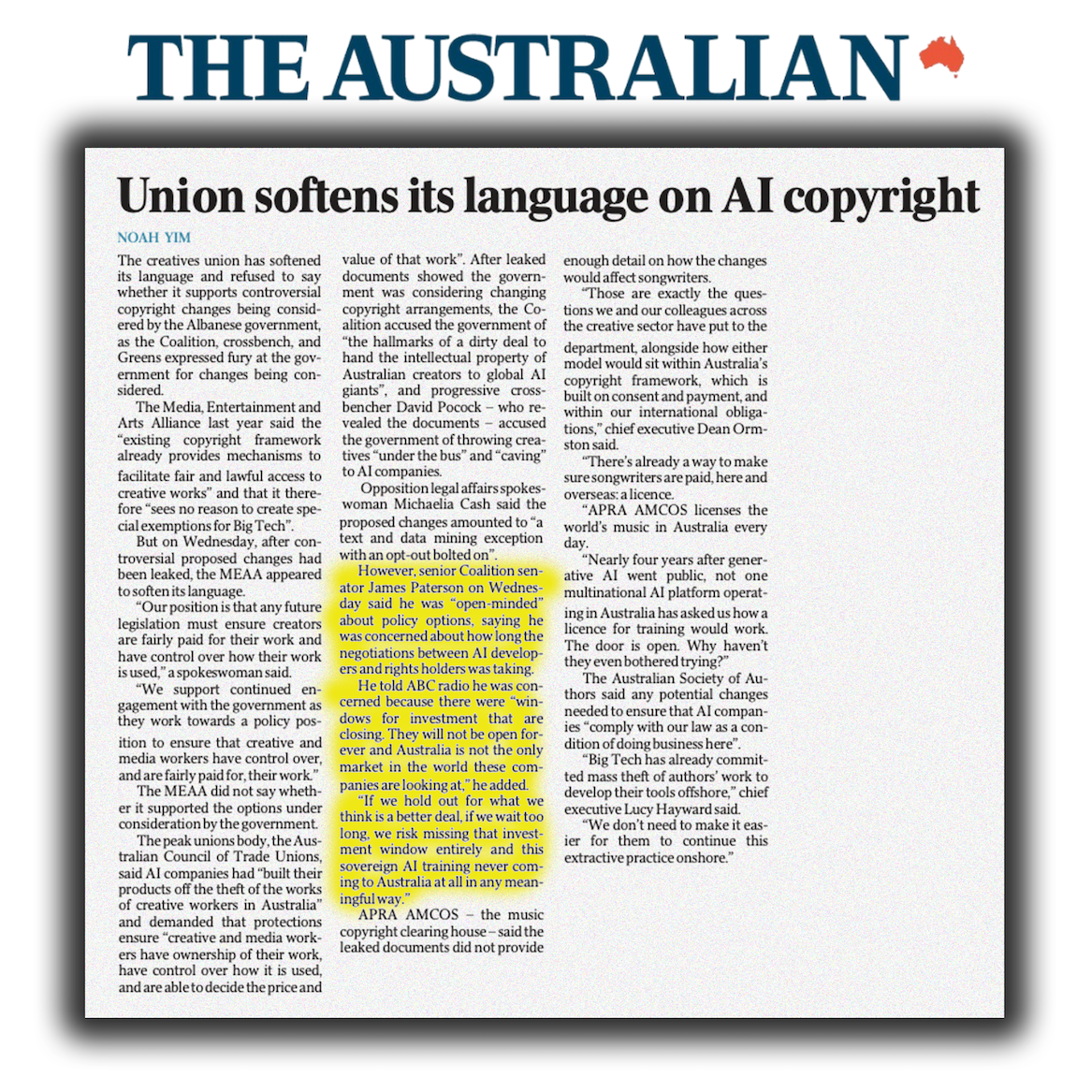
However, senior Coalition senator James Paterson on Wednesday said he was “open-minded” about policy options, saying he was concerned about how long the negotiations between AI developers and rights holders was taking.
He told ABC radio he was concerned because there were “windows for investment that are closing. They will not be open forever and Australia is not the only market in the world these companies are looking at,” he added.
“If we hold out for what we think is a better deal, if we wait too long, we risk missing that investment window entirely and this sovereign AI training never coming to Australia at all in any meaningful way.”
APRA AMCOS – the music copyright clearing house – said the leaked documents did not provide enough detail on how the changes would affect songwriters.
“Those are exactly the questions we and our colleagues across the creative sector have put to the department, alongside how either model would sit within Australia’s copyright framework, which is built on consent and payment, and within our international obligations,” chief executive Dean Ormston said.
“There’s already a way to make sure songwriters are paid, here and overseas: a licence.
“APRA AMCOS licenses the world’s music in Australia every day.
“Nearly four years after generative AI went public, not one multinational AI platform operating in Australia has asked us how a licence for training would work. The door is open. Why haven’t they even bothered trying?”
The Australian Society of Authors said any potential changes needed to ensure that AI companies “comply with our law as a condition of doing business here”.
“Big Tech has already committed mass theft of authors’ work to develop their tools offshore,” chief executive Lucy Hayward said.
“We don’t need to make it easier for them to continue this extractive practice onshore.”