

Media
|
Transcripts
February 27, 2026
SHADOW MINISTER FOR DEFENCE
SENATOR FOR VICTORIA
TRANSCRIPT
INTERVIEW
SKY NEWS NEWS DAY
Friday, 27 February 2026
Topics: AUKUS submarines, defence spending, Labor should stop ISIS brides returning to Australia, capital gains tax and negative gearing
E&OE…………………………………………………………………………………………
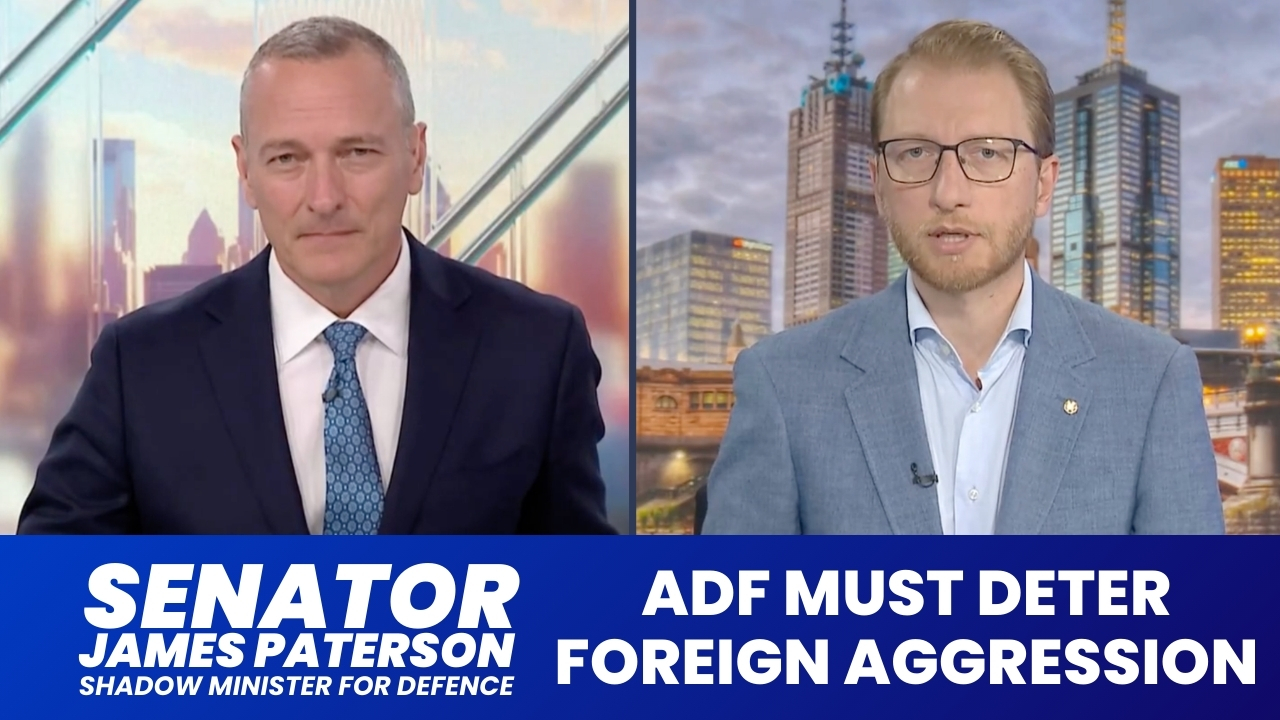
KIERAN GILBERT: Welcome back to the program. Let's go live to the Shadow Defence Minister James Paterson. Thanks for your time. The Defence Industry Minister has been in the UK. Progress on the AUKUS subs, the first of our purpose-built submarines. Do you welcome that? Is that good news?
SENATOR JAMES PATERSON: I absolutely do welcome it. AUKUS is a strictly bipartisan affair, and we want the government to succeed in delivering AUKUS on time and on budget and with the capability that Australia needs to defend our interests and our values in an extremely contested time in history and an extremely contested region. I am concerned, though, as many prominent defence experts are, that it can't just be about AUKUS, because AUKUS is about capability in the medium and long term, and we need urgent capability in the short term as well, before the AUKUS submarines arrive, either the Virginia-class submarines or the SSN-AUKUS that we're going to make jointly with the UK.
GILBERT: What are your priorities for those capabilities, for the force structure, but specifically the capabilities that you want to see?
PATERSON: What we need to do, Kieran, in the short term is to acquire as much capability as we reasonably can that would make any potential adversary of Australia think twice about threatening us either directly or indirectly through interests that we share, like a prosperous and stable and peaceful Indo-Pacific. What do we need do that? Some of those capabilities are going to have to be asymmetric because Australia is a regional power with global interests, we are not a superpower. We have limited resources and people, and we can't buy and acquire everything. So what is helpful in that area? Well, more missiles, air defences, particularly integrated air defences, more drones, more things that are capable of making a larger adversary think twice about threatening us and our interests.
GILBERT: The thing is, with expenditure, and you know, as someone who's had responsibilities in the economic space as well, there are always competing demands. Right now, cost of living remains the top issue for the electorate. How do you seek to navigate that? To say, look, we need to up the spend on this front, but reduce the spend overall?
PATERSON: You're absolutely right, Kieran, and we need to justify to the Australian people why spending on defence is more important than some other worthy considerations or requests that they have of government at this time, because there is an unlimited number of worthy things that federal governments can do, but there is a limited amount of resources to do it with. I think we need to rest very heavily on the expert advice that the government has received. When the government does something like commission a defence strategic review and it asks someone like an eminent former chief of defence force, like Sir Angus Houston, an academic expert like Professor Peter Dean and Stephen Smith as a former defence minister, and they provide advice - publicly in the case of Sir Angus and Professor Dean - that we need to urgently increase defence spending, otherwise we won't be able to secure our interests and our values, then we need to heed that advice. And unfortunately, the evidence is, as a proportion of GDP, there has been no increase in defence spending under the Albanese government. We are at or about the 2% of GDP that the former government left this government. Now, they say there's going to be increases in the future, but they are off in the never-never. We won't hit 2.3% of GDP spending until the early to mid-2030s, when every defence analyst and expert tells you that the risks we face, we face right now.
GILBERT: On the issue of ISIS brides, do you accept and believe the Prime Minister when he says he's got contempt for the individuals concerned, the adults involved in going to that terrorist hotspot, that caliphate, as it was self-styled? Do you accept and believe him on that? And secondly, if that is the case would the legislation you're proposing for next week do anything about blocking their return given as, you know, reprehensible and distasteful as these individuals are and what they did? Disgusting, what they did really, going to a terrorist hotspot. But can we stop them coming back?
PATERSON: The short answer to your first question Kieran is no. I don't really believe the Prime Minister because his actions don't match his words. He can have as much hairy-chested rhetoric as he likes about how terrible these people are, but the federal government has options available to it to prevent these people from returning to Australia and they are not taking them up. The first is passports did not need to be granted to these people because Section 14 of the Passports Act allows the Minister for Foreign Affairs to deny or cancel a visa to someone if they pose a threat to security of Australia. Secondly, there are temporary exclusion orders which can and should be applied to this cohort. As far as we know, they only intend to apply it to one of the adults in this cohort. And thirdly, they seem content to allow private citizens like Dr Jamal Rifi, who is a respected community leader but a private citizen, to run freelance repatriation operations for people who he himself has admitted on radio this morning he does not know much about and doesn't know whether they've been radicalised or not. Our legislation deals with that problem. Our legislation would make it an offence for a private citizen or a charity or any other non-government organisation to conduct a repatriation operation unless they have the approval of the government to do so. They should only be involved in those operations when they are approved to do so, and our legislation would provide for that. It would be very difficult for these people to return to Australia if they didn't have someone like Dr Rifi who's willing to coordinate, facilitate, apply for passports, take them over there and help them return.
GILBERT: And if they are returned, the word is, you know, the advice internally from government and others in the security space is that they probably will be locked up anyway, at least some of them. Is that your sense?
PATERSON: Well, I'd like to be able to have confidence in the answers provided by government on this issue so far, but I haven't been filled with confidence because it's been very heavily caveated and, you know, unclear. Every single one of these people is likely to have committed at least a declared area offence. Declared area is a region of the world that the Federal Government says you cannot go unless you have a permitted reason. And the area controlled by Islamic State in Syria and Iraq during the period that they were there was a declared area. So, every single one of them should be charged with that offence. It also appears on the face of it that they've associated with a listed terrorist organisation. It's a crime to associate with a listed terrorist organisation. They should be charged with that. It's also possible, depending on the individual circumstances of the people involved, that they were actively involved in terrorism. At least one of them, we know, is considered by our intelligence agencies to be a security risk. They should be charged if they've been involved in any terrorism activities. So, the idea that only some of them maybe might be charged if they come back doesn't fill me with confidence.
GILBERT: And just adding a bit of nuance to the debate, and I think that the Opposition Leader was right to visit the Assyrian community today to remind people, including humanitarian, and I'm not trying to patronise some of the campaigns in that space, but we need to remember the communities who suffered the atrocities at the hands of ISIS, and the Assyrian Christians are right at the top of that list.
PATERSON: Correct, Kieran. I mean, one of the generous things that Australia has done in the last decade under Tony Abbott's leadership as Prime Minister is open our arms to persecuted minorities who were victims of Islamic State. As you say, Assyrians, Chaldeans, Yazidis, others, who were tortured, murdered, raped, and persecuted by Islamic State, and we provided them a safety and a homeland in Australia, and they've come and they've made a good contribution to our country. Right now, they don't know whether their former persecutors will be moving into them next door. Because the Albanese Government can't guarantee that the ISIS brides won't come back, and they can't tell us where they're going to be if they are. We call these people ISIS brides, but let's remember they are just ISIS members, ISIS supporters. They went to support an Islamist caliphate which had the purpose of persecuting ethnic and religious minorities under their control and instituting a Sharia law style government. I think they've effectively repudiated their loyalty to Australia in doing so. I don't think we should welcome them back with open arms. We should not be providing them with a green light or a red carpet. But that's effectively what the government is doing, particularly when you have someone who is the closest personal and political supporter of the Home Affairs Minister, Tony Burke, in Dr Rifi, who is personally facilitating these repatriation operations.
GILBERT: Yes, indeed, naive sort of behaviour you would imagine from him. As you say, he's a respected community member. But those calls, anyway, it will be judged by this as well. Let's talk about the capital gains tax and negative gearing debate. How do you see that playing out next week? Parliament's set to return.
PATERSON: What I thought was very interesting in his press conference you were carrying earlier, Kieran, that the Treasurer, Jim Chalmers, failed to rule out changes either to capital gains tax or negative gearing. Let's be clear about this. At every recent federal election, the Labor Party has been crystal clear they have no plans to make any changes to either negative gearing or capital gains tax. They are particularly strong in ruling out negative gearing changes. But they also did a mea culpa on capital gains tax after they took that to the 2019 election and lost it as a result. So, this would be a major breach of faith with the Australian people, and we know why they're doing it. It's because Jim Chalmers and Katy Gallagher have been utterly incapable of controlling the spending side of the budget. And because spending has been out of control, they have to go after taxpayers’ money to make up for that lack of fiscal discipline, that lack-of-fiscal rules that they've imposed on themselves. And so it's ultimately Australian homeowners who are going to pay through higher taxes on housing as a result of this inability to control spending by Labor. And frankly, it's not going to make housing any more affordable. Putting taxes on housing does not make it more affordable, it just guarantees you'll get less of it.
GILBERT: We will see you next week. Senator Paterson, thanks.
PATERSON: Thanks Kieran.
ENDS