

Media
|
Transcripts
February 5, 2026
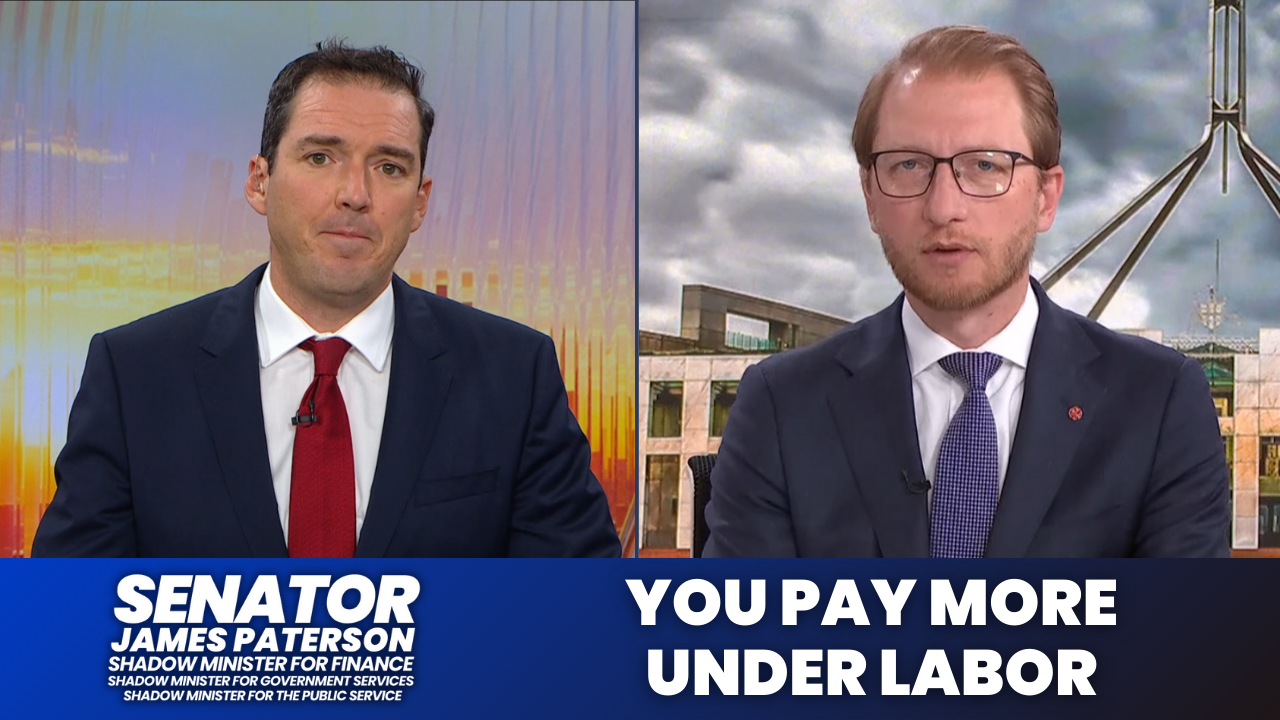
PETER STEFANOVIC: Well, last October, the Shadow Finance Minister and the Opposition's most effective spokesperson, James Paterson, argued it would be a disaster for the nation's oldest political alliance, the Coalition, to split up. Five months after its election defeat last year he called on the Coalition to stop its apology tour. Well, James Paterson joins us now, live for the first time this year. James good to see you, so no doubt you hoped the worst was behind you. Could you have imagined things would worsen so quickly after that speech?
SENATOR JAMES PATERSON: Good morning, Pete. No, I guess I couldn't have. And the sitting that we had in January, which was a difficult issue that had to be navigated in a difficult environment, I think, ended in the worst possible way from the Coalition's political perspective, with a split effectively in the National and Liberal Party Coalition. I don't think it's in the best interest of our parties or, more importantly, in the country's best interest for the two centre-right parties of this country, which have governed so effectively together for more than 80 years, to be at odds. And I think we should continue to have constructive and good faith dialogue to see whether there can be a reasonable accommodation. That doesn't mean capitulating on important principles. I think the principles of shadow cabinet solidarity in the Westminster system are essential for a serious opposition and an effective government, and we should continue to insist on those. But I don't want to see the door slammed shut to further negotiations and reformation of the Coalition for the rest of the term.
PETER STEFANOVIC: So you just heard some doubts from your colleague, Andrew Bragg, there. Do you think the Coalition can or will get back together?
SENATOR JAMES PATERSON: Well, I understand why colleagues are pessimistic about it, but let's think about this rationally. Will we have the most success at the next election if, in addition to fighting the Labor Party, the Teals, the Greens and One Nation, we are also fighting the National Party? And is the National Party best placed to hold all of their seats and win any new ones by being just another party of protest and no longer a party of government? I mean, the core proposition of the National Party for all of its history to its communities is, we are a party of government and we can deliver for you. But if the National Party is not in coalition with the Liberal Party, they are no longer a party government. They can no longer deliver for their communities, and there is nothing to distinguish them from other parties of protest like One Nation. So if people are looking for a party of protest, I think they're much more likely to favour One Nation than the Nationals if that's where they choose to compete. So I really think it is in all of our collective interests to reform the Coalition on reasonable terms, on a reasonable timeline.
PETER STEFANOVIC: So that brings us to John Howard, who has asked Sussan Ley to stop the nitpicking and make concessions if needed to get the Nationals back in the Coalition. Do you agree with John Howard on that point?
SENATOR JAMES PATERSON: Well, I don't think that was Mr Howard's exact form of language, but John Howard is our greatest living Liberal. And we, of course, don't have to do everything that Mr Howard recommends, but in my view, we have to have a very good reason if we're going to depart from his advice. And Sussan has publicly talked about how much she respects John Howard's advice, including on this issue, and how to navigate this as the strong and successful coalitionist that he was, the government that he led, which had an incredible partnership with the National Party. So I think we should listen very carefully to the advice that he gives us. I think we should give this the time that it needs and give it the best chance it can to succeed.
PETER STEFANOVIC: When you say time, I mean, what sort of timeframe are you looking at?
SENATOR JAMES PATERSON: Well, I think the most important thing is that no doors are slammed shut, Pete. I think it's really important that we leave open the possibility of reforming the Coalition, and we don't take any steps that would make it harder for the Coalition to reform. It may be the case that it will take some time for the National Party outside the Coalition to understand what the implications of that are. I mean, in the limited polling that we've had since the split, while it's been terrible for both parties, it has been particularly bad for the National Party, who are looking like a rounding error in national polls at the moment. I don't think it is in their interests in the long term to stay outside the Coalition. I think most National MPs understand that. And I think in time we will find goodwill between both parties to reform, upholding those critically important principles of shadow cabinet solidarity and the Westminster conventions.
PETER STEFANOVIC: Will there be a spill for the Liberal leadership?
SENATOR JAMES PATERSON: I don't believe so. I'm advocating against a spill. I've consistently advocated against a spill, both publicly and privately, and I'm not anticipating one.
PETER STEFANOVIC: So, I mean, you publicly shook the hand of Andrew Hastie last year. We saw those images. Hastie's ruled himself out of a potential spill. Yeah, there's the shot there. If there is a spill, would you support Sussan Ley over Angus Taylor?
SENATOR JAMES PATERSON: Absolutely. I'm a member of the Shadow Ministry. I'm a member of the leadership group. If I were to support a spill, I would have to resign from the leadership group and from the Shadow Cabinet. And I haven't done that. And if I advocate for a candidate or for a spill, the first person who would know before I did so would be Sussan Ley. And I haven't called her to tell her that. And so you can continue to safely assume that I support Sussan's leadership.
PETER STEFANOVIC: Okay, I just want to race through a couple of policies outside all of that, James, just because it's our first time this year. So, the government this morning has rebuffed questions over its plans to limit the Capital Gains tax discount, saying its housing policy is clear. This was Richard Marles earlier today.
[CLIP START]
HON RICHARD MARLES MP: In explaining our position in relation to housing policy, we do accept that there are intergenerational challenges in relation to housing, but the way in which we are dealing with that is on the supply side, making sure that we are having more houses built around the country. Now that's been our strategy for a number of years. That continues to be the strategy. That's what we took to the election.
[CLIP END]
PETER STEFANOVIC: Just this week, figures came out that the housing numbers aren't being reached. But anyway, this all was kicked off by the SMH today, James. A trimmed discount for the capital gains tax could form the centrepiece of Jim Charmer's budget alongside other tax measures to help young people buy homes. What's your response to that?
SENATOR JAMES PATERSON: Well, let's be very clear about this, Pete. If the government breaks an election commitment, which they've taken to successive elections to make no changes to capital gains tax or, indeed, negative gearing, it will be a very serious breach of faith with the Australian people, and it will be a desperate grab for revenue from a government that can't keep spending under control. We saw between the election time and the mid-year fiscal economic update, just before Christmas, that there was a $57 billion blowout over the medium term in the budget bottom line, and no Albanese government minister from the Treasurer to the Finance Minister has yet to provide an adequate explanation for why and how that occurs. We have deficits as far as the eye can see.
PETER STEFANOVIC: No one believes there's a spending problem. I mean, I spoke to the Treasurer about that this week, and even Richard Males this morning. They don't believe that the spending is excessive.
SENATOR JAMES PATERSON: No one in the Albanese government believes there's a spending problem, but there are dozens of respected independent economists who are crying out for some fiscal restraint here in Canberra. It's very clear that when you spend the highest proportion of the economy in 40 years, outside of a recession or a pandemic, that is going to put upward pressure on inflation and upward pressure off interest rates. And economists are calling this out. The thing that Jim Chalmers and Katy Gallagher have complete control over is government spending. They could take the pressure off of inflation, they could take the pressure off interest rates if they chose to exercise just a little bit more fiscal discipline than what they have over the last four years.
PETER STEFANOVIC: Where would you do that, by the way? Where would you cut? Where would you make trims?
SENATOR JAMES PATERSON: Well, a very good example that we've demonstrated on a big scale is the government's electric vehicle tax incentive, which was supposed to cost $90 million this financial year, but will instead cost $1.35 billion this financial year. So you're talking about a 15 times blowout in the cost of that program. It continues to get worse every day. I wouldn't be surprised if next financial year it's blown out even more. That's a program which is running off the rails, which is costing taxpayers money and which doesn't even achieve its stated objectives at a reasonable cost because its carbon abatement cost is about $1,000 a tonne, according to the Productivity Commission, and the beneficiaries, even according to the industry, are overwhelmingly high-income earners. So it's a shocker of a policy failure and it's an easy save that the government could take at any time.
PETER STEFANOVIC: Alright, I've gone way over time, James, but I just want to ask you one more. Isaac Herzog, he's coming here, the Israeli President, on the weekend. There has been some concerns from Labor MPs at a state level, but also at a federal level too, Ed Husic one of them, about inflammatory comments that the President has made in the past. What are your thoughts ahead of the President's visit here, and concerns about protests getting out of hand?
SENATOR JAMES PATERSON: Well, the Foreign Minister, Penny Wong, has for many years spoken about the importance of a government speaking with one voice when it comes to foreign policy. But it seems that the Albanese government has many voices when it comes to foreign policy, that Ed Husic gets to have his own foreign policy and Penny Wong has a different foreign policy. It wouldn't surprise me at all to learn that Ed Husic's views are widely shared within the Labor caucus, and perhaps we'll learn more about that in the coming weeks. But it seems extraordinary to me and frankly an act of bad faith and a terrible gesture towards the Australian Jewish community that we can't even have the President of the Jewish State of Israel come to Australia after Bondi for a memorial, for the purposes of providing comfort to the Australian-Jewish community, without Labor MPs publicly running it down and attacking it. I think that's appalling.
PETER STEFANOVIC: Okay. James Paterson, thanks for your time. As always, we'll chat to you again next week.
SENATOR JAMES PATERSON: Thanks, Pete.
ENDS