

Media
|
Transcripts
February 18, 2026
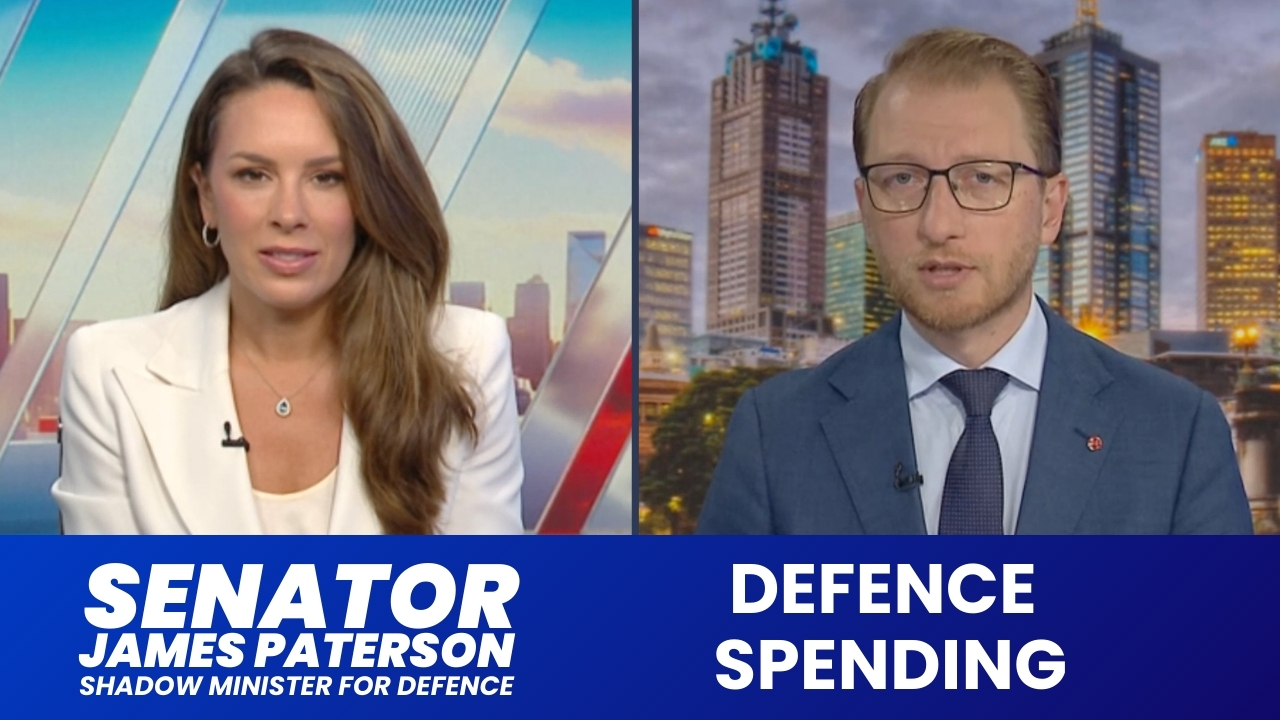
SENATOR JAMES PATERSON
SHADOW MINISTER FOR DEFENCE
SENATOR FOR VICTORIA
TRANSCRIPT
INTERVIEW
SKY NEWS AM AGENDA
Wednesday, 18 February 2026
Topics: Appointment as Shadow Minister for Defence, Labor should stop ISIS brides returning to Australia
E&OE…………………………………………………………………………………………
LAURA JAYES: Welcome back. You're watching AM Agenda. Let's get straight to the new Shadow Defence Minister, James Paterson. James, thanks so much for your time. You were the person who was seen as really getting people off the fence and switching their vote behind Angus Taylor. Do you see this as a reward? Did you want the Defence Portfolio?
SENATOR JAMES PATERSON: Laura, I've been someone who's always been happy to serve in whichever role any leader has asked me to perform. I enjoyed being the Shadow Minister for Finance under Sussan Ley's leadership. I enjoyed being the Shadow Minister for Home Affairs under Peter Dutton's leadership, I'm very happy to be taking on the role of Shadow Minister for Defence, which has obviously been vacated as a result of Angus becoming leader. Because frankly, the biggest and most existential questions facing our country are how do we preserve our way of life? How do we protect our way life? And the men and women of the ADF are on the front line of preserving our way of life every day, and, frankly, they need much more support to do that.
LAURA JAYES: AUKUS is obviously the big issue that you're going to have to tackle here. Do we need to up our defence spending? Do we need more assurances from the United States?
SENATOR JAMES PATERSON: We absolutely do need to up our defence spending and you don't have to take my word for it. Professor Peter Dean and Sir Angus Houston completed the Defence Strategic Review for the Albanese Government and they have both since said publicly that we need to be spending more like 3% of GDP on defence, not the 2.3% of GDP that the Albanese Government plans to spend in the early to mid 2030s. The truth is that AUKUS is a massive endeavour and if we want to have both AUKUS and a capable ADF in other domains, then we have to increase defence spending. Otherwise, AUKUS will inadvertently cannibalise other capabilities. That's why the Albanese Government has had to cancel so much defence capability, whether it's self-propelled howitzers, infantry fighting vehicles, military communications satellites, F-35s, Hunter-Class frigates, you know, you name it. There are so many capabilities that have been cancelled. In fact, it's got so bad that army reservists have been told that they can only do 150 days a year of deployment, not 200, because, you know, funds are so stretched within defence. So we urgently need to increase defence spending. And frankly, if I do a good job, Richard Marles will have an easier time at the Expenditure Review Committee arguing for more defence spending.
LAURA JAYES: Okay well that's quite the take but James you know you're also a party that has recommitted to lower, simpler, fairer taxes so where would you cut to pay for this massive increase in spending?
SENATOR JAMES PATERSON: Well, we'll outline our full policies and costings in the usual time and the usual way, Laura, but we understand the very significant fiscal choices that face us as a country, and the Albanese Government faces those choices too ...
LAURA JAYES: So, there will be cuts?
SENATOR JAMES PATERSON: ... the way they're choosing to deal with that problem…Well, no, I haven't said that. The way that the Albanese Government is choosing to deal with that problem is by increasing taxes. They're going to come after people's homes with higher taxes. And we don't think that is fair or right. And we certainly don't think it's going to make housing more affordable. What Angus has very clearly outlined already is that if you get the economy growing faster than the budget, then over time, the budget deficit will close and you will have more to fund those essential services, including our national security and defence. But we've also already previously outlined specific areas where we would save money. We think that the electric vehicle discount is not justified because the Productivity Commission has found that the bare minimum cost of abatement per tonne of carbon emissions saved is $1,000. That's extraordinarily inefficient. The industry themselves have admitted that the primary beneficiaries of this are high-income earners, and it has blown out dozens of times compared to its original costing. And so it's a failed policy that should end.
LAURA JAYES: Wouldn't that technically be an increase in tax though, James?
SENATOR JAMES PATERSON: No, I don't think so. I mean, this is very clearly a rebate, an incentive, a discount for people to buy electric vehicles. We have no objection to people buying electric vehicles, in fact, they already are exempted from paying fuel tax by virtue of buying an EV, but we don't think that this income tax incentive is well targeted if your objective is to reduce emissions and it is weighing down the budget.
LAURA JAYES: Ok, let's talk about the ISIS brides. Apparently, they will be making their way home in the next couple of days. You've called this morning for this, well, for them to be held where they are. But I'm not sure really where they are. Do you know if they're still in Syria? And what is the risk that you are concerned about? What risk do they pose?
SENATOR JAMES PATERSON: Well, we're relying on media reports only here, Laura. The government hasn't actually provided any information about what they know, about when they knew it and about what they're doing to manage this risk to the Australian population. But self-evidently, someone who left our country to join a listed terrorist organisation like ISIS, by definition, poses some level of risk and the height and the exact level of that risk will depend on their individual circumstances that we don't know. But I'm very concerned that we appear to have a freelance repatriation operation being run by a private citizen. Media reports indicate Dr Jamal Rifi is running this. Now he's a respected member of the community but he's a private citizen. He shouldn't be running repatriation operations and he's also ...
LAURA JAYES: When you say running ...
SENATOR JAMES PATERSON: ... known to be a close personal friend ...
LAURA JAYES: Yeah, running a repatriation operation, what do you mean when you say that? He is helping people get passports, he knows the system and obviously speaks the language, so is, over there?
SENATOR JAMES PATERSON: Well, Andrew Greene reported, I think exclusively for The Nightly yesterday, that Dr Rifi is organising this repatriation by, I believe, coordinating and fundraising and facilitating their departure. That's not an appropriate thing for a private citizen to be doing, and it's particularly concerning given how close Dr Rifi is to the Home Affairs Minister Tony Burke. He was the Chair of the Friends of Burke. He ran a political campaign to support Tony Burke's re-election as a local member, and they're known to have a close and a long-standing relationship.
LAURA JAYES: Do you think he's broken any laws? ...
SENATOR JAMES PATERSON: ... So, did he give Tony Burke a heads-up that he was doing this? Not that I believe. I have no expectation that he has. But did he tell Tony Burke that he was doing this? Did Tony Burke give him a green light in the same way he gave Save the Children a green light in that secret meeting for a previous repatriation operation? These are questions that Tony Burke hasn't answered but must answer and must answer today.
LAURA JAYES: Okay, so what would you do?
SENATOR JAMES PATERSON: Temporary exclusion orders are a very important tool that is designed to keep Australians safe. It can keep an Australian citizen offshore for up to two years while a case is built against them so that they can be charged if they ever do choose to return subsequently. Now, it is possible, depending on the individual circumstances of each of these people, that they have committed offences while overseas. It appears that they're associated with a listed terrorist organisation, ISIS, which is a crime. It is possible that they breached the declared area provisions which prevented Australians from going to Iraq and Syria during the period of Islamic State. And it's also possible that while they were there, they participated in the crimes of ISIS. Now all of those things need to be established by the courts, but a temporary exclusion order gives police the time to build a case so they can be charged if they come home.
LAURA JAYES: Do you consider the children that were born into this and the collateral damage that they seem to be in what you're putting forward this morning, and do you accept that any of these ISIS brides were taken to Syria not willingly?
SENATOR JAMES PATERSON: Laura, it is certainly possible that ISIS brides, so-called, left our country under some kind of duress. We have to know the individual circumstances. But we also know that many willingly chose to go and join a listed terrorist organisation and a death cult. Obviously, children deserve the most sympathy in these circumstances, particularly if they were born over there or they were taken from Australia as minors, as many would have been. And in the past, children have been independently repatriated back to Australia, separate from their parents, because of the unique circumstances and because the risk could be better managed. It's my understanding though that for several years the remaining Australian citizens have refused independent repatriation of children and insisted that repatriation only occur with a whole family unit. Now if the adults in that family unit pose a risk to our security and safety then I'm very clear eyed about this. We should keep them offshore. We do not want them home.
LAURA JAYES: James, thank you for your time. Congratulations on your appointment. Hope to be speaking to you regularly and again soon.
ENDS