

Media
|
News
March 5, 2026
Taxpayers have funded Australian academics to collaborate with scientists from the despot nations of Iran, China, Russia and even North Korea on at least 1500 joint research projects over the past decade.
As the Albanese government and opposition blame each other for the risky research, the Australian can reveal the extent of contentious collaborations involving some of the nation’s most elite universities.
Australian Research Council data shows it has funded 1468 research collaborations – most relating to hi-tech engineering and computing research – with China since 2014. Nearly 10 per cent of all ARC-funded research projects over the past decade involved China, making it Australia’s fourth-ranking research partner behind the US, UK and Germany.
The ARC also funded 76 research collaborations with the Russian Federation – with three-quarters of them involving science, engineering or mathematics.
The Australian National University – which is affiliated with Australia’s defence and spy agencies – took part in 14 academic collaborations with Russia, while the University of Melbourne and University of NSW each conducted 13 joint projects.
The ARC’s data portal reveals 15 collaborations between Australian universities and Iran between 2014 and 2023, when they were banned by the Albanese government. It indicates Monash University collaborated with Iranian researchers on four projects, while the ANU worked on three.
The nature and cost of each project is not revealed, but the ARC data shows one involved mathematical sciences, another biological sciences and the rest were related to psychology, law, archaeology, art or religion.
No funding was approved after Foreign Minister Penny Wong wrote to vice-chancellors in February 2023, ordering an end to all joint research projects with Iran.
The ARC data portal indicates the University of NSW collaborated with North Korean researchers on one economics-related project in 2014.
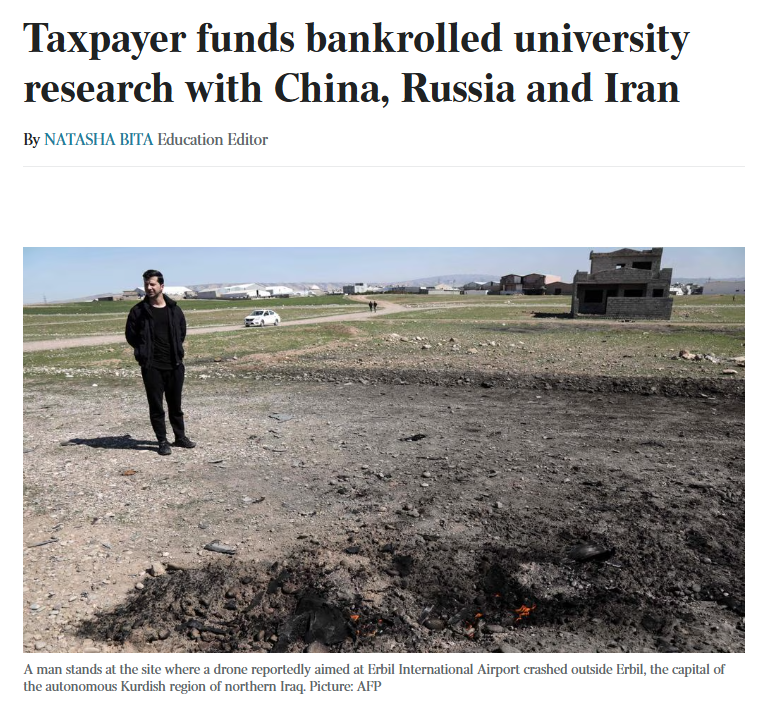
Apart from the ARC funding, individual universities had independently sponsored drone-related research with Iran prior to the government’s ban.
Separate collaborations with the sanctioned Sharif University of Technology in Iran involved researchers with ties to the University of Sydney, University of NSW and Adelaide University.
The Australian is not suggesting they worked on military uses for drones, or that research continued after the government ban.
Senator Wong said on Wednesday she had told universities early in 2023 to cease all collaborations with Iran. “When we came to government (in 2022) there were an alarming number of foreign arrangements in effect between universities and Iran, entered into under the Liberal and National government,’’ her spokeswoman said.
She said the Albanese government was “taking action to strengthen, clarify and streamline the Foreign Arrangements Scheme’’, which allows the Foreign Minister to terminate any university agreement that is inconsistent with Australia’s foreign policy.
Opposition education spokesman Julian Leeser said evidence of research with Iran was a matter of enormous concern. “Iran is one of the largest exporters of terrorism in the world, including to Australia, and has used its drone system to cause terror and strike at civilians across the region,’’ Mr Leeser said. “Australia’s research program should support Australia’s interests. Maintaining our technological edge requires us to have a research sector that is resilient to foreign interference and does not work in the interests of our adversaries.’’
Opposition defence spokesman James Paterson declared it “shocking that Australian universities still appear not to have learned the lessons of the past decade about the risks of dual use research’’.
“We should never co-operate with universities in authoritarian countries on research which has potential military applications,’’ Senator Paterson said. “Naivete is no longer a defence, particularly in research areas with such strategic significance like drones. If universities won’t get with the program, the Albanese government must use the numerous lever available to them to force their hand, including the powers in the Foreign Relations Act.’’
A federal Education Department spokeswoman said Australia had imposed sanctions on nearly 300 individuals and entities linked to Iran.
“Australia’s research sector should not collaborate with Iran,’’ she said. “Any collaboration with Iran on any aspect of drone technology is clearly not in the national interest.’’
The spokeswoman said the government’s University Foreign Interference Taskforce guidelines made it very clear that universities and researchers needed to conduct rigorous due diligence to assess national security and research security risks.
In a statement, the ARC said it had no current funded projects involving collaborations with Iranian institutions.
“Universities are responsible for managing international research collaborations,’’ it said. “All applicants and administering organisations receiving ARC funding are required to comply with government laws and whole-of-government policy requirements, including sanctions.’’
The ARC said it undertook “enhanced due diligence’’ and “when risks are identified, projects may be modified, subject to additional conditions, refused funding or have funding terminated’’.
A University of Sydney spokeswoman said on Wednesday it had “no institutional partnerships’’ in countries subject to “higher levels of sanctions’’, but gave academics the freedom to pursue peer-to-peer collaborations.
“International research collaborations bring positive tangible benefits to Australians and people around the world by addressing shared challenges including medical breakthroughs, technological advances, alternative energy sources and more,’’ she said.
“We have no institutional partnerships in countries subject to the higher levels of sanctions, while our researchers can use their academic freedom to pursue peer-to-peer collaboration globally that strictly complies with all relevant laws, government guidelines, ethical standards, codes of research conduct as well as our own policies, codes and standards.
“We require and support our researchers to identify and manage risks relating to their research.
“We’ll continue working with governments and the sector to maintain compliance in an increasingly complex environment.’’