

Media
|
Transcripts
November 3, 2026
TRANSCRIPT
TODAY SHOW NEWSCHAT
Tuesday, November 3, 2026
Topics: Prime Minister’s luxury travel to the Caribbean, Australians set to suffer the 17th interest rate hike under Labor, local government waste
E&OE…………………………………………………………………………………………
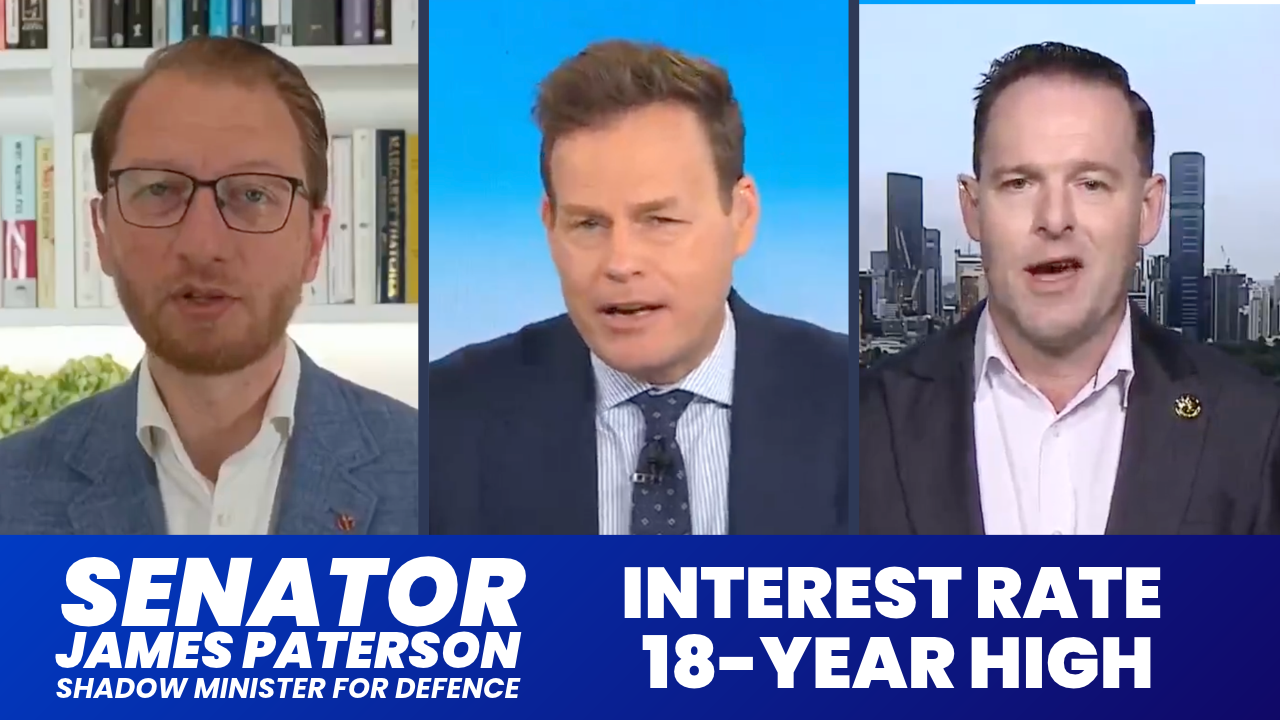
TOM STEINFORT: Interest rates hike today, so where is the Prime Minister as we all feel the squeeze? He's on board a billionaire's yacht on the gorgeous seas of the Caribbean, Antigua to be precise, in the company of King Charles. Joining us to discuss today's headlines is Shadow Minister for Defence James Paterson and Logan City Mayor Jon Raven. James, I'll start with you. I'm sure the PM would be at pains to say he's doing work on an important environmental campaign in the Caribbean, but he optics on a day like this? Oh boy.
SENATOR JAMES PATERSON: Look, the Prime Minister does need to travel for his job, and sometimes I think that's in the national interest. But I think a lot of Australians waking up this morning to see this news that the Prime Minster has flown to the Caribbean at taxpayers' expense to hang out on a yacht owned by a billionaire, they're going to be thinking, has he lost his mind or has he just completely lost touch? The truth is that we risk another rate rise today. It'll be the 17th on Labor's watch. It'll be a kick in the guts for mortgage holders around the country, who were promised by Anthony Albanese cheaper mortgages four years ago, but on average are paying more than $30,000 a year more in rent payments. And the truth is that his government has contributed to this and he should be here, facing the music and fixing the problems.
STEINFORT: Jon, do you think the Prime Minister is just a bit unlucky, timing-wise, on this one, or perhaps he should have seen this coming?
JON CRAVEN: Yeah, well, James knows full well if Angus Taylor was Prime Minister, he'd be at CHOGM representing Australia's interests. The Prime Minister has to go overseas, the Prime Minster has to represent Australia because we're a middle power and we're a trading nation, these relationships are so important. You ask anyone in business, they know that deals are done when you meet someone face to face. And that billionaire's yacht is Australian maritime innovation on the world stage. So you've got two Australian billionaires, you've Got Gina Reinhart and you've Andrew Forrest, one is bankrolling One Nation, the other one is showing off how good Australia is to the entire world, I know who I'd be backing.
STEINFORT: All right, well look, when we focus on the interest rate hike today that is expected, we've got leading economists now warning that these rate rises are driving Australia straight towards a recession. James, the Reserve Bank is trying to ease inflation, obviously, but is this just putting pressure on Australian households to the point that we will head into recession, do you think?
PATERSON: Well, the Reserve Bank has only one lever and if they see inflation out of control, they feel compelled to raise interest rates. The truth is that the government has other levers available to it and the Reserve Bank has been really clear that our inflation problem is driven domestically and that government spending is contributing to it, because as a proportion of our economy we are now at 40-year highs of government spending. It's the highest it's been outside the pandemic since the 1980s and that is driving up inflation. So, if the government keeps spending recklessly as federal Labor has been doing, the RBA's hands are tied, and I do think there is a real risk with this 17th rate rise on Labor's watch that we will enter a recession in the future and it'll be even worse than the last five years. We've already had a household recession, your living standards have already gone backwards, and soon we'll have a real recession with all the misery that entails.
STEINFORT: So, Jon, how much blame do you think government, state and federal, should be shouldering for this in terms of their level of spending?
CRAVEN: It's hard to blame government when you've seen diesel prices go up by 60% in the last six months. People know that inflation isn't high because Aussies are spending heaps of money on flash dinners or luxury holidays, it's high because of a war in Iran that is driving up the price of fuel.
STEINFORT: So, you don't think government spending is playing a role in increasing inflation?
CRAVEN: All spending that everyone does contributes to inflation, but Australia's economy is so sensitive to the price of diesel. We move food products further than anyone else in trucks, and that means that you see higher prices at the supermarket, you see a higher prices at the bowser. That is what is hurting us more than anything else, and I'm paying $3 a litre for diesel, that is what's hurting people's bank balance. And yes the RBA only has one tool to use and it's pretty easy for them to just keep punishing Australians for a war that's happening overseas but I think they need to just take a pause and think about what it means for people in Logan when they see their mortgage go up and that means they have to sacrifice things that they need, not things that they want.
STEINFORT: All right, well speaking of some pretty wild government spending. What about this South Australian Council? It's coping some backlash with reports that it is installing a new drinking fountain in a park at a cost of $50,000. Now, our graphics team has been very busy sort of modelling this one up, I'm not sure if it's a sort of gold plated, diamante studded situation there. Jon, you're our councilman here. Is that the going rate for a drinking fountain in your area?
CRAVEN: Yeah, drinking fountains can be pretty exy because we know that––
STEINFORT: 50 grand?
CRAVEN: Yeah, the government tax is real. But when council builds a piece of infrastructure like this they're not just ducking down to Bunnings and buying something off the shelf, they've got to build something––
STEINFORT: But isn't that the problem, that they don't just go the cheapest route?
CRAVEN: Well, it's got to last 30 years, right? So, and when you think about an asset that lasts 30 years the big cost isn't actually the initial spend. The big cost is how much it costs year on year to maintain that. And so, the question is how many people are using it? It's near a park run, we're getting 500 people a week that are using it. And the real question is, does it have the little thing at the bottom for the dog to drink some water? Because people love it when their fur babies can have some water when they're on a run as well.
STEINFORT: Wow, okay. So that's where the 50 grand goes. I mean, James, the question there from Jon was how many people are gonna use it? There is another water fountain 400 metres away from this glorious beauty there. Do you reckon that's a fair price tag? 50 grand for a water fountain?
PATERSON: It would have to be getting a hell of a lot of use to make that a justified expense, but I guess we should be grateful that this is in South Australia. Just imagine what it would cost if it was in Victoria. This is a state that managed to spend $600 million to not hold Commonwealth Games, that just built a toll road under a river for $10 billion that was supposed to cost $5 billion, and we know handed over $15 billion to organised crime, bikies and the CFMEU. A water fountain in Victoria would have to be supervised by organised criminals, the CFMEU and bikies and who knows what it would cost.
STEINFORT: Well yeah, building a water fountain might be tricky when they can't fill a pothole, so swings and roundabouts. Good to see you both then and enjoy your Melbourne Cup days.
ENDS