

Media
|
Speeches
May 26, 2026
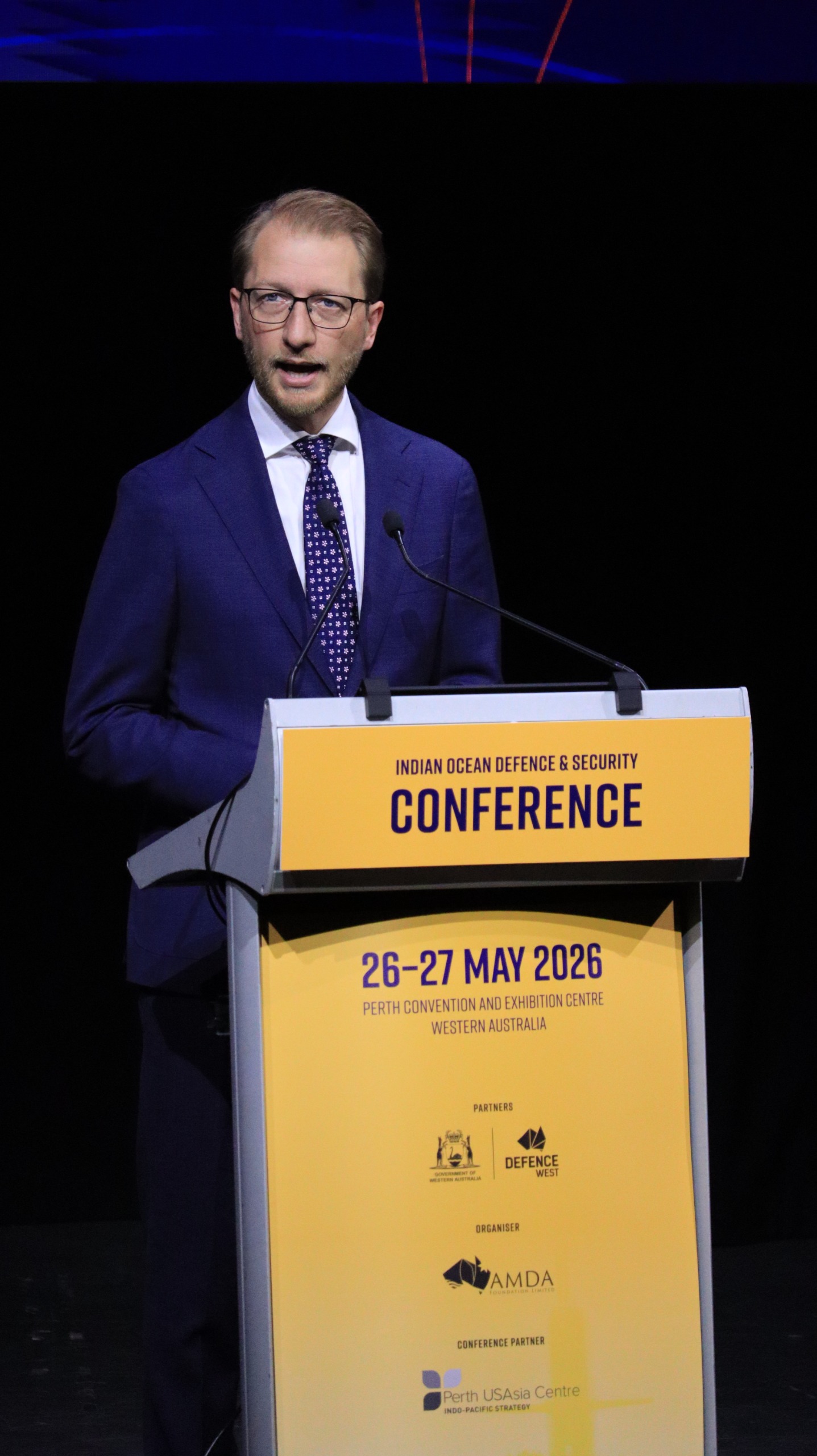
KEYNOTE SPEECH AT INDIAN OCEAN DEFENCE AND SECURITY CONFERENCE
Tuesday, 26 May 2026
Topics: Australia in the Indian Ocean - Is Australia ready?
E&OE…………………………………………………………………………………………
Thank you for the invitation to address the 2026 Indian Ocean Defence and Security Conference.
I am delighted to be here because Western Australia is a critical frontier for Australia’s defence and national security.
Submarine Rotational Force West at HMAS Stirling, the Henderson Defence Precinct, the SAS at Campbell Barracks, Naval Communication Station Harold E. Holt, and RAAF Learmonth are just some of the WA facilities critical to securing our national interest.
Looking out at the Indian Ocean, and with direct access to the Pacific, Western Australians have an innate sense of our strategic vulnerabilities.
In a world where states are increasingly emboldened to use all elements of state power to shape and coerce the decisions of others, Australia’s national security and economic interests are increasingly intertwined.
Over 99 per cent of our trade by volume[1] travels by sea, the vast majority moving through maritime chokepoints that ring the Indian Ocean, including the Straits of Lombok, Sunda and Malacca; the Suez Canal; and, of course, what is now a household name: the Strait of Hormuz.
The economic and security challenges facing Australia arising from conflict in the Middle East have laid bare how dangerously exposed our country is to global shocks, making our economy, and our national resilience, dependent on freedom of the seas.
As unpleasant as the closure of the Strait of Hormuz has been for Australians, through increased global oil prices and the flow on consequences for petrol and diesel, it is a walk in the park compared to the potential closure of chokepoints even closer to home, especially if they were disrupted simultaneously.
We have no more important national security imperative than deterring closure of those chokepoints to prevent the disruption of our maritime trade.
ANAO Collins class report
That is why I was incredibly troubled by the publication on Friday of the Auditor-General’s investigation into the life of type extension of the Collins Class submarines.
Our Collins submarines are one of the most important capabilities we have to support freedom of the seas in the Indo-Pacific.
They play a critical deterrence function to any power seeking to coerce Australia by closing any of those chokepoints.
Without them, until Virginia class and ultimately SSN-AUKUS submarines arrive, Australia is dangerously exposed.
But the ANAO has found that over the last four years, the life-of-type extension that was to keep Collins available and capable well into the 2030s has been badly botched by the Government.
The report tells a story of ignored warnings, failures to act, and an apparent inability to make timely decisions, with multiple submissions taken to the national security committee of cabinet over the last four years.
Indecision and delays have meant Defence now plans a significantly more modest life-of-type extension that will leave in place many of the components that were due to be replaced.
It remains a high-risk enterprise, and we risk having too few Collins available to be deployed for much of the next decade.
Money has been wasted – but even worse is the time lost while the strategic environment deteriorated.
The only resource more scarce in the Defence portfolio than money is time.
We cannot afford any more drift and delay with Collins, or AUKUS, because if that occurs dangerous capability gaps in long-range strike and undersea warfare will emerge.
That would leave Australia exposed to a much higher risk of coercion.
AUKUS
I am an AUKUS true believer.
I believe the acquisition of nuclear-powered submarines is a once in a generation strategic opportunity we must seize as a nation, because there are few platforms available today as uniquely suited to our circumstances.
We have a lot of work to do – and much of it here in Western Australia – to make sure that we deliver AUKUS.
Henderson is a vital part of delivering AUKUS.
I have no doubt that Australia’s commitment to nuclear submarine maintenance at Henderson, along with SRF-W at HMAS Stirling, was a significant factor in the Trump Administration’s tick of approval for AUKUS last year.
But demonstrated progress at these sites is critical to maintaining ongoing confidence in the broader AUKUS enterprise.
The Government announced its intentions around Henderson consolidation in 2024, building on the previous Government’s investments.
However, this month’s Budget only outlined $30 million of funding in financial year 2026-27, to mobilise a project currently estimated at $25 billion.
Since the 2024 IIP, the investment profile for Henderson precinct consolidation hasn’t ramped up nearly as quickly as you would expect.
And there are some big decisions to be made at the site before major works can start.
It is equally critical that the priority works at HMAS Stirling remain on track for the commencement of Submarine Rotational Force-West in 2027.
This is a hugely ambitious national undertaking.
Some of the challenges to successfully delivering AUKUS are outside our control.
So unless we are absolutely certain it can and will be delivered exactly as we hope it will, now is the time to be undertaking prudent contingency planning.
Because a capability gap in the late 2020s into the 2030s, a moment of maximum strategic peril, is not a risk we should be willing to tolerate.
I am not an advocate, as some others are, for a “Plan B” substitute for AUKUS.
I am an advocate for supplementary capabilities which can help bridge any capability gap, and then serve alongside nuclear propelled submarines to further enhance our deterrence strategy.
Last month at the National Press Club, to kickstart this conversation, I proposed Australia investigate acquiring B-21 Raiders.
They could provide the long-range stealth strike which is core to our deterrence and denial strategy.
Their ability to deliver maritime strike capability at distance is a particularly important capability to deter coercion through blockade of our maritime choke points.
But I am open minded to other suitable capabilities which can perform a similar function, including long-range drones, ballistic and hypersonic missiles.
I am personally less convinced that acquiring another submarine – effectively seeking to operate four different classes over the next decade and a half – is the right course of action.
What’s clear though is that all options should be on the table while we still have time.
I do not want to be reading another ANAO report in four year’s time, which says we have failed to anticipate and plan for this capability gap and we are now exposed.
Because no matter how much we increase defence spending in the future, we can never get that time back.
Budget
However, more Defence spending is clearly going to be necessary not just to make AUKUS a success, but to keep a capable ADF in other domains.
It is clear the warnings that trying to deliver AUKUS on a peacetime budget would risk cannabalising the other services, are coming to pass.
In their 2026 National Defence Strategy, the Albanese government claimed to be increasing Defence funding by $14 billion over the forward estimates, and $53 billion over the decade.
If that was in fact true, I would be the first to congratulate them.
Unfortunately, independent analysis by Defence experts of the 2026-27 Budget contradicts this.
Those experts have instead found that only $7 billion of new government funding is provided for over the forward estimates, and just $35.6 billion over the decade.
In fact, Defence will suffer a cut in funding next financial year, falling from $63.2 billion in 2025-26 to $62.6 billion in 2026-27.
As a percentage of GDP, Defence funding also falls and then flatlines, despite a bipartisan objective to increase Defence spending.
Marcus Hellyer of Strategic Analysis Australia notes that “defence spending hits 2.13% of GDP in 2025-26, it falls back down to 2.02% in 2026-27 and 2.05% in 2027-28, putting us in the territory we’ve been in for nigh on a decade, hovering around 2%”.
The Government has again cut $5 billion of capabilities from the Integrated Investment Program over the Forward Estimates, and $10 billion over the planning decade.
These cuts will come on top of cuts in their 2024 IIP, including capabilities that could have significantly strengthened Australia’s position in the Indian Ocean in coming years, including:
These cuts – and many others – are the consequences of pursuing an ambitious AUKUS agenda without the funding to match it.
It’s why Opposition Leader Angus Taylor used his Budget reply speech earlier this month to commit the Coalition to defence spending of three per cent of GDP, if we win the next election.
And it’s why I will do everything I can to convince the Albanese government to increase defence spending well before then.
Conclusion
I want the Albanese government to succeed when it comes to AUKUS and Defence. Failure is far too serious to contemplate.
But success is going to require honesty about where we are, how little time we have left and how much more we have to do.
You are all essential partners in this enterprise. It is ultimately defence and defence industry that has to deliver on the plans of politicians.
I know how committed you are to that task and our country.
You deserve a partner in government who backs you to succeed. I look forward to working with you to ensure that you do.
[1] https://www.amsa.gov.au/operating-environment-snapshot
ENDS