

Media
|
News
July 16, 2026
Thursday 16 July 2026
Samantha Maiden
Adelaide Advertiser
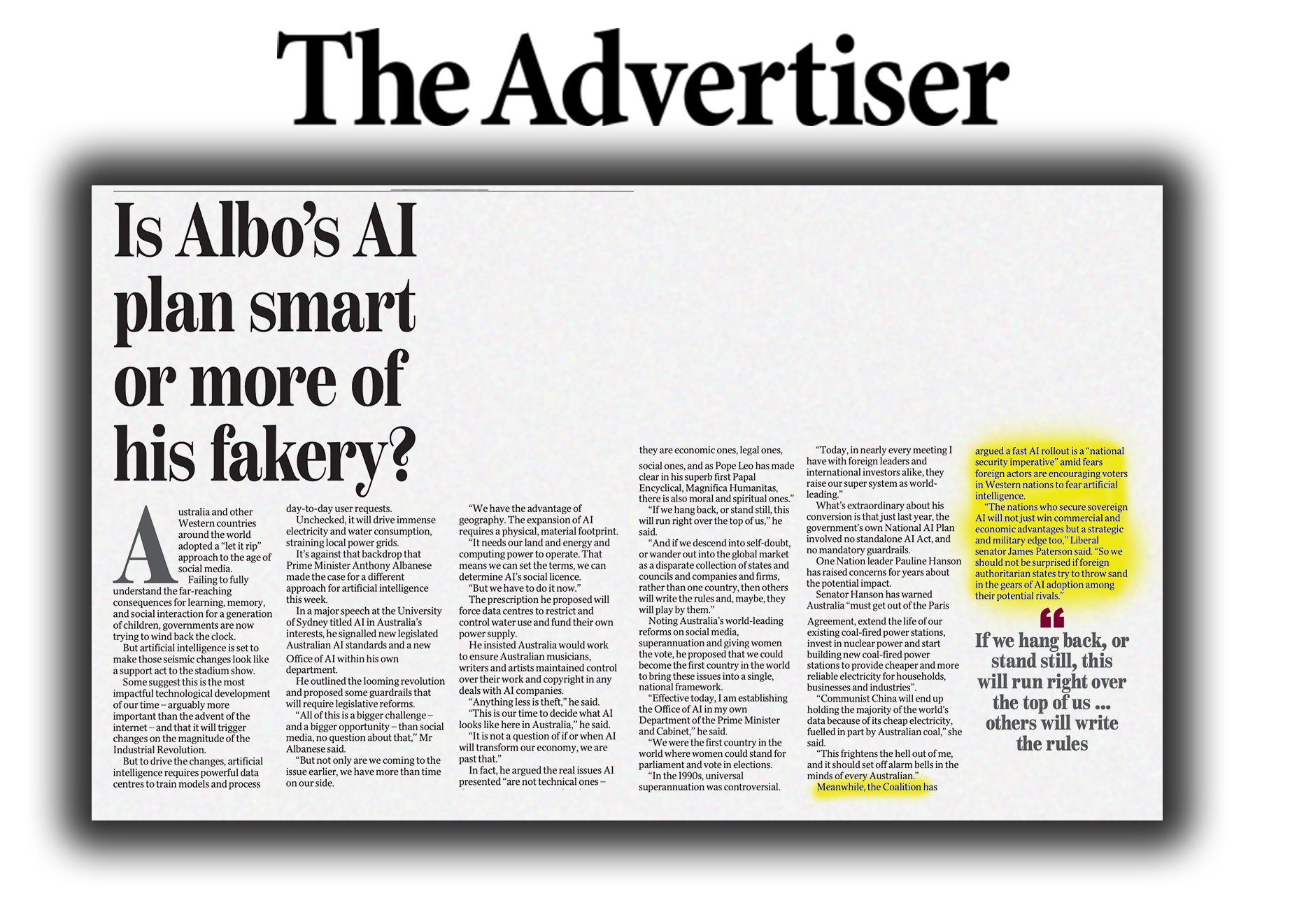
Australia and other western countries around the world adopted a ‘let it rip’ approach to the age of social media.
Failing to fully understand the far-reaching consequences for learning, memory, and social interaction for a generation of children, governments are now trying to wind back the clock.
But artificial intelligence is set to make those seismic changes look like a support act to the stadium show.
Some suggest this is the most impactful technological development of our time – arguably more important than the advent of the internet – and that it will trigger changes on the magnitude of the Industrial Revolution.
But to drive the changes, artificial intelligence requires powerful data centres to train models and process day-to-day user requests.
Unchecked, it will drive immense electricity and water consumption, straining local power grids.
It’s against that backdrop that the Prime Minister Anthony Albanese made the case for a different approach for artificial intelligence this week.
In a major speech at the University of Sydney titled AI in Australia’s interests, he signalled new legislated Australian AI standards and a new Office of AI within his own department.
He outlined the looming revolution and proposed some guardrails that will require legislative reforms.
“All of this is a bigger challenge – and a bigger opportunity – than social media, no question about that,’’ Mr Albanese said.
“But not only are we coming to the issue earlier, we have more than time on our side.
“We have the advantage of geography. The expansion of AI requires a physical, material footprint.
“It needs our land and energy and computing power to operate. That means we can set the terms, we can determine AI’s social licence.
“But we have to do it now.”
The prescription he proposed will force data centres to restrict and control water use and fund their own power supply.
He insisted that Australia will work to ensure that Australian musicians, writers and artists maintain control over their work and copyright in any deals with AI companies.
“Anything less is theft,” he said.
“This is our time to decide what AI looks like here in Australia,’’ he said.
“It is not a question of ‘if’ or ‘when’ AI will transform our economy, we are past that.”
In fact, he argued that the real issues AI presents “are not technical ones – they are economic ones, legal ones, social ones, and as Pope Leo has made clear in his superb first Papal Encyclical, Magnifica Humanitas, there is also moral and spiritual ones.”
“If we hang back, or stand still, this will run right over the top of us,’’ he said.
“And if we descend into self-doubt, or wander out into the global market as a disparate collection of states and councils and companies and firms, rather than one country, then others will write the rules and, maybe, they will play by them.”
Noting Australia’s world-leading reforms on social media, superannuation and giving women the vote, he proposed that we could become the first country in the world to bring these issues into a single, national framework.
“Effective today, I am establishing The Office of AI in my own Department of the Prime Minister and Cabinet,’’ he said.
“We were the first country in the world where women could stand for parliament and vote in elections.
“In the 1990s, universal superannuation was controversial.
“Today, in nearly every meeting I have with foreign leaders and international investors alike, they raise our super system as world-leading.”
What’s extraordinary about his conversion is that just last year, the government’s own National AI Plan involved no stand-alone AI Act, and no mandatory guardrails.
One Nation leader Pauline Hanson has raised concerns for years about the potential impact.
Senator Hanson has warned Australia “must get out of the Paris Agreement, extend the life of our existing coal-fired power stations, invest in nuclear power and start building new coal-fired power stations to provide cheaper and more reliable electricity for households, businesses and industries”.
“Communist China will end up holding the majority of the world’s data because of its cheap electricity, fuelled in part by Australian coal,” she said.
“This frightens the hell out of me, and it should set off alarm bells in the minds of every Australian.”
Meanwhile, the Coalition has argued that a fast AI rollout is a “national security imperative” amid fears foreign actors are encouraging voters in western nations to fear artificial intelligence.
“The nations who secure sovereign AI will not just win commercial and economic advantages but a strategic and military edge too,” Liberal Senator James Paterson said.
“So we should not be surprised if foreign authoritarian states try to throw sand in the gears of AI adoption among their potential rivals.”