

Media
|
News
December 17, 2025
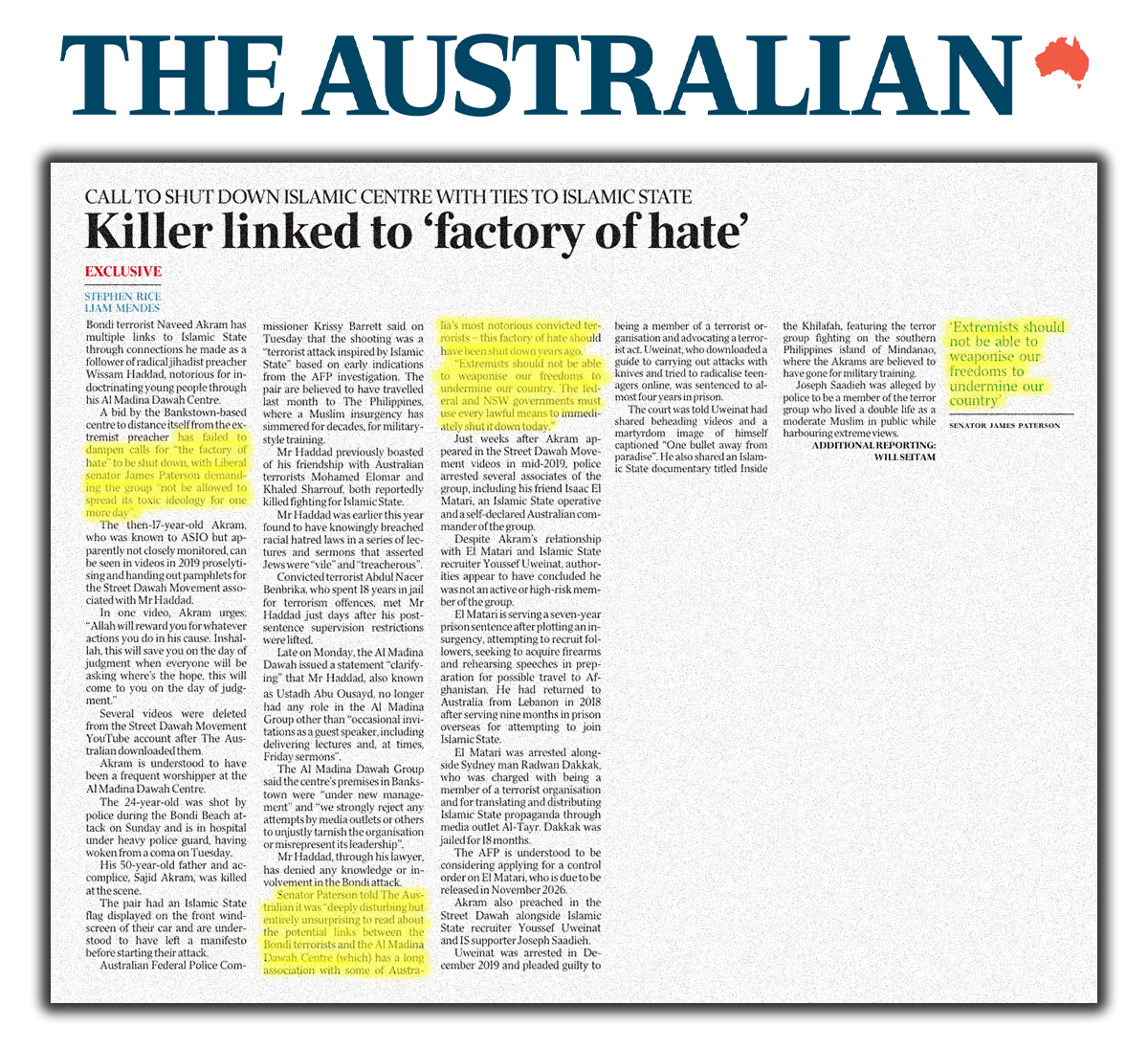
Bondi terrorist Naveed Akram has multiple links to Islamic State through connections he made as a follower of radical jihadist preacher Wissam Haddad, notorious for indoctrinating young people through his Al Madina Dawah Centre.
A bid by the Bankstown-based centre to distance itself from the extremist preacher has failed to dampen calls for "the factory of hate" to be shut down, with Liberal senator James Paterson demanding the group "not be allowed to spread its toxic ideology for one more day".
The then-17-year-old Akram, who was known to ASIO but apparently not closely monitored, can be seen in videos in 2019 proselytising and handing out pamphlets for the Street Dawah Movement associated with Mr Haddad.
In one video, Akram urges: "Allah will reward you for whatever actions you do in his cause. Inshallah, this will save you on the day of judgment when everyone will be asking where's the hope, this will come to you on the day of judgment."
Several videos were deleted from the Street Dawah Movement YouTube account after The Australian downloaded them.
Akram is understood to have been a frequent worshipper at the Al Madina Dawah Centre.
The 24-year-old was shot by police during the Bondi Beach attack on Sunday and is in hospital under heavy police guard, having woken from a coma on Tuesday.
His 50-year-old father and accomplice, Sajid Akram, was killed at the scene.
The pair had an Islamic State flag displayed on the front windscreen of their car and are understood to have left a manifesto before starting their attack.
Australian Federal Police Commissioner Krissy Barrett said on Tuesday that the shooting was a "terrorist attack inspired by Islamic State" based on early indications from the AFP investigation. The pair are believed to have travelled last month to The Philippines, where a Muslim insurgency has simmered for decades, for militarystyle training.
Mr Haddad previously boasted of his friendship with Australian terrorists Mohamed Elomar and Khaled Sharrouf, both reportedly killed fighting for Islamic State.
Mr Haddad was earlier this year found to have knowingly breached racial hatred laws in a series of lectures and sermons that asserted Jews were "vile" and "treacherous".
Convicted terrorist Abdul Nacer Benbrika, who spent 18 years in jail for terrorism offences, met Mr Haddad just days after his postsentence supervision restrictions were lifted.
Late on Monday, the Al Madina Dawah issued a statement "clarifying" that Mr Haddad, also known as Ustadh Abu Ousayd, no longer had any role in the Al Madina Group other than "occasional invitations as a guest speaker, including delivering lectures and, at times, Friday sermons".
The Al Madina Dawah Group said the centre's premises in Bankstown were "under new management" and "we strongly reject any attempts by media outlets or others to unjustly tarnish the organisation or misrepresent its leadership".
Mr Haddad, through his lawyer, has denied any knowledge or involvement in the Bondi attack.
Senator Paterson told The Australian it was "deeply disturbing but entirely unsurprising to read about the potential links between the Bondi terrorists and the Al Madina Dawah Centre (which) has a long association with some of Australia's most notorious convicted terrorists this factory of hate should have been shut down years ago.
"Extremists should not be able to weaponise our freedoms to undermine our country. The federal and NSW governments must use every lawful means to immediately shut it down today."
Just weeks after Akram appeared in the Street Dawah Movement videos in mid-2019, police arrested several associates of the group, including his friend Isaac El Matari, an Islamic State operative and a self-declared Australian commander of the group.
Despite Akram's relationship with El Matari and Islamic State recruiter Youssef Uweinat, authorities appear to have concluded he was not an active or high-risk member of the group.
El Matari is serving a seven-year prison sentence after plotting an insurgency, attempting to recruit followers, seeking to acquire firearms and rehearsing speeches in preparation for possible travel to Afghanistan. He had returned to Australia from Lebanon in 2018 after serving nine months in prison overseas for attempting to join Islamic State.
El Matari was arrested alongside Sydney man Radwan Dakkak, who was charged with being a member of a terrorist organisation and for translating and distributing Islamic State propaganda through media outlet Al-Tayr. Dakkak was jailed for 18 months.
The AFP is understood to be considering applying for a control order on El Matari, who is due to be released in November 2026.
Akram also preached in the Street Dawah alongside Islamic State recruiter Youssef Uweinat and IS supporter Joseph Saadieh.
Uweinat was arrested in December 2019 and pleaded guilty to being a member of a terrorist organisation and advocating a terrorist act. Uweinat, who downloaded a guide to carrying out attacks with knives and tried to radicalise teenagers online, was sentenced to almost four years in prison.
The court was told Uweinat had shared beheading videos and a martyrdom image of himself captioned "One bullet away from paradise". He also shared an Islamic State documentary titled Inside the Khilafah, featuring the terror group fighting on the southern Philippines island of Mindanao, where the Akrams are believed to have gone for military training.
Joseph Saadieh was alleged by police to be a member of the terror group who lived a double life as a moderate Muslim in public while harbouring extreme views.