

Media
|
News
December 3, 2025
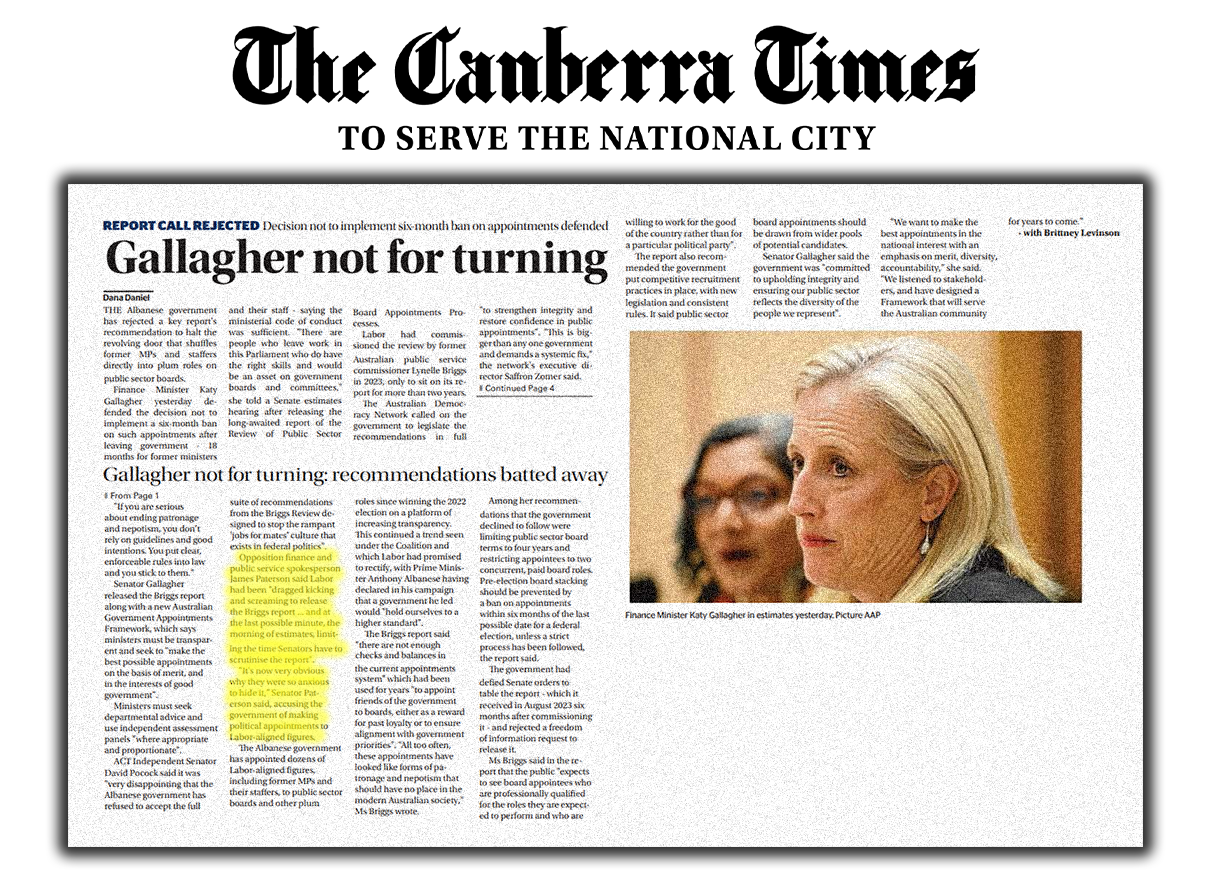
The Albanese government has rejected a key report's recommendation to halt the revolving door that shuffles former MPs and staffers directly into plum roles on public sector boards.
Finance Minister Katy Gallagher yesterday defended the decision not to implement a six-month ban on such appointments after leaving government - 18 months for former ministers and their staff- saying the ministerial code of conduct was sufficient. "There are people who leave work in this Parliament who do have the right skills and would be an asset on government boards and committees," she told a Senate estimates hearing after releasing the long-awaited report of the Review of Public Sector Board Appointments Processes.
Labor had commissioned the review by former Australian public service commissioner Lynelle Briggs in 2023, only to sit on its report for more than two years.
The Australian Democracy Network called on the government to legislate the recommendations in full "to strengthen integrity and restore confidence in public appointments". "This is bigger than any one government and demands a systemic fix," the network's executive director Saffron Zomer said.
"If you are serious about ending patronage and nepotism, you don't rely on guidelines and good intentions. You put clear, enforceable rules into law and you stick to them."
Senator Gallagher released the Briggs report along with a new Australian Government Appointments Framework, which says ministers must be transparent and seek to "make the best possible appointments on the basis of merit, and in the interests of good government".
Ministers must seek departmental advice and use independent assessment panels "where appropriate and proportionate".
ACT Independent Senator David Pocock said it was "very disappointing that the Albanese government has refused to accept the full suite of recommendations from the Briggs Review designed to stop the rampant 'jobs for mates' culture that exists in federal politics".
Opposition finance and public service spokesperson James Paterson said Labor had been "dragged kicking and screaming to release the Briggs report ... and at the last possible minute, the morning of estimates, limiting the time Senators have to scrutinise the report".
"It's now very obvious why they were so anxious to hide it," Senator Paterson said, accusing the government of making political appointments to Labor-aligned figures.
The Albanese government has appointed dozens of Labor-aligned figures, including former MPs and their staffers, to public sector boards and other plum roles since winning the 2022 election on a platform of increasing transparency. This continued a trend seen under the Coalition and which Labor had promised to rectify, with Prime Minister Anthony Albanese having declared in his campaign that a government he led would "hold ourselves to a higher standard".
The Briggs report said "there are not enough checks and balances in the current appointments system" which had been used for years "to appoint friends of the government to boards, either as a reward for past loyalty or to ensure alignment with government priorities". "All too often, these appointments have looked like forms of patronage and nepotism that should have no place in the modern Australian society," Ms Briggs wrote.
Among her recommendations that the government declined to follow were limiting public sector board terms to four years and restricting appointees to two concurrent, paid board roles. Pre-election board stacking should be prevented by a ban on appointments within six months of the last possible date for a federal election, unless a strict process has been followed, the report said.
The government had defied Senate orders to table the report - which it received in August 2023 six months after commissioning it - and rejected a freedom of information request to release it.
Ms Briggs said in the report that the public "expects to see board appointees who are professionally qualified for the roles they are expected to perform and who are willing to work for the good of the country rather than for a particular political party".
The report also recommended the government put competitive recruitment practices in place, with new legislation and consistent rules. It said public sector board appointments should be drawn from wider pools of potential candidates.
Senator Gallagher said the government was "committed to upholding integrity and ensuring our public sector reflects the diversity of the people we represent".
"We want to make the best appointments in the national interest with an emphasis on merit, diversity, accountability," she said. "We listened to stakeholders, and have designed a Framework that will serve the Australian community for years to come."
- with Brittney Levinson